


The spectacular withdrawal of former prime minister Saad Hariri from politics on Monday has left his political party in disarray, with MPs uncertain of their future and fearing growing division just five months away from parliamentary elections.
“We’re a bit lost, let’s see what the next couple of days bring,” MP Sami Fatfat from the Future Movement told The National. “It’s a blow.”
MP Mohammad Hajjar said that he feared that the party’s enemies, including Iran-backed Hezbollah, would gain more ground. “I’m worried about my people and my region. Who could replace me?” he asked. “I think there will be massive abstention among the Sunni population.”
Mr Hariri’s withdrawal creates a void in Lebanese political life, which is governed along complex sectarian lines. The Future Movement, which will not participate in the May 15 parliamentary elections following Mr Hariri’s speech, represented most of the country’s Sunni Muslims.
a former parliamentarian and senior member of the Future Movement party
The post of prime minister is always held by a Sunni Muslim, while the presidency goes to a Maronite Christian, and the Parliament Speaker is a Shiite Muslim.
A three-time prime minister, Mr Hariri is the political heir of his late father Rafik, a billionaire who was assassinated in 2005.
-
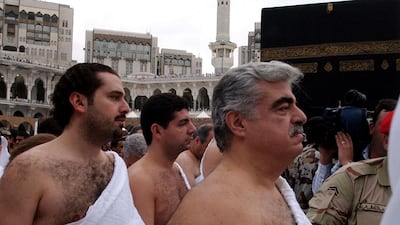
Former Lebanese prime minister Rafik Hariri and his sons Saad, left and Bahaa, centre, perform Umrah at the Grand Mosque in Makkah, Saudi Arabia, in 2003. Saad would go on to become prime minister in 2009, four years after the assassination of his father. All photos: AFP -
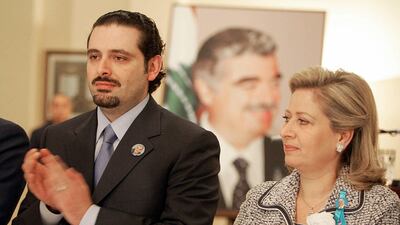
Saad Hariri and Solange Gemayel, the widow of assassinated president and Christian warlord Bashir Gemayel, attend a press conference in Beirut in 2005, where Hariri announced his list for the coming elections. Ms Gemayel became a shoo-in for Beirut's only Maronite Christian seat. -
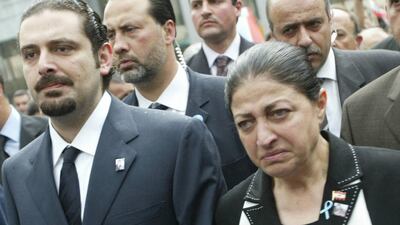
Saad with Rafik Hariri's sister, Bahia, during the funeral procession for former minister Bassel Fleihan, Hariri's close aide, who died from wounds sustained in the February 14 bomb blast that killed the prime minister. -
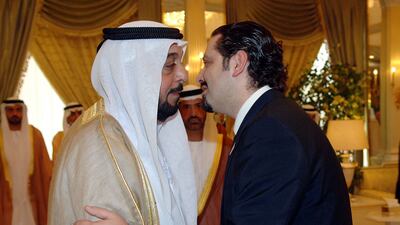
UAE President Sheikh Khalifa receives Saad Hariri on December 4, 2005 in Abu Dhabi. -

Mr Hariri, newly-elected Lebanese parliamentarian, meets Russian Foreign Minister Sergey Lavrov in New York, in 2005, on the sidelines of the UN General Assembly. -
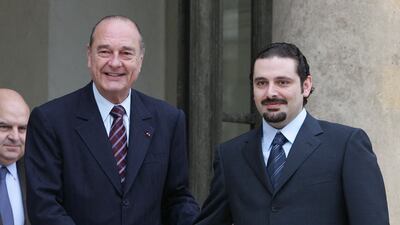
Former French president Jacques Chirac with Hariri in 2005, after a meeting at the Elysee palace in Paris. -

With Jordan's King Abdullah II on the sidelines of UN General Assembly in New York, 2005. -
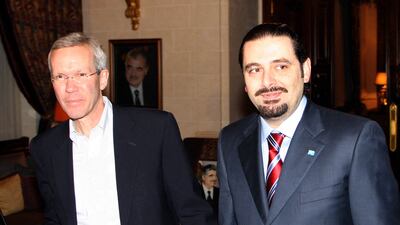
US envoy David Welch, left, then assistant secretary of state for Near East affairs, meets Mr Hariri in Beirut, in 2007. Mr Welch held talks in Lebanon to discuss a presidential void. -
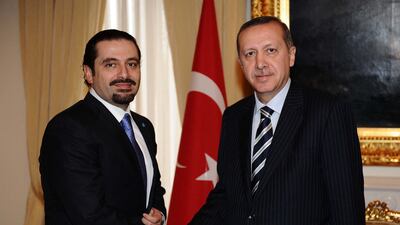
With Turkish Prime Minister Recep Tayyip Erdogan in Ankara, in 2011. -
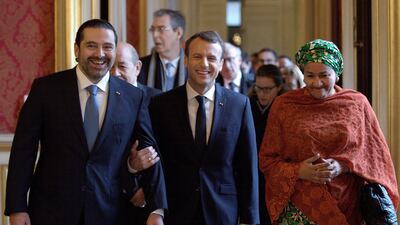
French President Emmanuel Macron walks between Saad Hariri and UN Deputy Secretary General Amina Mohammed, right, as they arrive to attend the Lebanon International Support Group meeting in Paris on December 8, 2017. -
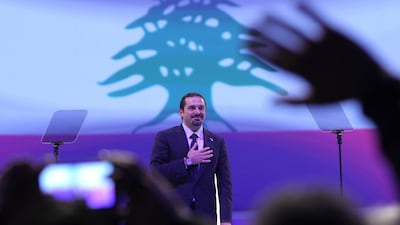
Mr Hariri delivers a speech to mark the 10th anniversary of the assassination of his father in Beirut, 2015. -

With former Egyptian president Hosni Mubarak in Cairo, in 2008. -
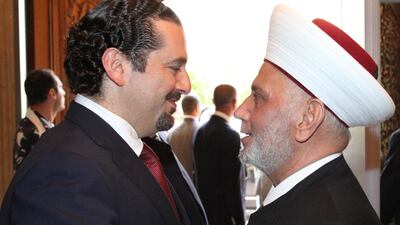
Mr Hariri greets Lebanon's newly-elected Sunni Mufti Sheikh Abdul Latif Deryan, in 2014. -
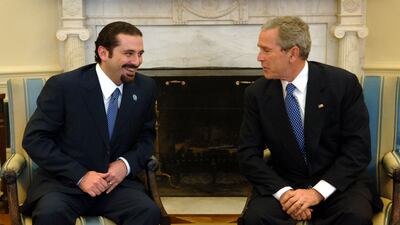
Former US president George W Bush shares a light moment with Mr Hariri during their meeting in the Oval Office of the White House in Washington, in 2006. -

Vice President and Ruler of Dubai Sheikh Mohammed bin Rashid, then Crown Prince of Dubai, receives Mr Hariri in 2005. -
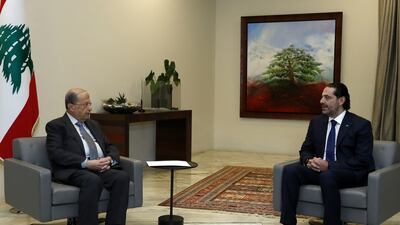
With Lebanese President Michel Aoun at the presidential palace in Beirut, in 2020. -

Russian Prime Minister Mikhail Mishustin meets Mr Hariri in Moscow, in 2021. -

With then Saudi Crown Prince Sultan bin Abdul Aziz, in 2005, at the UN in New York. -

France's former president Francois Hollande, right, welcomes Mr Hariri to a meeting at the Elysee presidential palace, in 2012. -
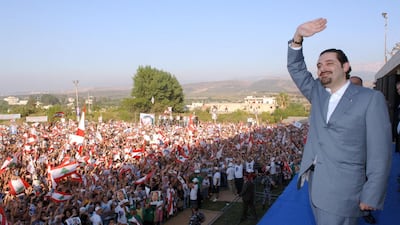
Mr Hariri salutes thousands of supporters in Lebanon's Miniyeh region. -

Greeting supporters upon arrival at his home in Beirut, in 2017, after a mysterious odyssey that resulted in him announcing his resignation while in Saudi Arabia. Hariri told cheering supporters that he was staying. -
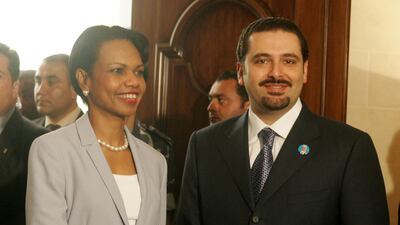
With former US secretary of state Condoleezza Rice in 2005. -
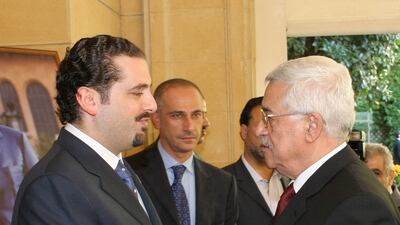
Meeting Palestinian leader Mahmoud Abbas in Beirut, in 2005.


But his businesses have faced turmoil in the past years, starting with the closure of the family construction firm in Saudi Arabia in 2017. He recognised this in his speech on Monday, saying that he had suffered personal financial losses and lost friendships due to political compromises.
Mr Hariri has shown growing frustration with local politics in recent years and announced in July that he had given up trying to form a Cabinet after he was appointed prime minister in October 2020. At the time, he blamed President Michel Aoun, who shifted the blame back on Mr Hariri. He had previously resigned in the face of mass anti-government protests in late 2019.
'We had no impact'
Political infighting has worsened Lebanon’s financial crisis, which has pushed more than three quarters of the population into poverty.
“I cannot stand […] that some Lebanese consider me as a pillar of this regime that is responsible for this catastrophe,” Mr Hariri said in his speech on Monday.
In a tweet, Lebanon’s Prime Minister Najib Mikati described Mr Hariri’s withdrawal as a “sad page” for the country but that he understood his “bitterness”. “The homeland will unite us and moderation is our path,” he said.
Mustafa Allouche, a former parliamentarian and senior member of the Future Movement party, told The National that the Future Movement could not continue being a “Sunni cover” for Hezbollah’s actions, which he blamed for the country's woes. The Shiite Muslim party is allied to President Aoun.
“We had no impact” while in power, he said.
He was unsure of what will come next. “It’ll be a soup of everything,” he said. “Anyone who tries to find a reason to run in the elections and was part of the Future Movement is just a hypocrite now.”

Mr Allouche said that he and Mr Hariri had lost hope in Lebanon’s future. “We might see the disintegration of the country through war or just withering away,” he said.
Though some party members like Mr Hajjar said that Mr Hariri’s withdrawal was temporary, Lebanese political analyst Imad Salamey believes that he has quit for good. He described his move as “both good and bad”.
“It’s natural for political leaders who lose on the ground because of miscalculations or electoral outcomes to give their post to others,” he said.
The Future Movement appeared the main loser in the 2018 legislative elections, when it lost around a third of its seats.
But the party's absence this year may also encourage conflicts because of the nature of Lebanon’s sectarian politics. “There isn’t much alternative among the Sunnis, which will create a power gap and instability,” said Mr Salamey.
“It can add to the sense of deprivation within the Sunni community and that can feed into extremism.”
Former prime minister Tammam Salam, who said last week he would not run in the May elections, wrote on Twitter on Monday that Mr Hariri’s decision reflected “deep political imbalances”.
In what looked like a reference to the Future Movement’s rivals such as Mr Aoun, he added that it could be a lesson “to those who consider themselves victorious today over the remains of the collapsed homeland”.

