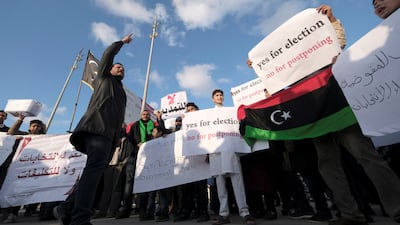
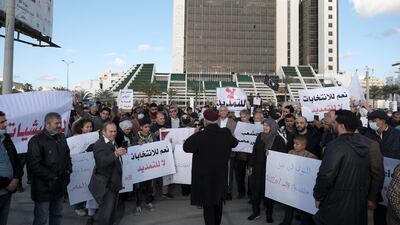
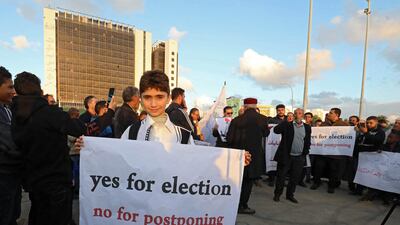
Libyan activists protest against the postponement of the presidential elections in Martyrs Square, Tripoli, on December 25. The banner reads in Arabic: ‘We want ballot boxes, not ammunition boxes’. AFP
Libyan activists protest against the postponement of the presidential elections in Martyrs Square, Tripoli, on December 25. The banner reads in Arabic: ‘We want ballot boxes, not ammunition boxes’. AF

Libya parliament refuses to fix date for delayed polls to end decade of chaos


Ahmed Maher
  • English
  • Arabic

Libya’s parliament on Monday refused to fix a date for presidential elections meant to have taken place last week, leaving question marks over the fate of the poll.

The vote, set for Friday, was meant to be the culmination of UN-led efforts to drag Libya out of a decade of conflict since a 2011 revolt. But it was derailed by bitter arguments over divisive candidates and a disputed legal framework.

On Monday, the parliamentary committee charged with overseeing the election presented a report saying setting a new date would be risky at this stage.

It was a direct rebuff to the High National Elections Commission, which had suggested holding the vote on January 24.

The parliamentary committee is part of an assembly based in eastern Libya since 2014, reflecting the country’s deep divisions.

It recommended laying out “a new, realistic and applicable roadmap, with defined stages, rather than fixing new dates and repeating the same errors”.

The report, read to MPs by committee president Imad Al Sayeh, also suggested setting up a committee to draft a new constitution to replace the one scrapped by dictator Muammar Qaddafi in 1969.

It also called for a reshuffle of the interim government of Abdul Hamid Dbeibah, whose mandate was meant to end with Friday’s elections.

The parliament has yet to debate the proposals.

Mr Dbeibah leads a unity administration based in the capital Tripoli, in the country’s west, which had the role of leading Libya to the elections.

Libyans celebrate the 70th anniversary of their country's independence on the day presidential elections were scheduled to take place. AFP

The vote, after a year of relative calm, was to have been the country’s first direct presidential ballot.

But after months of disputes, the vote postponed two days before it was to take place, when the committee overseeing the election said holding it on the designated date would be impossible.

The electoral commission has yet to announce the final list of presidential candidates. Its work was hobbled by court cases against the bids of several divisive figures.

Eastern strongman Khalifa Haftar, who had waged a year-long military offensive against Tripoli, Qaddafi’s son Saif Al-Islam, a symbol of the old regime also accused of war crimes, and Mr Dbeibah, who had pledged not to run, were all particularly controversial.

In its report, the parliamentary committee said the date of January 24 had been chosen on the basis of “political” considerations, and that an election then “would have the same fate” as that set for Friday.

Shortly before the session on Monday, UN envoy Stephanie Williams urged the parliament “to live up to its national responsibilities” and urgently address recommendations from HNEC “in order to push the electoral process forward”.

In a joint statement on Friday, five western nations had called for a new electoral timeline to be put in place as soon as possible.

The US, France, Britain, Germany and Italy also said the unity government should stay in place until election results are announced.

Libya’s elections postponed — in pictures

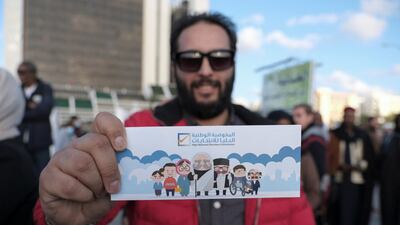
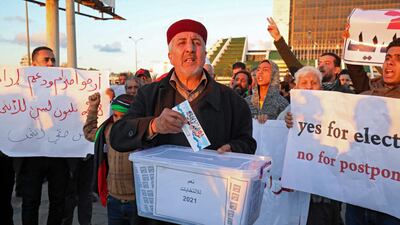
  • A man shows his electoral card during a protest against the postponement of the Libyan presidential election initially planned for December 24, 2021, in Benghazi, Libya. Reuters
    A man shows his electoral card during a protest against the postponement of the Libyan presidential election initially planned for December 24, 2021, in Benghazi, Libya. Reuters
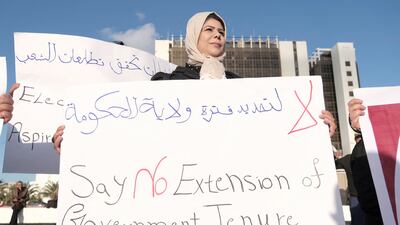
  • A woman holds a banner during a protest against the delay to the Libyan presidential election, in Benghazi, Libya, on December 24, 2021. Reuters
    A woman holds a banner during a protest against the delay to the Libyan presidential election, in Benghazi, Libya, on December 24, 2021. Reuters
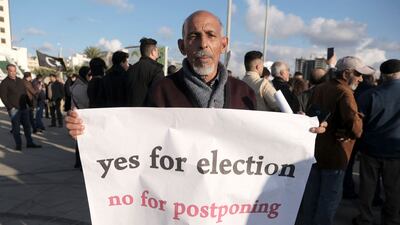
  • A man protests against the postponement of the Libyan presidential election, in Benghazi, Libya. Reuters
    A man protests against the postponement of the Libyan presidential election, in Benghazi, Libya. Reuters
  • A demonstration against the postponement of the Libyan presidential election, in Benghazi, Libya. Reuters
    A demonstration against the postponement of the Libyan presidential election, in Benghazi, Libya. Reuters
  • A protest in Benghazi, Libya, against the delaying of the presidential election. Reuters
    A protest in Benghazi, Libya, against the delaying of the presidential election. Reuters
  • Libyans in Benghazi demonstrate against the postponement of elections. AFP
    Libyans in Benghazi demonstrate against the postponement of elections. AFP
  • Libyans demonstrate against the postponement of elections, in the city of Benghazi. AFP
    Libyans demonstrate against the postponement of elections, in the city of Benghazi. AFP
Opening Premier League fixtures, August 14
  • Brentford v Arsenal
  • Burnley v Brighton
  • Chelsea v Crystal Palace
  • Everton v Southampton
  • Leicester City v Wolves
  • Manchester United v Leeds United
  • Newcastle United v West Ham United
  • Norwich City v Liverpool
  • Tottenham v Manchester City
  • Watford v Aston Villa
Avatar: Fire and Ash

Director: James Cameron

Starring: Sam Worthington, Sigourney Weaver, Zoe Saldana

Rating: 4.5/5

How to avoid crypto fraud
  • Use unique usernames and passwords while enabling multi-factor authentication.
  • Use an offline private key, a physical device that requires manual activation, whenever you access your wallet.
  • Avoid suspicious social media ads promoting fraudulent schemes.
  • Only invest in crypto projects that you fully understand.
  • Critically assess whether a project’s promises or returns seem too good to be true.
  • Only use reputable platforms that have a track record of strong regulatory compliance.
  • Store funds in hardware wallets as opposed to online exchanges.
'The worst thing you can eat'

Trans fat is typically found in fried and baked goods, but you may be consuming more than you think.

Powdered coffee creamer, microwave popcorn and virtually anything processed with a crust is likely to contain it, as this guide from Mayo Clinic outlines: 

Baked goods - Most cakes, cookies, pie crusts and crackers contain shortening, which is usually made from partially hydrogenated vegetable oil. Ready-made frosting is another source of trans fat.

Snacks - Potato, corn and tortilla chips often contain trans fat. And while popcorn can be a healthy snack, many types of packaged or microwave popcorn use trans fat to help cook or flavour the popcorn.

Fried food - Foods that require deep frying — french fries, doughnuts and fried chicken — can contain trans fat from the oil used in the cooking process.

Refrigerator dough - Products such as canned biscuits and cinnamon rolls often contain trans fat, as do frozen pizza crusts.

Creamer and margarine - Nondairy coffee creamer and stick margarines also may contain partially hydrogenated vegetable oils.

The years Ramadan fell in May

1987

1954

1921

1888

UAE currency: the story behind the money in your pockets
Ten tax points to be aware of in 2026

1. Domestic VAT refund amendments: request your refund within five years

If a business does not apply for the refund on time, they lose their credit.

2. E-invoicing in the UAE

Businesses should continue preparing for the implementation of e-invoicing in the UAE, with 2026 a preparation and transition period ahead of phased mandatory adoption. 

3. More tax audits

Tax authorities are increasingly using data already available across multiple filings to identify audit risks. 

4. More beneficial VAT and excise tax penalty regime

Tax disputes are expected to become more frequent and more structured, with clearer administrative objection and appeal processes. The UAE has adopted a new penalty regime for VAT and excise disputes, which now mirrors the penalty regime for corporate tax.

5. Greater emphasis on statutory audit

There is a greater need for the accuracy of financial statements. The International Financial Reporting Standards standards need to be strictly adhered to and, as a result, the quality of the audits will need to increase.

6. Further transfer pricing enforcement

Transfer pricing enforcement, which refers to the practice of establishing prices for internal transactions between related entities, is expected to broaden in scope. The UAE will shortly open the possibility to negotiate advance pricing agreements, or essentially rulings for transfer pricing purposes. 

7. Limited time periods for audits

Recent amendments also introduce a default five-year limitation period for tax audits and assessments, subject to specific statutory exceptions. While the standard audit and assessment period is five years, this may be extended to up to 15 years in cases involving fraud or tax evasion. 

8. Pillar 2 implementation 

Many multinational groups will begin to feel the practical effect of the Domestic Minimum Top-Up Tax (DMTT), the UAE's implementation of the OECD’s global minimum tax under Pillar 2. While the rules apply for financial years starting on or after January 1, 2025, it is 2026 that marks the transition to an operational phase.

9. Reduced compliance obligations for imported goods and services

Businesses that apply the reverse-charge mechanism for VAT purposes in the UAE may benefit from reduced compliance obligations. 

10. Substance and CbC reporting focus

Tax authorities are expected to continue strengthening the enforcement of economic substance and Country-by-Country (CbC) reporting frameworks. In the UAE, these regimes are increasingly being used as risk-assessment tools, providing tax authorities with a comprehensive view of multinational groups’ global footprints and enabling them to assess whether profits are aligned with real economic activity. 

Contributed by Thomas Vanhee and Hend Rashwan, Aurifer

The bio

Date of Birth: April 25, 1993
Place of Birth: Dubai, UAE
Marital Status: Single
School: Al Sufouh in Jumeirah, Dubai
University: Emirates Airline National Cadet Programme and Hamdan University
Job Title: Pilot, First Officer
Number of hours flying in a Boeing 777: 1,200
Number of flights: Approximately 300
Hobbies: Exercising
Nicest destination: Milan, New Zealand, Seattle for shopping
Least nice destination: Kabul, but someone has to do it. It’s not scary but at least you can tick the box that you’ve been
Favourite place to visit: Dubai, there’s no place like home

Dhadak 2

Director: Shazia Iqbal

Starring: Siddhant Chaturvedi, Triptii Dimri 

Rating: 1/5

Updated: December 28, 2021, 4:33 AM