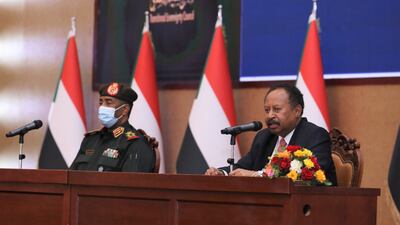
A handout photo made available by the Republican Media Palace shows Sudan's Prime Minister Abdalla Hamdok (Front-R) and Sudan's Top Military Lieutenant General Abdel Fattah Abdelrahman Burhan (Front-2nd R) holding their agreement documents after signing them, in Khartoum, Sudan, 21 November 2021. Sudanese national television announced on 21 November that Prime Minister Hamadok and Sudan's Top Military Lieutenant General Burhan signed a political agreement to end the political crisis which started on 25 October. The agreement reinstates Hamadok as Prime Minister and announces a new transitory period led by military and civilians together. EPA / REPUBLICAN MEDIA PALACE / HANDOUT HANDOUT EDITORIAL USE ONLY / NO SALES
A handout photo made available by the Republican Media Palace shows Sudan's Prime Minister Abdalla Hamdok (Front-R) and Sudan's Top Military Lieutenant General Abdel Fattah Abdelrahman Burhan (Front-2

Sudan’s new deal: a way to end political crisis or an ‘insult to the people’?


Ahmed Maher
  • English
  • Arabic

The power-sharing agreement to reinstate Sudan’s ousted prime minister Abdalla Hamdok has yet to create common ground among the country’s political parties, with politicians from both sides of the rift divided over the deal.

Supporters of the agreement, unveiled by Gen Abdel Fattah Al Burhan earlier this week, say it is a key step to stabilise Sudan’s fragile transition towards democracy.

But opponents of the deal have dismissed it as political cover for last month’s military takeover.

Gen Al Burhan on Sunday used a televised address to propose what he believed to be a silver bullet to solve Sudan’s political crisis: reinstating Mr Hamdok, releasing political detainees and keeping a hard-won power-sharing agreement struck between the military and civilian politicians in 2019 as the foundation for further talks.

“There was a great sigh of relief,” said Mohammed Badruldin, the director of International Affairs at the Popular Congress Party (PCP), which supports the deal.

Mr Badruldin told The National he believed the agreement would help Sudan escape the cycle of repeated coups in its recent history.

“For many years, we have been living with a high tempo of coups and attempted coups. In some periods, they were happening very quickly – almost as fast as a government is set up, an army general backs a political party to bring it down,” he said.

Mr Badruldin called on all sides to accept the agreement as a way to end a month of “full-blown crisis”.

  • Sudan's Prime Minister Abdalla Hamdok, right, and Gen Abdel Fattah Al Burhan have signed an agreement in the capital Khartoum. EPA
    Sudan's Prime Minister Abdalla Hamdok, right, and Gen Abdel Fattah Al Burhan have signed an agreement in the capital Khartoum. EPA
  • Under the deal, Mr Hamdok agreed to lead a government of independent technocrats. EPA
    Under the deal, Mr Hamdok agreed to lead a government of independent technocrats. EPA
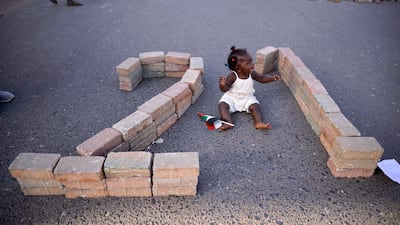
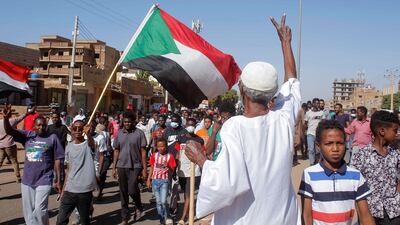
  • Anti-military protests have been held for 21 days in the capital, despite the agreement. AFP
    Anti-military protests have been held for 21 days in the capital, despite the agreement. AFP
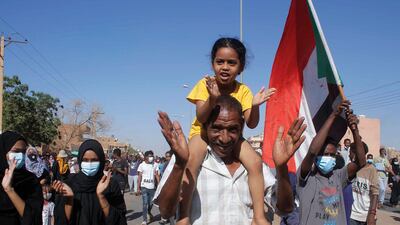
  • Protesters have turned out in large numbers in Khartoum, despite attempts to restore the transition to civilian rule in the country. AFP
    Protesters have turned out in large numbers in Khartoum, despite attempts to restore the transition to civilian rule in the country. AFP
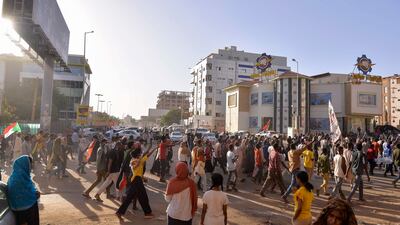
  • Protesters march along 60th Street in Khartoum. AFP
    Protesters march along 60th Street in Khartoum. AFP
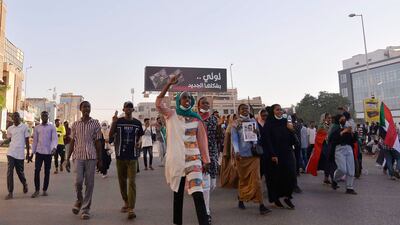
  • Protesters call for a return to civilian rule in Khartoum. AFP
    Protesters call for a return to civilian rule in Khartoum. AFP
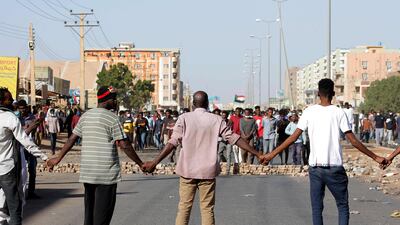
  • Protesters barricade most of the streets in the north of the capital in anticipation of clashes with security forces. AFP
    Protesters barricade most of the streets in the north of the capital in anticipation of clashes with security forces. AFP
  • Anti-military protesters in Khartoum demand the reinstatement of civilian rule in Sudan. AFP
    Anti-military protesters in Khartoum demand the reinstatement of civilian rule in Sudan. AFP
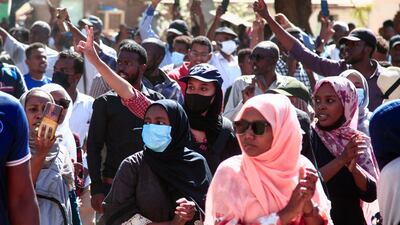
  • Women participate in large numbers in demonstrations in the city. AFP
    Women participate in large numbers in demonstrations in the city. AFP

Mr Hamdok, who will lead a government of technocrats, said he agreed to the deal to prevent casualties from further unrest and focus on enhancing democracy and safeguarding the country's economic recovery.

"Sudanese blood is precious. Let us stop the bloodshed and direct the youth's energy into building and development," he said at the signing ceremony in the presidential palace in Khartoum.

Gen Al Burhan said the deal would be inclusive.

"We do not want to exclude anyone except, as we have agreed, the National Congress Party," he said, referring to ousted president Omar Al Bashir's former ruling party.

But the agreement made no mention of the Forces of Freedom and Change (FFC), the civilian coalition that shared power with the military before the military takeover on October 25.

The FFC, which spearheaded the protest movement that ousted Al Bashir, says it will not recognise any agreement with the military and dismissed this week’s deal as providing political cover for what they perceive as a military takeover.

“This is an insult to the people on the streets – especially after more than 40 protesters have been killed in cold blood in four weeks by the security forces,” said Seddiq Abu Fawwaz, the leader and founder of the Hashd Al Wahdawi party – one of the founding parties of the FFC.

The number of protesters killed in demonstrations since the military takeover last month rose to 41 on Monday, according to the pro-democracy Sudan Doctors Committee.

They say that the latest victim was a boy, 16, who died after being shot in the head while protesting against the new power-sharing deal.

The army and police deny using live ammunition to disperse the protesters.

Police officials have tried to distance themselves from the deaths, saying their forces have used "minimum force" and blamed the protesters for the violence.

In the same manner that it has failed to appease Sudan’s political parties, the return of Mr Hamdok has divided protesters, many of whom continue to call for full civilian rule.

Thousands of demonstrators outside the palace in central Khartoum chanted “no to military power” as Mr Hamdok and Gen Al Burhan shook hands on the power-sharing deal.

Although Sudan's Sovereign Council, which acts as the country's head of state, is made up of nine civilians and five military officers, the protesters remain convinced that the balance of power still favours the military.

However, others have welcomed Mr Hamdok’s return. Sudanese political commentator Diauldin Bilal said he believed Mr Hamdok could emerge in a strong position from the deal but opposition among the protesters could prove costly.

“Prime Minister Hamdok could be the biggest political winner from what happened. His popularity has taken a severe blow after two years of political tensions and painful economic reforms to emerge as a national hero after the coup,” he told The National.

“He is now back on track and is fully supported by the major regional and world powers, as well as the international financial institutions like the World Bank. But he risks a dramatic fall among the protesters. He is in a real dilemma.”

In agreeing to bring back Mr Hamdok, Mr Bilal said the army had responded to “immense pressure locally and internationally”.

“The army leadership wanted to save face by reaching this deal with Mr Hamdok,” he said.

The new power-sharing arrangement was welcomed by the international community, including the UN and African Union, as well as the so-called Troika of Britain, Norway and the US.

Under the new deal, the Cabinet will still be under oversight of a ruling council led by the military.


Labour dispute

The insured employee may still file an ILOE claim even if a labour dispute is ongoing post termination, but the insurer may suspend or reject payment, until the courts resolve the dispute, especially if the reason for termination is contested. The outcome of the labour court proceedings can directly affect eligibility.


- Abdullah Ishnaneh, Partner, BSA Law 

Email sent to Uber team from chief executive Dara Khosrowshahi

From: Dara

To: Team@

Date: March 25, 2019 at 11:45pm PT

Subj: Accelerating in the Middle East

Five years ago, Uber launched in the Middle East. It was the start of an incredible journey, with millions of riders and drivers finding new ways to move and work in a dynamic region that’s become so important to Uber. Now Pakistan is one of our fastest-growing markets in the world, women are driving with Uber across Saudi Arabia, and we chose Cairo to launch our first Uber Bus product late last year.

Today we are taking the next step in this journey—well, it’s more like a leap, and a big one: in a few minutes, we’ll announce that we’ve agreed to acquire Careem. Importantly, we intend to operate Careem independently, under the leadership of co-founder and current CEO Mudassir Sheikha. I’ve gotten to know both co-founders, Mudassir and Magnus Olsson, and what they have built is truly extraordinary. They are first-class entrepreneurs who share our platform vision and, like us, have launched a wide range of products—from digital payments to food delivery—to serve consumers.

I expect many of you will ask how we arrived at this structure, meaning allowing Careem to maintain an independent brand and operate separately. After careful consideration, we decided that this framework has the advantage of letting us build new products and try new ideas across not one, but two, strong brands, with strong operators within each. Over time, by integrating parts of our networks, we can operate more efficiently, achieve even lower wait times, expand new products like high-capacity vehicles and payments, and quicken the already remarkable pace of innovation in the region.

This acquisition is subject to regulatory approval in various countries, which we don’t expect before Q1 2020. Until then, nothing changes. And since both companies will continue to largely operate separately after the acquisition, very little will change in either teams’ day-to-day operations post-close. Today’s news is a testament to the incredible business our team has worked so hard to build.

It’s a great day for the Middle East, for the region’s thriving tech sector, for Careem, and for Uber.

Uber on,

Dara

%3Cp%3E%3Cstrong%3EEngine%3A%20%3C%2Fstrong%3E4-litre%20twin-turbo%20V8%0D%3Cbr%3E%3Cstrong%3ETransmission%3A%3C%2Fstrong%3E%208-speed%20auto%0D%3Cbr%3E%3Cstrong%3EPower%3A%20%3C%2Fstrong%3E470hp%2C%20338kW%0D%3Cbr%3E%3Cstrong%3ETorque%3A%3C%2Fstrong%3E%20620Nm%0D%3Cbr%3E%3Cstrong%3EPrice%3A%3C%2Fstrong%3E%20From%20Dh491%2C500%20(estimate)%0D%3Cbr%3E%3Cstrong%3EOn%20sale%3A%20%3C%2Fstrong%3Enow%3C%2Fp%3E%0A
Mountain%20Boy
%3Cp%3E%3Cstrong%3EDirector%3A%3C%2Fstrong%3E%20Zainab%20Shaheen%3C%2Fp%3E%0A%3Cp%3E%3Cstrong%3EStarring%3A%3C%2Fstrong%3E%20Naser%20Al%20Messabi%3C%2Fp%3E%0A%3Cp%3E%3Cstrong%3ERating%3C%2Fstrong%3E%3A%203%2F5%3C%2Fp%3E%0A
FIXTURES

All kick-off times UAE ( 4 GMT)
Brackets denote aggregate score

Tuesday:
Roma (1) v Shakhtar Donetsk (2), 11.45pm
Manchester United (0) v Sevilla (0), 11.45pm

Wednesday:
Besiktas (0) v Bayern Munich (5), 9pm
Barcelona (1) v Chelsea (1), 11.45pm

Updated: November 23, 2021, 1:00 PM