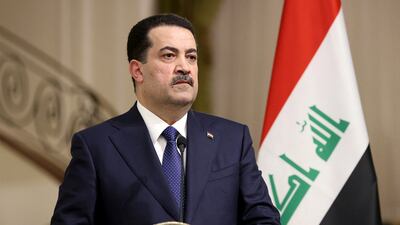
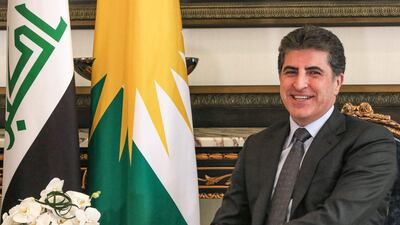
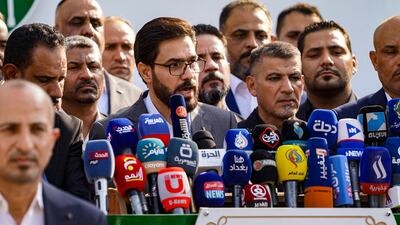
Politicians from two of the largest political blocs in Iraq after the national elections on October 10 are calling for unity, as rival political groups negotiate for important positions in a new and inclusive government.
Another bloc, Fatah, which is linked to Iran-backed groups, as well as two blocs led by former Iraqi prime ministers – Haidar Al Abadi's National State Forces and Nouri Al Maliki's State of Law, are contesting the election results.
The general election saw populist cleric Moqtada Al Sadr’s political coalition land the majority of votes. The bloc is expected to hold major influence over Iraq’s direction and relationship with Iran and the West. Fatah suffered major losses, winning only 14 seats in the 329-member assembly.
“The next government will be formed against the will of the US, Iran and Turkey, and will be a national government. We must unite together,” said Ameer Al Kinani, a member of the Sadrist movement who won the majority of seats in the Iraqi Parliament.
Although the final results of the elections have yet to be announced, the preliminary outcome puts the Sadrist movement top with 72 seats.
“We need a strategic vision for management, our problem is due to the various coalitions, with every government-building process we have a crisis, from outlining the budget to choosing Cabinet ministers,” Mr Al Kinani said at a forum held by The Middle East Research Institute in Erbil.
“We are the political powers that are responsible for reforms, changes and to serve the public. We’ve been chosen democratically to govern."
The second biggest winner in the elections was Parliament Speaker Mohammed Al Halbousi’s Taqaddum group, which won 37 seats, while the State of Law bloc was third with about 35.
Speaking on the panel of politicians was Muzahim Al Khayat, a newly elected MP for the Taqaddum coalition, who said Iraq’s democracy was in danger.
“It is up to the country’s political groups to move forward and overcome challenges. We need a national political dialogue,” he said.
It is the only way to overcome corruption, build the economy and offer opportunities for the youth, he said.
Mr Al Khayat called for unity, “otherwise chaos will prevail in the country which will lead to the collapse of the state”.
"Iraq needs a national vision so that the destroyed cities and nation will be rebuilt. We need a united and strong Iraq in this neighbourhood,” he said.
Jafar Eminki from the Kurdish Democratic Party said that, “no single component can lead Iraq alone. Iraq can be strong if all components are participating together.”
"We should all agree on a common programme because ministries and positions are not important. What is important is to have a strong federal government in Baghdad."
Now that preliminary results are out, the winning parties will have to engage in dialogue to form the new government.
The period after the results is a crucial time for political parties as they negotiate to secure vital ministries for their candidates.
Diplomatic reactions to the election process
US ambassador to Iraq, Mathew Tueller, said the national elections provided "an extraordinary signal that democracy can prevail in this region”.
Washington is calling on Iraq to “form a government in the same peaceful sphere that prevailed during the election period”, he said.
“We also support a government formation process that reflects the will of the people.”
“Iraqis must find a way to adapt and find democracy in their new government and we will find ways to work with leaders to find this.
“The US believes that Iraqi people deserve the right to express their will and form the government without external interference."

Our legal consultant
Name: Hassan Mohsen Elhais
Position: legal consultant with Al Rowaad Advocates and Legal Consultants.
Mercer, the investment consulting arm of US services company Marsh & McLennan, expects its wealth division to at least double its assets under management (AUM) in the Middle East as wealth in the region continues to grow despite economic headwinds, a company official said.
Mercer Wealth, which globally has $160 billion in AUM, plans to boost its AUM in the region to $2-$3bn in the next 2-3 years from the present $1bn, said Yasir AbuShaban, a Dubai-based principal with Mercer Wealth.
“Within the next two to three years, we are looking at reaching $2 to $3 billion as a conservative estimate and we do see an opportunity to do so,” said Mr AbuShaban.
Mercer does not directly make investments, but allocates clients’ money they have discretion to, to professional asset managers. They also provide advice to clients.
“We have buying power. We can negotiate on their (client’s) behalf with asset managers to provide them lower fees than they otherwise would have to get on their own,” he added.
Mercer Wealth’s clients include sovereign wealth funds, family offices, and insurance companies among others.
From its office in Dubai, Mercer also looks after Africa, India and Turkey, where they also see opportunity for growth.
Wealth creation in Middle East and Africa (MEA) grew 8.5 per cent to $8.1 trillion last year from $7.5tn in 2015, higher than last year’s global average of 6 per cent and the second-highest growth in a region after Asia-Pacific which grew 9.9 per cent, according to consultancy Boston Consulting Group (BCG). In the region, where wealth grew just 1.9 per cent in 2015 compared with 2014, a pickup in oil prices has helped in wealth generation.
BCG is forecasting MEA wealth will rise to $12tn by 2021, growing at an annual average of 8 per cent.
Drivers of wealth generation in the region will be split evenly between new wealth creation and growth of performance of existing assets, according to BCG.
Another general trend in the region is clients’ looking for a comprehensive approach to investing, according to Mr AbuShaban.
“Institutional investors or some of the families are seeing a slowdown in the available capital they have to invest and in that sense they are looking at optimizing the way they manage their portfolios and making sure they are not investing haphazardly and different parts of their investment are working together,” said Mr AbuShaban.
Some clients also have a higher appetite for risk, given the low interest-rate environment that does not provide enough yield for some institutional investors. These clients are keen to invest in illiquid assets, such as private equity and infrastructure.
“What we have seen is a desire for higher returns in what has been a low-return environment specifically in various fixed income or bonds,” he said.
“In this environment, we have seen a de facto increase in the risk that clients are taking in things like illiquid investments, private equity investments, infrastructure and private debt, those kind of investments were higher illiquidity results in incrementally higher returns.”
The Abu Dhabi Investment Authority, one of the largest sovereign wealth funds, said in its 2016 report that has gradually increased its exposure in direct private equity and private credit transactions, mainly in Asian markets and especially in China and India. The authority’s private equity department focused on structured equities owing to “their defensive characteristics.”
RESULTS
6.30pm: Maiden (TB) Dh 82,500 (Dirt) 1.600m
Winner: Miller’s House, Richard Mullen (jockey), Satish Seemar (trainer).
7.05pm: Maiden (TB) Dh 82,500 (D) 2,000m
Winner: Kanood, Adrie de Vries, Fawzi Nass.
7.50pm: Handicap (TB) Dh 82,500 (D) 1,600m
Winner: Gervais, Sandro Paiva, Ali Rashid Al Raihe.
8.15pm: The Garhoud Sprint Listed (TB) Dh 132,500 (D) 1,200m
Winner: Important Mission, Royston Ffrench, Salem bin Ghadayer.
8.50pm: The Entisar Listed (TB) Dh 132,500 (D) 2,000m
Winner: Firnas, Xavier Ziani, Salem bin Ghadayer.
9.25pm: Conditions (TB) Dh 120,000 (D) 1,400m
Winner: Zhou Storm, Connor Beasley, Ali Rashid Al Raihe.
BABYLON
%3Cp%3EDirector%3A%20Damien%20Chazelle%3C%2Fp%3E%0A%3Cp%3EStars%3A%20Brad%20Pitt%2C%20Margot%20Robbie%2C%20Jean%20Smart%3C%2Fp%3E%0A%3Cp%3ERating%3A%204%2F5%3C%2Fp%3E%0A
Education reform in Abu Dhabi
The emirate’s public education system has been in a constant state of change since the New School Model was launched in 2010 by the Abu Dhabi Education Council. The NSM, which is also known as the Abu Dhabi School Model, transformed the public school curriculum by introducing bilingual education starting with students from grades one to five. Under this new curriculum, the children spend half the day learning in Arabic and half in English – being taught maths, science and English language by mostly Western educated, native English speakers. The NSM curriculum also moved away from rote learning and required teachers to develop a “child-centered learning environment” that promoted critical thinking and independent learning. The NSM expanded by one grade each year and by the 2017-2018 academic year, it will have reached the high school level. Major reforms to the high school curriculum were announced in 2015. The two-stream curriculum, which allowed pupils to elect to follow a science or humanities course of study, was eliminated. In its place was a singular curriculum in which stem -- science, technology, engineering and maths – accounted for at least 50 per cent of all subjects. In 2016, Adec announced additional changes, including the introduction of two levels of maths and physics – advanced or general – to pupils in Grade 10, and a new core subject, career guidance, for grades 10 to 12; and a digital technology and innovation course for Grade 9. Next year, the focus will be on launching a new moral education subject to teach pupils from grades 1 to 9 character and morality, civic studies, cultural studies and the individual and the community.
Benefits of first-time home buyers' scheme
- Priority access to new homes from participating developers
- Discounts on sales price of off-plan units
- Flexible payment plans from developers
- Mortgages with better interest rates, faster approval times and reduced fees
- DLD registration fee can be paid through banks or credit cards at zero interest rates
Take Me Apart
Kelela
(Warp)
UAE WARRIORS RESULTS
Featherweight
Azouz Anwar (EGY) beat Marcelo Pontes (BRA)
TKO round 2
Catchweight 90kg
Moustafa Rashid Nada (KSA) beat Imad Al Howayeck (LEB)
Split points decision
Welterweight
Gimbat Ismailov (RUS) beat Mohammed Al Khatib (JOR)
TKO round 1
Flyweight (women)
Lucie Bertaud (FRA) beat Kelig Pinson (BEL)
Unanimous points decision
Lightweight
Alexandru Chitoran (ROU) beat Regelo Enumerables Jr (PHI)
TKO round 1
Catchweight 100kg
Marc Vleiger (NED) beat Mohamed Ali (EGY)
Rear neck choke round 1
Featherweight
James Bishop (NZ) beat Mark Valerio (PHI)
TKO round 2
Welterweight
Abdelghani Saber (EGY) beat Gerson Carvalho (BRA)
TKO round 1
Middleweight
Bakhtiyar Abbasov (AZE) beat Igor Litoshik (BLR)
Unanimous points decision
Bantamweight
Fabio Mello (BRA) beat Mark Alcoba (PHI)
Unanimous points decision
Welterweight
Ahmed Labban (LEB) v Magomedsultan Magomedsultanov (RUS)
TKO round 1
Bantamweight
Trent Girdham (AUS) beat Jayson Margallo (PHI)
TKO round 3
Lightweight
Usman Nurmagomedov (RUS) beat Roman Golovinov (UKR)
TKO round 1
Middleweight
Tarek Suleiman (SYR) beat Steve Kennedy (AUS)
Submission round 2
Lightweight
Dan Moret (USA) v Anton Kuivanen (FIN)
TKO round 2
Our legal consultants
Name: Hassan Mohsen Elhais
Position: legal consultant with Al Rowaad Advocates and Legal Consultants.
Petrarch: Everywhere a Wanderer
Christopher Celenza,
Reaktion Books
What is tokenisation?
Tokenisation refers to the issuance of a blockchain token, which represents a virtually tradable real, tangible asset. A tokenised asset is easily transferable, offers good liquidity, returns and is easily traded on the secondary markets.
Donating your hair
• Your hair should be least 30 cms long, as some of the hair is lost during manufacturing of the wigs.
• Clean, dry hair in good condition (no split ends) from any gender, and of any natural colour, is required.
• Straight, wavy, curly, permed or chemically straightened is permitted.
• Dyed hair must be of a natural colour
Ten tax points to be aware of in 2026
1. Domestic VAT refund amendments: request your refund within five years
If a business does not apply for the refund on time, they lose their credit.
2. E-invoicing in the UAE
Businesses should continue preparing for the implementation of e-invoicing in the UAE, with 2026 a preparation and transition period ahead of phased mandatory adoption.
3. More tax audits
Tax authorities are increasingly using data already available across multiple filings to identify audit risks.
4. More beneficial VAT and excise tax penalty regime
Tax disputes are expected to become more frequent and more structured, with clearer administrative objection and appeal processes. The UAE has adopted a new penalty regime for VAT and excise disputes, which now mirrors the penalty regime for corporate tax.
5. Greater emphasis on statutory audit
There is a greater need for the accuracy of financial statements. The International Financial Reporting Standards standards need to be strictly adhered to and, as a result, the quality of the audits will need to increase.
6. Further transfer pricing enforcement
Transfer pricing enforcement, which refers to the practice of establishing prices for internal transactions between related entities, is expected to broaden in scope. The UAE will shortly open the possibility to negotiate advance pricing agreements, or essentially rulings for transfer pricing purposes.
7. Limited time periods for audits
Recent amendments also introduce a default five-year limitation period for tax audits and assessments, subject to specific statutory exceptions. While the standard audit and assessment period is five years, this may be extended to up to 15 years in cases involving fraud or tax evasion.
8. Pillar 2 implementation
Many multinational groups will begin to feel the practical effect of the Domestic Minimum Top-Up Tax (DMTT), the UAE's implementation of the OECD’s global minimum tax under Pillar 2. While the rules apply for financial years starting on or after January 1, 2025, it is 2026 that marks the transition to an operational phase.
9. Reduced compliance obligations for imported goods and services
Businesses that apply the reverse-charge mechanism for VAT purposes in the UAE may benefit from reduced compliance obligations.
10. Substance and CbC reporting focus
Tax authorities are expected to continue strengthening the enforcement of economic substance and Country-by-Country (CbC) reporting frameworks. In the UAE, these regimes are increasingly being used as risk-assessment tools, providing tax authorities with a comprehensive view of multinational groups’ global footprints and enabling them to assess whether profits are aligned with real economic activity.
Contributed by Thomas Vanhee and Hend Rashwan, Aurifer
THE SPECS
Engine: 6.75-litre twin-turbocharged V12 petrol engine
Power: 420kW
Torque: 780Nm
Transmission: 8-speed automatic
Price: From Dh1,350,000
On sale: Available for preorder now
BUNDESLIGA FIXTURES
Friday (UAE kick-off times)
Borussia Dortmund v Paderborn (11.30pm)
Saturday
Bayer Leverkusen v SC Freiburg (6.30pm)
Werder Bremen v Schalke (6.30pm)
Union Berlin v Borussia Monchengladbach (6.30pm)
Eintracht Frankfurt v Wolfsburg (6.30pm)
Fortuna Dusseldof v Bayern Munich (6.30pm)
RB Leipzig v Cologne (9.30pm)
Sunday
Augsburg v Hertha Berlin (6.30pm)
Hoffenheim v Mainz (9pm)
Williams at Wimbledon
Venus Williams - 5 titles (2000, 2001, 2005, 2007 and 2008)
Serena Williams - 7 titles (2002, 2003, 2009, 2010, 2012, 2015 and 2016)
The specs
- Engine: 3.9-litre twin-turbo V8
- Power: 640hp
- Torque: 760nm
- On sale: 2026
- Price: Not announced yet
Napoleon
%3Cp%3E%3Cstrong%3EDirector%3C%2Fstrong%3E%3A%20Ridley%20Scott%3Cbr%3E%3Cstrong%3EStars%3C%2Fstrong%3E%3A%20Joaquin%20Phoenix%2C%20Vanessa%20Kirby%2C%20Tahar%20Rahim%3Cbr%3E%3Cstrong%3ERating%3C%2Fstrong%3E%3A%202%2F5%3Cbr%3E%3Cbr%3E%3C%2Fp%3E%0A