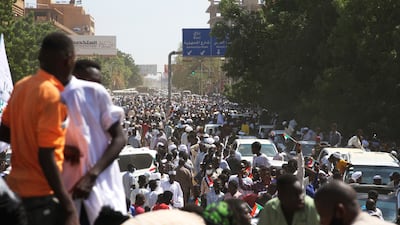
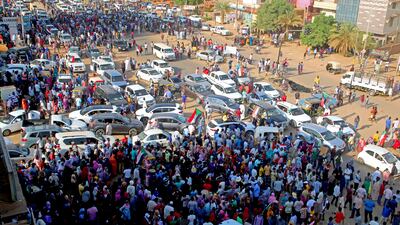
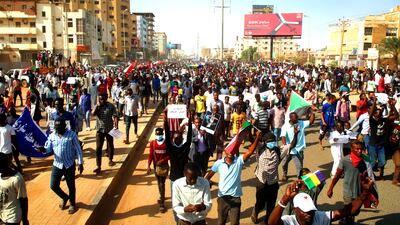
• Sudanese protesters hold a rally in Khartoum against overnight detentions by the army of government members. Soldiers arrested Sudan's prime minister for his refusal to support their 'coup', the Information Ministry said. All photos: AFP
    Sudanese protesters hold a rally in Khartoum against overnight detentions by the army of government members. Soldiers arrested Sudan's prime minister for his refusal to support their 'coup', the Information Ministry said. All photos: AFP
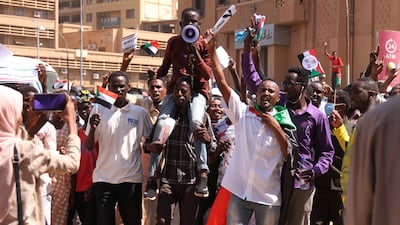
  • Sudanese demonstrators wave the national flag on the streets of the capital, Khartoum.
    Sudanese demonstrators wave the national flag on the streets of the capital, Khartoum.
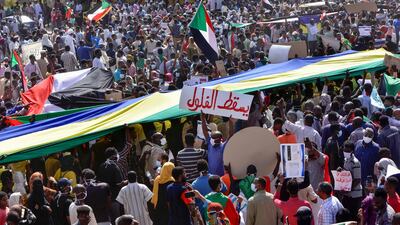
  • Sudanese protesters hold a rally in Khartoum against overnight detentions by the army of government members. The detentions follows weeks of tensions between military and civilian figures who have shared power since the fall of former president Omar Al Bashir.
    Sudanese protesters hold a rally in Khartoum against overnight detentions by the army of government members. The detentions follows weeks of tensions between military and civilian figures who have shared power since the fall of former president Omar Al Bashir.
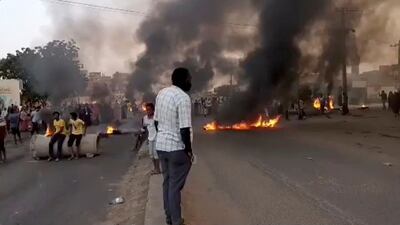
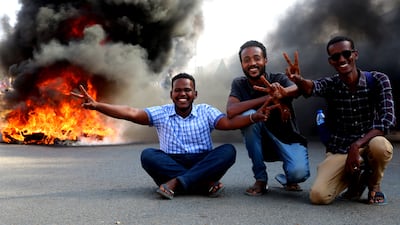
  • Protesters burnt tyres to block a road in Khartoum.
    Protesters burnt tyres to block a road in Khartoum.
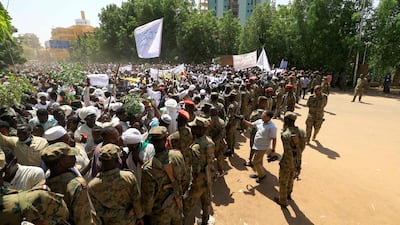
  • Soldiers detained Sudan's prime minister over a refusal to support their 'coup', the Information Ministry said.
    Soldiers detained Sudan's prime minister over a refusal to support their 'coup', the Information Ministry said.
  • Sudanese protesters jump over a roadblock made of bricks and burning tyres as they rally on 60th Street in the capital, Khartoum.
    Sudanese protesters jump over a roadblock made of bricks and burning tyres as they rally on 60th Street in the capital, Khartoum.
  • There have been weeks of tensions between the military and civilian figures who shared power since the fall of former president Omar Al Bashir.
    There have been weeks of tensions between the military and civilian figures who shared power since the fall of former president Omar Al Bashir.
  • Sudanese protesters use bricks and burning tyres to block 60th Street in Khartoum.
    Sudanese protesters use bricks and burning tyres to block 60th Street in Khartoum.
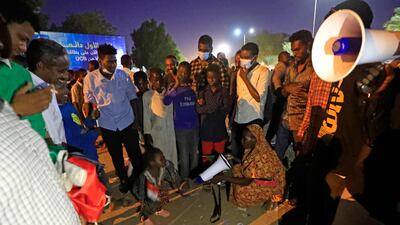
  • Protesters are angry about the overnight detentions by the army of members of Sudan's government.
    Protesters are angry about the overnight detentions by the army of members of Sudan's government.
  • Soldiers detained Sudan's prime minister over his refusal to support their 'coup', the Information Ministry said, after weeks of tensions between military and civilian figures.
    Soldiers detained Sudan's prime minister over his refusal to support their 'coup', the Information Ministry said, after weeks of tensions between military and civilian figures.

What's happening in Sudan and who is Gen Abdel Fattah Al Burhan?


  • English
  • Arabic

Sudan's Prime Minister Abdalla Hamdok and several members of his civilian-led government were arrested by the military on Monday morning, prompting protests in the capital Khartoum.

Military head Gen Abdel Fattah Al Burhan announced the dismissal of the government and a national state of emergency and said the military would be taking control until a new government of technocrats could be formed to rule under the direction of the army.

Here is everything you need to know about what has happened in Sudan and who is involved:

Who is in charge of Sudan?

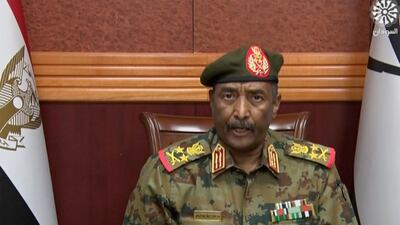
  • Sudan's Gen Abdel Fattah Al Burhan announced in a televised address that he was dissolving the country's ruling Sovereign Council and the government led by Prime Minister Abdalla Hamdok. Gen Al Burhan said the military would run the country until elections in 2023. Photo: Sudan TV / AP
    Sudan's Gen Abdel Fattah Al Burhan announced in a televised address that he was dissolving the country's ruling Sovereign Council and the government led by Prime Minister Abdalla Hamdok. Gen Al Burhan said the military would run the country until elections in 2023. Photo: Sudan TV / AP
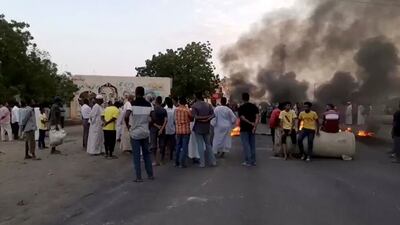
  • People gather on the streets of Khartoum as smoke rises after reports of a coup on Monday. Photo: Rasd Sudan Network / Reuters
    People gather on the streets of Khartoum as smoke rises after reports of a coup on Monday. Photo: Rasd Sudan Network / Reuters
  • People gather on the streets of Khartoum as smoke rises after reports of a coup on October 25, 2021. Rasd Sudan Network via Reuters
    People gather on the streets of Khartoum as smoke rises after reports of a coup on October 25, 2021. Rasd Sudan Network via Reuters
  • The scene on Khartoum's streets. Photo: Rasd Sudan Network / Reuters
    The scene on Khartoum's streets. Photo: Rasd Sudan Network / Reuters
  • Sudanese Prime Minister Abdalla Hamdok has been arrested by the military and taken to an undisclosed location, the Information Ministry reported. AFP
    Sudanese Prime Minister Abdalla Hamdok has been arrested by the military and taken to an undisclosed location, the Information Ministry reported. AFP
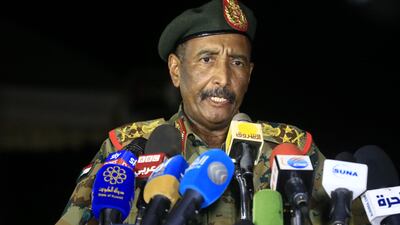
  • Political parties and pro-civilian rule groups have accused army general and head of the sovereign council Gen Abdel Fattah Al Burhan of ordering the military takeover. AFP
    Political parties and pro-civilian rule groups have accused army general and head of the sovereign council Gen Abdel Fattah Al Burhan of ordering the military takeover. AFP
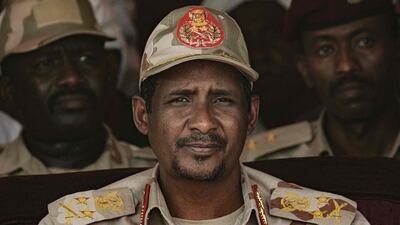
  • Mohamed Hamdan Dagalo, known as Himediti, is the deputy head of Sudan's ruling Transitional Military Council (TMC) and commander of the Rapid Support Forces (RSF) paramilitaries, making him one of the country’s most powerful generals. AFP
    Mohamed Hamdan Dagalo, known as Himediti, is the deputy head of Sudan's ruling Transitional Military Council (TMC) and commander of the Rapid Support Forces (RSF) paramilitaries, making him one of the country’s most powerful generals. AFP
  • The military’s move comes after protests in favour of the military and against Mr Hamdok as well as those backing civilian rule. AFP
    The military’s move comes after protests in favour of the military and against Mr Hamdok as well as those backing civilian rule. AFP
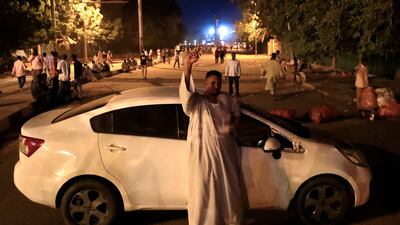
  • A protester blocks a street with his car during a demonstration to demand the dissolution of Sudan's transitional government. AFP
    A protester blocks a street with his car during a demonstration to demand the dissolution of Sudan's transitional government. AFP
  • There have been numerous protests in recent days, including outside the presidential palace in Sudan's capital, Khartoum. AFP
    There have been numerous protests in recent days, including outside the presidential palace in Sudan's capital, Khartoum. AFP
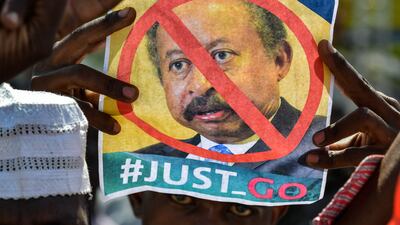
  • Protesters camping outside the presidential palace demand the dismissal of the government of Prime Minister Abdalla Hamdok. AP
    Protesters camping outside the presidential palace demand the dismissal of the government of Prime Minister Abdalla Hamdok. AP
  • Protesters chant 'one army, one people' and 'the army will bring us bread' slogans during their demonstration outside the presidential palace in Khartoum. AP
    Protesters chant 'one army, one people' and 'the army will bring us bread' slogans during their demonstration outside the presidential palace in Khartoum. AP
  • Pro-military protesters hold a rally demanding the dissolution of Sudan’s government, outside the presidential palace. AP
    Pro-military protesters hold a rally demanding the dissolution of Sudan’s government, outside the presidential palace. AP
  • Mr Hamdok has issued a warning that the transition is facing its 'worst and most dangerous' crisis. AFP
    Mr Hamdok has issued a warning that the transition is facing its 'worst and most dangerous' crisis. AFP
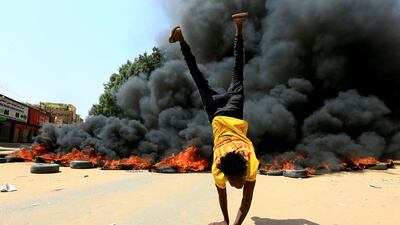
  • A person does a handstand in front of a burning pile of tyres during a pro-civilian rule protest against any military takeover in Khartoum on October 21. Reuters
    A person does a handstand in front of a burning pile of tyres during a pro-civilian rule protest against any military takeover in Khartoum on October 21. Reuters
  • Thousands rallied to back Mr Hamdok’s government after protests by pro-military supporters. EPA
    Thousands rallied to back Mr Hamdok’s government after protests by pro-military supporters. EPA
  • Thousands of people marched during a demonstration called by the Alliance of Forces for Freedom and Change, the Central Council Group to support the government of Abdullah Hamdok, while the army and police forces closed the roads leading to government headquarters and main markets. EPA
    Thousands of people marched during a demonstration called by the Alliance of Forces for Freedom and Change, the Central Council Group to support the government of Abdullah Hamdok, while the army and police forces closed the roads leading to government headquarters and main markets. EPA
  • People attend demonstrations in support of the civilian government on October 21. EPA
    People attend demonstrations in support of the civilian government on October 21. EPA
  • Sudanese demonstrators take part in a protest in the city of Khartoum Bahri, the northern twin city of the capital, to demand the government's transition to civilian rule. AFP
    Sudanese demonstrators take part in a protest in the city of Khartoum Bahri, the northern twin city of the capital, to demand the government's transition to civilian rule. AFP

Sudan began its transition to democracy after a popular uprising that led to the removal of long-time president Omar Al Bashir in April 2019, ending his 29-year rule.

Al Bashir, who is in jail, is wanted by the International Criminal Court to face charges of war crimes in the western Sudanese region of Darfur.

After four months of protests in 2018-2019 led by the Forces of Freedom and Change (FFC), a pro-democracy alliance, Al Bashir was removed by the army.

A power-sharing deal between the FFC and the military was agreed in August 2019 and the Sovereign Council, led by Gen Abdel Fattah Al Burhan, was formed to oversee a "transitional government" until elections in 2023.

According to the deal, the military is in charge of the first rotational phase of the transitional government and they were due to hand over to a civilian leader next month for the second phase.

Monday's arrests came after weeks of tension between the military and their civilian partners.

Internet activity tracking website NetBlocks reported cuts to services in Sudan on Monday morning and residents told The National they could not get online. Internet cuts were common during the 2018-2019 uprising and were used to prevent public gatherings from growing.

Who is Gen Abdel Fattah Al Burhan?

Gen Al Burhan on Monday announced a state of emergency across the country and dissolving the transitional government.

Mr Al Burhan is an armed forces veteran who flew under the radar until he was assigned a senior role under Al Bashir's government.

Born in 1960 to a Sufi family in the village of Gandatu, north of Khartoum, Gen Al Burhan studied in the Sudanese army academy and later in Egypt and Jordan. He is married and has three children.

What is the military's role?

Although the military's role is supposed to be largely honorary, civilians have repeatedly complained of its overreach in foreign policy and peace negotiations.

The military has accused civilian parties of mismanagement and monopolising power. A coalition of rebel groups and political parties have recently aligned themselves with the armed forces and have campaigned to dissolve the civilian-led Cabinet.

In September, authorities said they foiled an attempted coup. Al Bashir loyalists were behind the move, they said.

One of the sore spots involves bringing Al Bashir to justice over his involvement in the Darfur conflict in the early 2000s. The military and the government were at odds over whether to hand him over to the ICC for trial, with the generals reluctant to do so.

The Cabinet has signed off on handing over suspects, but the Sovereign Council, with its military leaders, has not.

Another issue of contention is an investigation into the killings of pro-democracy protesters on June 3, 2019, in which military forces are implicated for violently dispersing a protest sit-in outside the military headquarters in Khartoum.

Activists and civilian groups have been angered by delays in making the findings of the investigation public.

Civilians have also pushed for oversight and restructuring of the military, particularly through the integration of the powerful paramilitary Rapid Support Forces.

What led to Al Bashir's downfall?

A worsening economic crisis that sent the currency plunging and created frequent shortages of bread and fuel was the trigger for Al Bashir's downfall.

The transitional government has introduced rapid reforms monitored by the International Monetary Fund in a successful effort to secure debt relief and attract foreign financing.

This came after Mr Hamdok led efforts to remove Sudan from the US list of state sponsors of terrorism, opening the country up for investment and improving its standing among the international community.

After the reforms were introduced, inflation rose to historic highs of more than 400 per cent and many Sudanese have complained of struggling to get by. There have been occasional protests against economic conditions.

What about Sudan's neighbours?

Sudan is part of a volatile region, bordering the Red Sea, the Sahel and the Horn of Africa. Several of its neighbours, including Ethiopia, Chad and South Sudan, have been affected by political upheaval and conflict.

Since late last year, conflict in Ethiopia's Tigray region has pushed tens of thousands of refugees into eastern Sudan and caused tension in disputed agricultural lands along the border.

Sudan is pushing, with Egypt, for a binding deal over the operation of a hydropower dam Ethiopia is building near the Sudanese border.

Talks have stalled but Ethiopia has started filling the reservoir behind the dam, which Sudan says could put its people, dams and water centres at risk.


The National's picks

4.35pm: Tilal Al Khalediah
5.10pm: Continous
5.45pm: Raging Torrent
6.20pm: West Acre
7pm: Flood Zone
7.40pm: Straight No Chaser
8.15pm: Romantic Warrior
8.50pm: Calandogan
9.30pm: Forever Young

Secret Pigeon Service: Operation Colomba, Resistance and the Struggle to Liberate Europe
Gordon Corera, Harper Collins

The%20specs
%3Cp%3E%3Cstrong%3EEngine%3A%20%3C%2Fstrong%3E2.3-litre%20turbo%204-cyl%3Cbr%3E%3Cstrong%3ETransmission%3A%20%3C%2Fstrong%3E10-speed%20auto%3Cbr%3E%3Cstrong%3EPower%3A%20%3C%2Fstrong%3E298hp%3Cbr%3E%3Cstrong%3ETorque%3A%20%3C%2Fstrong%3E452Nm%3Cbr%3E%3Cstrong%3ETowing%20capacity%3A%20%3C%2Fstrong%3E3.4-tonne%3Cbr%3E%3Cstrong%3EPayload%3A%20%3C%2Fstrong%3E4WD%20%E2%80%93%20776kg%3B%20Rear-wheel%20drive%20819kg%3Cbr%3E%3Cstrong%3EPrice%3A%20%3C%2Fstrong%3EPrice%3A%20Dh138%2C945%20(XLT)%20Dh193%2C095%20(Wildtrak)%3Cbr%3E%3Cstrong%3EDelivery%3A%3C%2Fstrong%3E%20from%20August%3C%2Fp%3E%0A
SPEC%20SHEET%3A%20APPLE%20M3%20MACBOOK%20AIR%20(13%22)
%3Cp%3E%3Cstrong%3EProcessor%3A%3C%2Fstrong%3E%20Apple%20M3%2C%208-core%20CPU%2C%20up%20to%2010-core%20CPU%2C%2016-core%20Neural%20Engine%3C%2Fp%3E%0A%3Cp%3E%3Cstrong%3EDisplay%3A%3C%2Fstrong%3E%2013.6-inch%20Liquid%20Retina%2C%202560%20x%201664%2C%20224ppi%2C%20500%20nits%2C%20True%20Tone%2C%20wide%20colour%3C%2Fp%3E%0A%3Cp%3E%3Cstrong%3EMemory%3A%3C%2Fstrong%3E%208%2F16%2F24GB%3C%2Fp%3E%0A%3Cp%3E%3Cstrong%3EStorage%3A%3C%2Fstrong%3E%20256%2F512GB%20%2F%201%2F2TB%3C%2Fp%3E%0A%3Cp%3E%3Cstrong%3EI%2FO%3A%3C%2Fstrong%3E%20Thunderbolt%203%2FUSB-4%20(2)%2C%203.5mm%20audio%2C%20Touch%20ID%3C%2Fp%3E%0A%3Cp%3E%3Cstrong%3EConnectivity%3A%3C%2Fstrong%3E%20Wi-Fi%206E%2C%20Bluetooth%205.3%3C%2Fp%3E%0A%3Cp%3E%3Cstrong%3EBattery%3A%3C%2Fstrong%3E%2052.6Wh%20lithium-polymer%2C%20up%20to%2018%20hours%2C%20MagSafe%20charging%3C%2Fp%3E%0A%3Cp%3E%3Cstrong%3ECamera%3A%3C%2Fstrong%3E%201080p%20FaceTime%20HD%3C%2Fp%3E%0A%3Cp%3E%3Cstrong%3EVideo%3A%3C%2Fstrong%3E%20Support%20for%20Apple%20ProRes%2C%20HDR%20with%20Dolby%20Vision%2C%20HDR10%3C%2Fp%3E%0A%3Cp%3E%3Cstrong%3EAudio%3A%3C%2Fstrong%3E%204-speaker%20system%2C%20wide%20stereo%2C%20support%20for%20Dolby%20Atmos%2C%20Spatial%20Audio%20and%20dynamic%20head%20tracking%20(with%20AirPods)%3C%2Fp%3E%0A%3Cp%3E%3Cstrong%3EColours%3A%3C%2Fstrong%3E%20Midnight%2C%20silver%2C%20space%20grey%2C%20starlight%3C%2Fp%3E%0A%3Cp%3E%3Cstrong%3EIn%20the%20box%3A%3C%2Fstrong%3E%20MacBook%20Air%2C%2030W%2F35W%20dual-port%2F70w%20power%20adapter%2C%20USB-C-to-MagSafe%20cable%2C%202%20Apple%20stickers%3C%2Fp%3E%0A%3Cp%3E%3Cstrong%3EPrice%3A%3C%2Fstrong%3E%20From%20Dh4%2C599%3C%2Fp%3E%0A
Gertrude Bell's life in focus

A feature film

At one point, two feature films were in the works, but only German director Werner Herzog’s project starring Nicole Kidman would be made. While there were high hopes he would do a worthy job of directing the biopic, when Queen of the Desert arrived in 2015 it was a disappointment. Critics panned the film, in which Herzog largely glossed over Bell’s political work in favour of her ill-fated romances.

A documentary

A project that did do justice to Bell arrived the next year: Sabine Krayenbuhl and Zeva Oelbaum’s Letters from Baghdad: The Extraordinary Life and Times of Gertrude Bell. Drawing on more than 1,000 pieces of archival footage, 1,700 documents and 1,600 letters, the filmmakers painstakingly pieced together a compelling narrative that managed to convey both the depth of Bell’s experience and her tortured love life.

Books, letters and archives

Two biographies have been written about Bell, and both are worth reading: Georgina Howell’s 2006 book Queen of the Desert and Janet Wallach’s 1996 effort Desert Queen. Bell published several books documenting her travels and there are also several volumes of her letters, although they are hard to find in print. Original documents are housed at the Gertrude Bell Archive at the University of Newcastle, which has an online catalogue.
 

Updated: October 26, 2021, 6:59 AM