
The US has lifted a long-standing designation of Sudan as a state sponsor of terrorism, paving the way for Khartoum to once again engage with the international community, draw investment and seek financial assistance in overcoming a punishing economic crisis.
But why was Sudan designated a sponsor of terrorism 27 years ago, what did that mean for the country and why has the US removed the terror listing now?
-
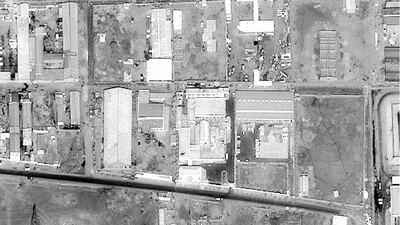
This satellite image released by the US Department of Defence on August 20 shows the Shifa Pharmaceutical Plant in Khartoum, Sudan, which the Pentagon says was producing components for making chemical weapons before the August 20 attack by US cruise missiles. AFP -

Ruins of Shifa pharmaceutical plant, alleged chemical weapons manufacturing facility said bankrolled by Osama bin Laden, cruise missile target in retaliatory US air strikes after terror bombings of US embassies in Africa. Getty Images -
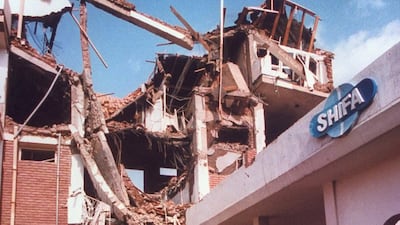
Ruins of Shifa pharmaceutical plant, alleged chemical weapons manufacturing facility said bankrolled by Islamic terrorist financer Osama bin Laden, cruise missile target in retaliatory US air strikes after terror bombings of US embassies in Africa. Getty Images -

Sudanese President Omar al-Bashir points at the remains of a US cruise missile which hit the al-Shifa pharmaceutical plant one year ago 20 August 1999 in Khartoum. Bashir and several Sudanese officials attended a ceremony at the remains of the factory to mark the anniversary of the US missile strike. AFP -
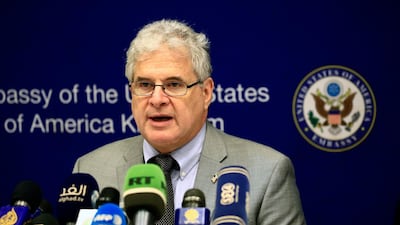
Top US envoy in Khartoum, Charge D'affaires Steven Koutsis, speaks during a press conference at the US embassy on October 7, 2017, a day after Washington lifted its 20-year-old trade embargo imposed on Sudan over alleged support to violent Islamist groups. The US decision came after months of diplomatic talks between the two countries that began during the tenure of former US president Barack Obama. AFP -
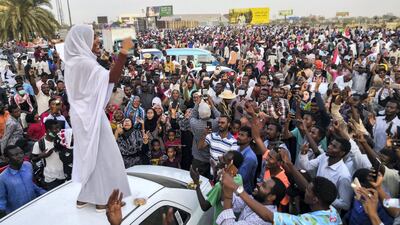
Alaa Salah, a Sudanese woman propelled to internet fame earlier this week after clips went viral of her leading powerful protest chants against President Omar al-Bashir, addresses protesters during a demonstration in front of the military headquarters in the capital Khartoum on April 10, 2019. AFP -
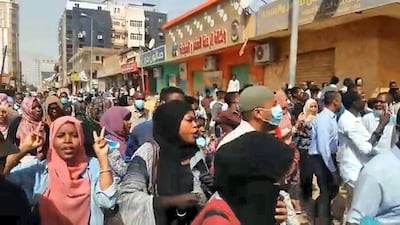
An image grab taken from AFP TV on January 17, 2019, shows people chanting and shouting during a protest calling for the resignation of the Sudanese President in the capital Khartoum. Sudanese police fired tear gas at hundreds of protesters marching towards the presidential palace demanding President Omar al-Bashir's resignation. AFP -
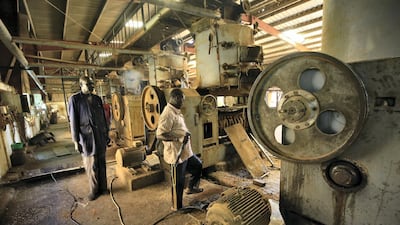
Workers operate machinery at Teital Oil Mills in the Sudanese capital Khartoum on November 24, 2019. A year after the start of a protest movement that led to the fall of dictator Omar al-Bashir, Sudan is looking for a fresh start despite a stagnant economy. The United States in 1997 imposed a trade embargo on Sudan for hosting Al-Qaeda leader Osama bin Laden between 1992 and 1996, affecting not only international banking but also technology and trade in spare parts. While the embargo was lifted in 2017, business owners are still unable to invest in their facilities as the country is not part of the global banking system and they are unable to make international money transfers. AFP -

Sarah al-Fateh, General Manager at Teital Oil Mills, walks at the facility in the Sudanese capital Khartoum on November 24, 2019. A year after the start of a protest movement that led to the fall of dictator Omar al-Bashir, Sudan is looking for a fresh start despite a stagnant economy. The United States in 1997 imposed a trade embargo on Sudan for hosting Al-Qaeda leader Osama bin Laden between 1992 and 1996, affecting not only international banking but also technology and trade in spare parts. While the embargo was lifted in 2017, business owners are still unable to invest in their facilities as the country is not part of the global banking system and they are unable to make international money transfers. AFP -
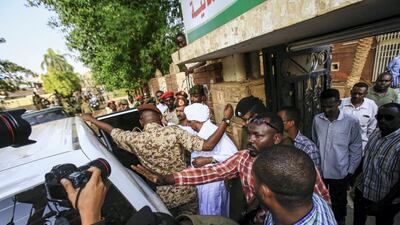
Sudan's ousted president Omar al-Bashir is escorted into a vehicle as he returns to prison following his appearance before prosecutors over charges of corruption and illegal possession of foreign currency, in the capital Khartoum on June 16, 2019. Bashir was On June 16 seen in public for the first time since being ousted, as he was driven to the prosecutor's office. The former strongman, who ruled his northeast African nation with an iron fist for three decades, was toppled on April 11 after weeks of protests against his reign. AFP -
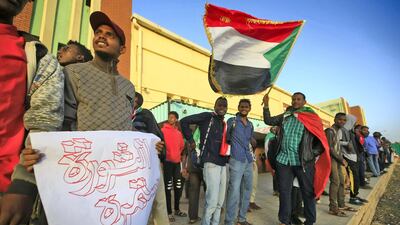
Sudanese protesters wait at a train station in Khartoum to board a train to Atbara on December 19, 2019 to celebrate the one-year anniversary of their protest movement that brought down Omar al-Bashir last April after a thirty-year rule. A year after demonstrations broke out in Sudan over soaring bread prices, celebrations are planned across the country to mark the uprising that brought down veteran autocrat Bashir. AFP


Here’s everything you need to know about the latest developments:
What is a state sponsor of terrorism?
The US Secretary of State can declare a country a state sponsor of terrorism when, according to the US State Department, the country has "repeatedly provided support for acts of international terrorism". This is a rare and drastic measure, currently applied to long-standing US adversaries such as North Korea, Iran and Syria.
What does the designation mean for a country?
Once added to the list, a country will face a range of sanctions, while US economic assistance can be blocked, as well as arms sales. Individuals within the country who are accused of links to terror groups are also at risk of targeted sanctions – their bank accounts could be frozen, for example, or they may be banned from visiting the US. Foreign companies trading with a listed country, particularly those thought to be supplying "dual use" items, in other words civilian material that could be used to make weapons, are at risk of financial and legal penalties. As a result, many foreign companies stay away and economic growth slows.
Why was Sudan declared a ‘state sponsor of terrorism’?
When Sudan was added to the state sponsors of terrorism list in August 1993, the US State Department was concerned that long-time autocrat Omar Al Bashir's regime was supporting hardline Palestinian faction Hamas, Lebanon-based Iranian proxy Hezbollah and Al Gamaat Al Islamiyya, an Egypt-based extremist movement linked to a range of Al Qaeda-linked affiliates.
Wasn’t Osama bin Laden involved?
In 1991, Osama bin Laden travelled from Afghanistan to Sudan, three years after he played a leading role in founding Al Qaeda.
After inheriting a fortune, the militant set up front construction companies in Sudan and was welcomed by Al Bashir.
At the time, the country was desperate for investment and Bin Laden was soon building roads and infrastructure but also using funds to plan terror attacks and recruit followers.
Business relations between Bin Laden and Al Bashir were complicated by delayed payments by the government. But the soon to be global terrorist remained friends with Sudanese politician Hassan Turabi, an Al Bashir ally.
In Sudan, Bin Laden found shelter and resources for his terror campaign during the 1990s.
He wasted little time planning operations. By December 1992, Al Qaeda had bombed two hotels in Yemen in a failed attempt to kill US troops who were briefly stationed in Aden.
While initial sanctions were about support for other groups, Bin Laden would soon be on Washington’s radar.
In 1995, Al Qaeda associates tried to kill Egyptian president Hosni Mubarak, a plot that led both the US and the UN to place sanctions on Sudan.
Major terrorist attacks by Al Qaeda followed, including the 1998 attack on the US embassies in Kenya and Tanzania.
They led Bill Clinton to order controversial US air strikes on Sudan in response.
In 2000, an Al Qaeda attack on the USS Cole guided-missile destroyer killed 17 American sailors and in 2007, a US federal court held Sudan responsible, based on its prior relationship with Al Qaeda.
Bin Laden was expelled from Sudan in 1999, by then already the world's most wanted man.
But Sudan remained on the US sanctions list as a state sponsor of terror, in part for continued support for Hamas and for backing a range of regional militia groups.
Why has Sudan been removed now?
Al Bashir was removed from power by the military amid a popular uprising in 2019, leading to rapid change in the country and its leadership. But the US State Department had already begun to relax some of the sanctions on Sudan.
The new transitional government has presented policies amounting to a sea change in the country’s regional outlook, paying compensation for those killed and wounded in attacks by Al Qaeda carried out with its support and agreeing to establish ties with Israel.
While the designation was linked to the Al Bashir regime – now gone – it lingered.
A major sticking point was compensation for families of victims, as well as concerns in Khartoum that further lawsuits would continue to hit the state.
In October, Sudan paid $335 million in compensation for its alleged role in the 1998 bombings of the two US embassies in East Africa.
In return, Washington signed an agreement with Khartoum to restore sovereign immunity, protecting the state from further lawsuits.
Then on December 14, the US formally lifted Sudan's designation as a state sponsor of terrorism, 27 years after putting the country on its blacklist.
"The Congressional notification period of 45 days has lapsed and the Secretary of State has signed a notification stating rescission of Sudan's State Sponsor of Terrorism designation is effective as of today [December 14], to be published in the Federal Register," the US embassy wrote.
What does the removal mean for Sudan?
After being on the state sponsors of terror list for nearly 30 years, the country's removal will allow it to again trade and seek investors at a time when Khartoum is facing a daunting economic challenge. More aid is likely from the US, the UAE and Israel. The country's removal from the list will also allow for quicker approval of World Bank and IMF assistance, although this was already under way following the end of Al Bashir's regime.

