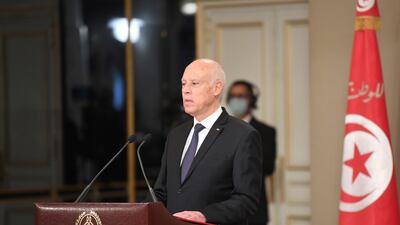
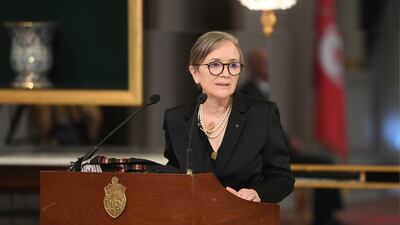
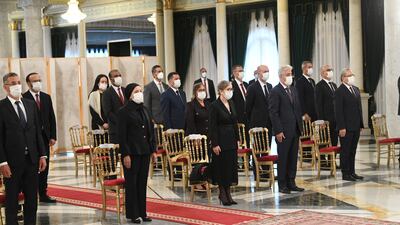
In this photo distributed by the Tunisian Presidency, Tunisian Prime Minister Najla Bouden talks during the the swearing-in ceremony of the new government, Monday, Oct. 11, 2021 in Tunis. Tunisia got a new government Monday after more than two months without one, with the prime minister naming her Cabinet, including a record number of women. (Slim Abid, Tunisian Presidency via AP)
In this photo distributed by the Tunisian Presidency, Tunisian Prime Minister Najla Bouden talks during the the swearing-in ceremony of the new government, Monday, Oct. 11, 2021 in Tunis. Tunisia got

Tunisia PM prioritises economic reform as US welcomes new government


Erin Clare Brown
  • English
  • Arabic

Tunisian Prime Minister Najla Bouden Romdhane has said fixing public finances and implementing economic reforms is a priority. It is the first sign of the government's intention to launch reforms demanded by lenders and ease the financial crisis.

Ms Bouden met Tuesday with the country's central bank governor and the finance minister to discuss the urgent financial situation facing Tunisia.

“The Prime Minister said the priority of her government is to balance public finances and to proceed with the necessary economic reforms,” a government statement issued on Facebook said of the meeting.

Tunisia's President Kais Saied unveiled a new Cabinet on Monday. Under new rules implemented after Mr Saied suspended much of the constitution last month, the new Cabinet will ultimately answer to him rather than the prime minister.

The new government will have to tackle massive unemployment, a bloated public wage bill, and loans coming due from foreign lenders within the coming weeks.

The central bank said last week it was worried about an acute shortage of external financial resources and foreign currency. It said that financing the budget carries economic risks, including boosting inflation, reducing the bank's reserves and causing a drop in the value of the local currency.

Tunisia needs to raise at least $3.5 billion this year to roll over foreign debts and pay the wages of hundreds of thousands of employees in the public sector.

Tunisia's new government sworn in — pictures

  • Tunisian President Kais Saied at the swearing-in ceremony of the new government on Monday in Tunis. AP
    Tunisian President Kais Saied at the swearing-in ceremony of the new government on Monday in Tunis. AP
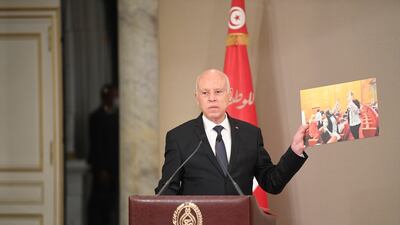
  • Mr Saied shows a scene of what he says were scuffles among politicians in Tunisia’s previous parliament. Photo: Tunisian Presidency via AP
    Mr Saied shows a scene of what he says were scuffles among politicians in Tunisia’s previous parliament. Photo: Tunisian Presidency via AP
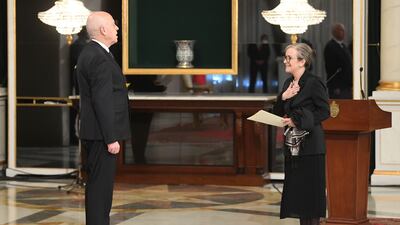
  • Mr Saied talks to Prime Minister Najla Bouden during the swearing-in of the new government. Photo: Tunisian Presidency via AP
    Mr Saied talks to Prime Minister Najla Bouden during the swearing-in of the new government. Photo: Tunisian Presidency via AP
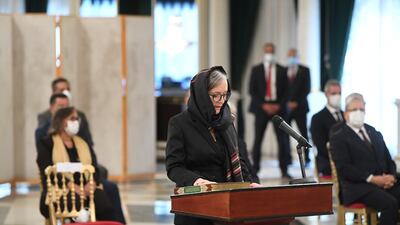
  • Najla Bouden takes the oath. Photo: Tunisian Presidency via Reuters
    Najla Bouden takes the oath. Photo: Tunisian Presidency via Reuters
  • Prime Minister Najla Bouden Romdhane during the swearing-in ceremony for the new government in Tunis. AP
    Prime Minister Najla Bouden Romdhane during the swearing-in ceremony for the new government in Tunis. AP
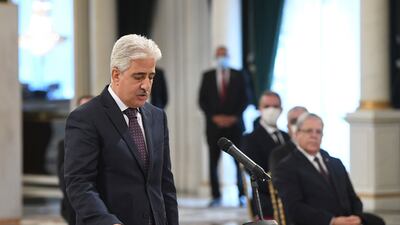
  • Imed Nemich is the new Defence Minister. Photo: Tunisian Presidency via AP
    Imed Nemich is the new Defence Minister. Photo: Tunisian Presidency via AP
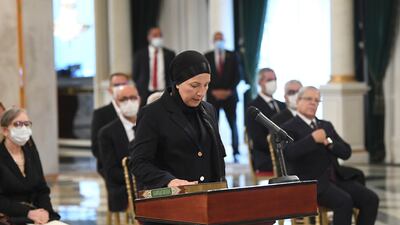
  • Leila Jaffel is new Justice Minister. Photo: Tunisian Presidency via AP
    Leila Jaffel is new Justice Minister. Photo: Tunisian Presidency via AP
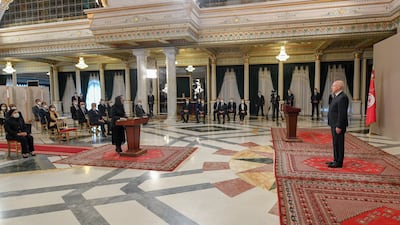
  • The ceremony. Photo: Tunisian Presidency via Reuters
    The ceremony. Photo: Tunisian Presidency via Reuters
  • President Kais Saied poses with members of the new government in Tunis. Photo: Tunisian Presidency via Reuters
    President Kais Saied poses with members of the new government in Tunis. Photo: Tunisian Presidency via Reuters
  • Members of Tunisia's new government, with face masks, stand during their swearing-in ceremony in Tunis. Photo: Tunisian Presidency via Reuters
    Members of Tunisia's new government, with face masks, stand during their swearing-in ceremony in Tunis. Photo: Tunisian Presidency via Reuters

'Welcome step'

The US praised the appointment of the new Tunisian government as a positive step and encouraged further action three months after the presidential seizure of powers.

“The new government, which includes 10 female ministers, is a welcome step forwards towards addressing the significant economic, health and social challenges facing the country,” State Department spokesman Ned Price told reporters.

“We look forward to further announcements to establish a broadly inclusive process for a rapid return to constitutional order."

Mr Saied in July suspended parliament, sacked the government and assumed sole control of the country, following months of growing public anger over an economic crisis and the handling of the Covid-19 pandemic.

Since his consolidation of power he has faced growing pressure from internal and external allies to move the country back towards the democratic process. The US last week voiced disappointment over a crackdown on the media in Tunisia and the use of military courts to try civilians for critical remarks against the government.


Ten tax points to be aware of in 2026

1. Domestic VAT refund amendments: request your refund within five years

If a business does not apply for the refund on time, they lose their credit.

2. E-invoicing in the UAE

Businesses should continue preparing for the implementation of e-invoicing in the UAE, with 2026 a preparation and transition period ahead of phased mandatory adoption. 

3. More tax audits

Tax authorities are increasingly using data already available across multiple filings to identify audit risks. 

4. More beneficial VAT and excise tax penalty regime

Tax disputes are expected to become more frequent and more structured, with clearer administrative objection and appeal processes. The UAE has adopted a new penalty regime for VAT and excise disputes, which now mirrors the penalty regime for corporate tax.

5. Greater emphasis on statutory audit

There is a greater need for the accuracy of financial statements. The International Financial Reporting Standards standards need to be strictly adhered to and, as a result, the quality of the audits will need to increase.

6. Further transfer pricing enforcement

Transfer pricing enforcement, which refers to the practice of establishing prices for internal transactions between related entities, is expected to broaden in scope. The UAE will shortly open the possibility to negotiate advance pricing agreements, or essentially rulings for transfer pricing purposes. 

7. Limited time periods for audits

Recent amendments also introduce a default five-year limitation period for tax audits and assessments, subject to specific statutory exceptions. While the standard audit and assessment period is five years, this may be extended to up to 15 years in cases involving fraud or tax evasion. 

8. Pillar 2 implementation 

Many multinational groups will begin to feel the practical effect of the Domestic Minimum Top-Up Tax (DMTT), the UAE's implementation of the OECD’s global minimum tax under Pillar 2. While the rules apply for financial years starting on or after January 1, 2025, it is 2026 that marks the transition to an operational phase.

9. Reduced compliance obligations for imported goods and services

Businesses that apply the reverse-charge mechanism for VAT purposes in the UAE may benefit from reduced compliance obligations. 

10. Substance and CbC reporting focus

Tax authorities are expected to continue strengthening the enforcement of economic substance and Country-by-Country (CbC) reporting frameworks. In the UAE, these regimes are increasingly being used as risk-assessment tools, providing tax authorities with a comprehensive view of multinational groups’ global footprints and enabling them to assess whether profits are aligned with real economic activity. 

Contributed by Thomas Vanhee and Hend Rashwan, Aurifer

The National Archives, Abu Dhabi

Founded over 50 years ago, the National Archives collects valuable historical material relating to the UAE, and is the oldest and richest archive relating to the Arabian Gulf.

Much of the material can be viewed on line at the Arabian Gulf Digital Archive - https://www.agda.ae/en

THE BIO

Bio Box

Role Model: Sheikh Zayed, God bless his soul

Favorite book: Zayed Biography of the leader

Favorite quote: To be or not to be, that is the question, from William Shakespeare's Hamlet

Favorite food: seafood

Favorite place to travel: Lebanon

Favorite movie: Braveheart

Gifts exchanged
  • King Charles - replica of President Eisenhower Sword
  • Queen Camilla -  Tiffany & Co vintage 18-carat gold, diamond and ruby flower brooch
  • Donald Trump - hand-bound leather book with Declaration of Independence
  • Melania Trump - personalised Anya Hindmarch handbag
Gender pay parity on track in the UAE

The UAE has a good record on gender pay parity, according to Mercer's Total Remuneration Study.

"In some of the lower levels of jobs women tend to be paid more than men, primarily because men are employed in blue collar jobs and women tend to be employed in white collar jobs which pay better," said Ted Raffoul, career products leader, Mena at Mercer. "I am yet to see a company in the UAE – particularly when you are looking at a blue chip multinationals or some of the bigger local companies – that actively discriminates when it comes to gender on pay."

Mr Raffoul said most gender issues are actually due to the cultural class, as the population is dominated by Asian and Arab cultures where men are generally expected to work and earn whereas women are meant to start a family.

"For that reason, we see a different gender gap. There are less women in senior roles because women tend to focus less on this but that’s not due to any companies having a policy penalising women for any reasons – it’s a cultural thing," he said.

As a result, Mr Raffoul said many companies in the UAE are coming up with benefit package programmes to help working mothers and the career development of women in general. 

Mercer, the investment consulting arm of US services company Marsh & McLennan, expects its wealth division to at least double its assets under management (AUM) in the Middle East as wealth in the region continues to grow despite economic headwinds, a company official said.

Mercer Wealth, which globally has $160 billion in AUM, plans to boost its AUM in the region to $2-$3bn in the next 2-3 years from the present $1bn, said Yasir AbuShaban, a Dubai-based principal with Mercer Wealth.

Within the next two to three years, we are looking at reaching $2 to $3 billion as a conservative estimate and we do see an opportunity to do so,” said Mr AbuShaban.

Mercer does not directly make investments, but allocates clients’ money they have discretion to, to professional asset managers. They also provide advice to clients.

“We have buying power. We can negotiate on their (client’s) behalf with asset managers to provide them lower fees than they otherwise would have to get on their own,” he added.

Mercer Wealth’s clients include sovereign wealth funds, family offices, and insurance companies among others.

From its office in Dubai, Mercer also looks after Africa, India and Turkey, where they also see opportunity for growth.

Wealth creation in Middle East and Africa (MEA) grew 8.5 per cent to $8.1 trillion last year from $7.5tn in 2015, higher than last year’s global average of 6 per cent and the second-highest growth in a region after Asia-Pacific which grew 9.9 per cent, according to consultancy Boston Consulting Group (BCG). In the region, where wealth grew just 1.9 per cent in 2015 compared with 2014, a pickup in oil prices has helped in wealth generation.

BCG is forecasting MEA wealth will rise to $12tn by 2021, growing at an annual average of 8 per cent.

Drivers of wealth generation in the region will be split evenly between new wealth creation and growth of performance of existing assets, according to BCG.

Another general trend in the region is clients’ looking for a comprehensive approach to investing, according to Mr AbuShaban.

“Institutional investors or some of the families are seeing a slowdown in the available capital they have to invest and in that sense they are looking at optimizing the way they manage their portfolios and making sure they are not investing haphazardly and different parts of their investment are working together,” said Mr AbuShaban.

Some clients also have a higher appetite for risk, given the low interest-rate environment that does not provide enough yield for some institutional investors. These clients are keen to invest in illiquid assets, such as private equity and infrastructure.

“What we have seen is a desire for higher returns in what has been a low-return environment specifically in various fixed income or bonds,” he said.

“In this environment, we have seen a de facto increase in the risk that clients are taking in things like illiquid investments, private equity investments, infrastructure and private debt, those kind of investments were higher illiquidity results in incrementally higher returns.”

The Abu Dhabi Investment Authority, one of the largest sovereign wealth funds, said in its 2016 report that has gradually increased its exposure in direct private equity and private credit transactions, mainly in Asian markets and especially in China and India. The authority’s private equity department focused on structured equities owing to “their defensive characteristics.”

EA Sports FC 24
Updated: October 13, 2021, 1:46 PM