


Sudan's joint civilian-military council is split on handing former autocrat Omar Al Bashir to the International Criminal Court, foreign minister Mariam Sadiq Al Mahdi told The National.
Also, Israel will not be opening an embassy in Khartoum any time soon, Ms Al Mahdi said, in a discussion focused on the country's democratic transition.
In an exclusive interview at the Foreign Ministry in the Sudanese capital, she downplayed progress in building ties with Israel just 11 months after the two countries agreed to end hostilities.
Last October Sudan joined the UAE, Bahrain and Morocco in agreeing to normalise ties with Israel.
But, unlike the other states, Sudan said the normalisation agreement needed the endorsement of parliament, a body that has yet to be established under the transitional process, to come into force. The current Cabinet repealed an Israeli boycott law in April, but little public progress has been made.
Ms Al Mahdi firmly denied reports about visits by Israeli delegations to discuss co-operation in different sectors and said there were no plans to build an Israeli diplomatic outpost.
“There's not any sign of normalisation with Israel … and there are no talks at any official level,” Ms Al Mahdi said. “I’m telling you this as the foreign minister … Abolishing a law on boycotting Israel does not mean that we consider opening an Israeli embassy in Khartoum.”
She reiterated the need for Sudan’s new parliament to address the issue of Israel relations when it is formed before anything could be done.
“Any decision in this respect should be taken by the interim legislative parliament during the transitional period,” she said.
The announcement last October ended the state of belligerency that had existed since 1948. Khartoum took part in the 1967 and 1973 wars against Israel.
Ms Al Mahdi said improving relations with Israel was necessary to improve ties with Washington and the West and said it was tied to support for Sudan joining the World Trade Organisation after nearly two decades of failed attempts.
“This file has been completely linked to lifting Sudan off the US state sponsors of terrorism list,” she said.
“We have been trying to be a member of the WTO, whose terms stipulate that there should be no boycotts between member states. We want to be a country open to the world and different partnerships.”
Sudan is facing a number of crises and transitional representatives have been trying to sign accords to end long-running civil and ethnic conflicts in the country, to bring peace and divert state funds devoted to security towards fixing the economy.
They are also in dispute with neighbouring Ethiopia over borders and the construction of the $5 billion Grand Renaissance Dam project, which Khartoum fears will cause flooding and water shortages without live information sharing and a legal mechanism for dispute resolution — two things Addis Ababa has refused.
The political dynamics of Sudan have changed remarkably in the nearly two and a half years since Al Bashir was removed by the military after huge popular protests against his almost 30-year rule.
-

Sudanese protesters run for cover from tear gas canisters fired by police outside the military headquarters in the capital Khartoum on April 6, 2019. AFP -
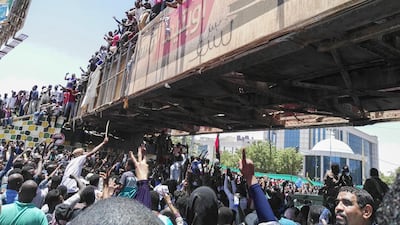
Sudanese protesters rally in front of the military headquarters in the capital Khartoum on April 8, 2019. AFP -
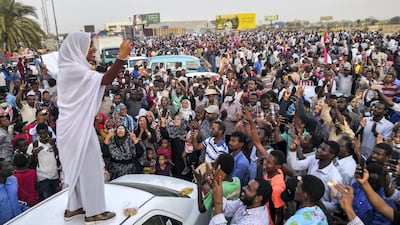
Alaa Salah, a Sudanese woman propelled to internet fame earlier this week after clips went viral of her leading powerful protest chants against President Omar Al Bashir, addresses protesters during a demonstration in front of the military headquarters in the capital Khartoum on April 10, 2019. AFP -
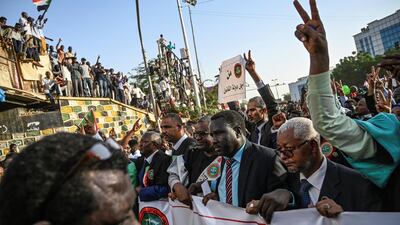
Sudanese judges, dressed in their robes, gather for a "million-strong" march outside the army headquarters in the capital Khartoum on April 25, 2019. AFP -

A Sudanese anti-regime protester kisses a soldier on the head during protests on April 11, 2019 in the area around the army headquarters in Sudan's capital Khartoum. AFP -
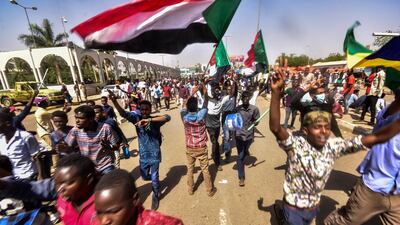
Sudanese demonstrators march with national flags as they gather during a rally demanding a civilian body to lead the transition to democracy. AFP -
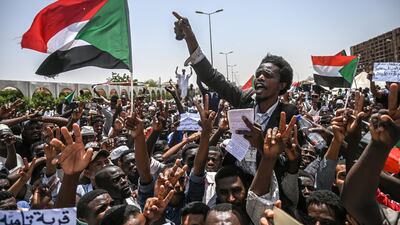
Protesters massed outside the army complex in central Khartoum on April 6, initially to demand the overthrow of longtime leader Omar Al Bashir. AFP -
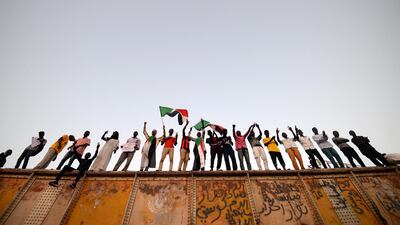
Sudanese protesters gather outside the army headquarters in Khartoum on May 6, 2019. AFP -
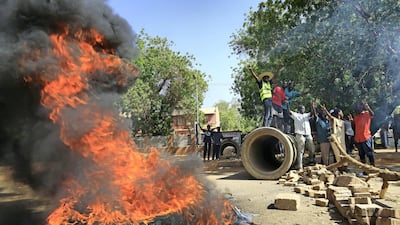
Sudanese protesters burn tyres as they block Nile Street for the second consecutive day during continuing protests in Sudan's capital Khartoum on May 13, 2019. AFP -
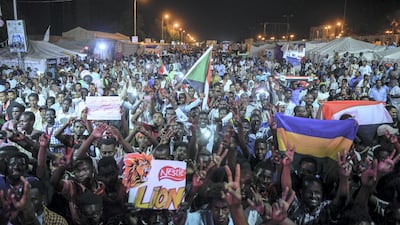
Sudanese protesters wave flags and flash victory signs as they gather for a sit-in outside the military headquarters in Khartoum on May 19, 2019. AFP -
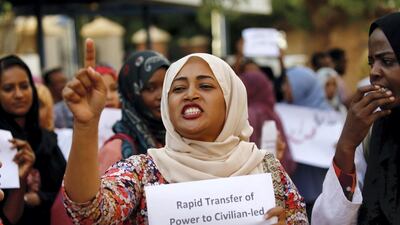
A Sudanese health worker carries a placard as scores of medics hold a rally in front of a hospital in the capital Khartoum on May 23, 2019. AFP -
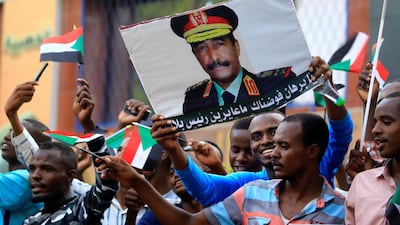
Sudanese supporters of the ruling Transitional Military Council (TMC) hold up a sign showing a portrait of its head General Abdel Fattah Al Burhan with a caption below reading in Arabic "we have delegated you Burhan, we want no president but you", during a rally in the centre of the capital Khartoum on May 31, 2019. AFP -
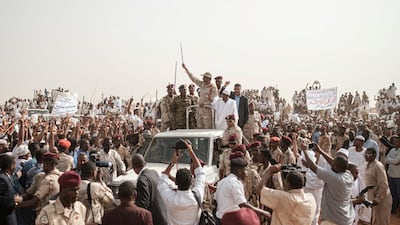
Mohamed Hamdan Dagalo, known as Himediti, deputy head of Sudan's ruling Transitional Military Council and commander of the Rapid Support Forces paramilitaries, waves a baton to supporters on a vehicle as he arrives for a rally in the village of Abraq, about 60 kilometres northwest of Khartoum, on June 22, 2019. AFP -
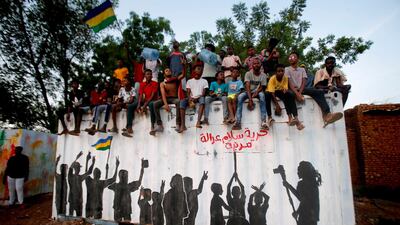
Sudanese protestors celebrate in the streets of Khartoum after ruling generals and protest leaders announced they have reached an agreement on the disputed issue of a new governing body on July 5, 2019. AFP -
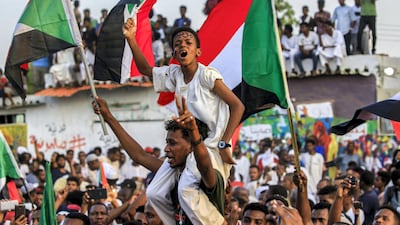
Thousands went to the streets to welcome the agreement on Saturday. AFP -
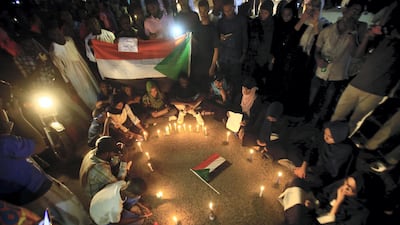
Sudanese protesters take part in a vigil in the capital Khartoum to mourn dozens of demonstrators killed last month in a raid on a Khartoum sit-in. AFP -
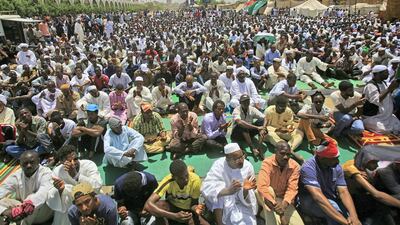
Sudanese protesters gather during Friday noon prayers outside the army headquarters in Khartoum on May 3, 2019, as they continue to protest demanding that the ruling military council hand power to a civilian administration. AFP -
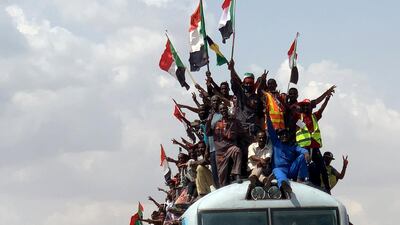
Sudanese civilians from other provinces ride on the train to join in the celebrations of the signing of Sudan's power-sharing deal. Reuters -
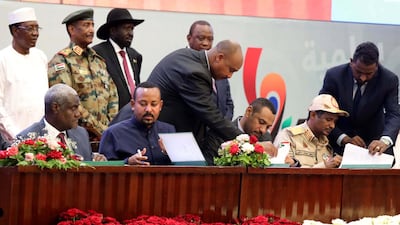
Sudan's Forces of Freedom and Change coalition leader Ahmad Rabiah (3-R) and Sudan's General and Vice President of Sudanese Transitional Military Council, Mohamed Hamdan Dagalo (2-R) sign power-sharing agreement,. EPA -
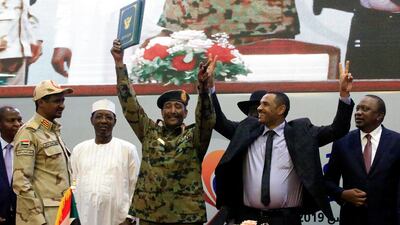
Sudan's Head of Transitional Military Council, Lieutenant General Abdel Fattah Al-Burhan, and Sudan's opposition alliance coalition's leader Ahmad Rabiah, celebrate the signing of the power-sharing deal, that paves the way for a transitional government, and eventual elections. Reuters -
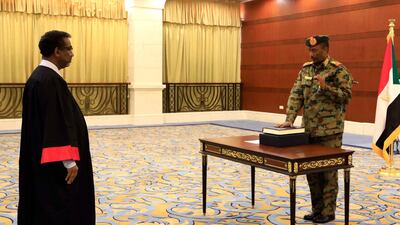
epa07783624 Leader of Sudan's transitional council, Lieutenant General Abdel Fattah Abdelrahman Burhan (R) is sworn in as the Head of the newly formed transitional Council at the presidential palace in Khartoum, Sudan, 21 August 2019. The Sudanese opposition and military council signed on 17 August a power sharing agreement. The agreement sets up a sovereign council made of five generals and six civilians, to rule the country until general elections. Protests had erupted in Sudan at the end of 2018, culminating in a long sit-in outside the army headquarters which ended with more than one hundred people being killed and others injured. Sudanese President Omar Hassan al-Bashir stepped down on 11 April 2019. EPA/STRINGER -
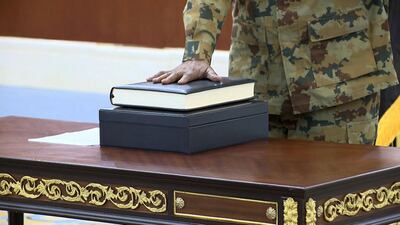
A pictured released by Sudan's Presidential Palace shows General Abdel Fattah al-Burhan, the head of Sudan's ruling military council, during a swearing in ceremony in Khartoum on August 21, 2019. Burhan was sworn today as chairman of Sudan's new sovereign council that will steer the country through a three-year transition to civilian rule. "General Abdel Fattah al-Burhan Abdel Rahman was sworn in as president of the sovereign council," the official SUNA news agency reported. / AFP / SUDAN PRESIDENTIAL PALACE / - / RESTRICTED TO EDITORIAL USE - MANDATORY CREDIT "AFP PHOTO / SUDAN PRESIDENTAIL PALACE" - NO MARKETING NO ADVERTISING CAMPAIGNS - DISTRIBUTED AS A SERVICE TO CLIENTS -
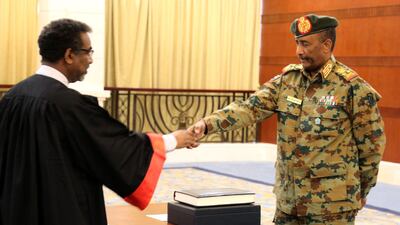
A picture released by Sudan's Presidential Palace shows General Abdel Fattah al-Burhan, the head of Sudan's ruling military council, during a swearing in ceremony in Khartoum on August 21, 2019. Burhan was sworn today as chairman of Sudan's new sovereign council that will steer the country through a three-year transition to civilian rule. "General Abdel Fattah al-Burhan Abdel Rahman was sworn in as president of the sovereign council," the official SUNA news agency reported. / AFP / SUDAN PRESIDENTIAL PALACE / - / RESTRICTED TO EDITORIAL USE - MANDATORY CREDIT "AFP PHOTO / SUDAN PRESIDENTAIL PALACE" - NO MARKETING NO ADVERTISING CAMPAIGNS - DISTRIBUTED AS A SERVICE TO CLIENTS -
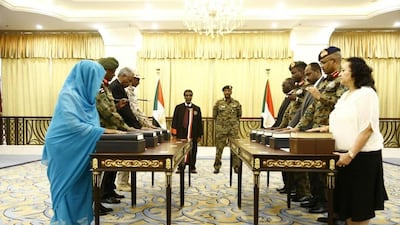
A picture released by Sudan's Presidential Palace shows General Abdel Fattah al-Burhan (C-R), the head of Sudan's ruling military council, standing during a swearing in of the new sovereign council, in Khartoum on August 21, 2019. Sudan took further steps in its transition towards civilian rule today with the swearing in of a new sovereign council, to be followed by the appointment of a prime minister. The body replaces the Transitional Military Council (TMC) that took charge after months of deadly street protests brought down longtime ruler Omar al-Bashir in April. Burhan, who already headed the TMC, was sworn in as the chairman of the new sovereign council in the morning. / AFP / SUDAN PRESIDENTIAL PALACE / - / RESTRICTED TO EDITORIAL USE - MANDATORY CREDIT "AFP PHOTO / SUDAN PRESIDENTAIL PALACE" - NO MARKETING NO ADVERTISING CAMPAIGNS - DISTRIBUTED AS A SERVICE TO CLIENTS -
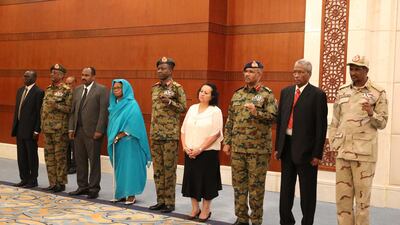
epa07784051 Members of Sudan's newly formed transitional Council (R-L) General Mohamed Hamdan Dagalo, Hassan Sheikh Idris, Genereal Ibrahim Jaber, Raja Nicola Issa Abdul-Masseh, General Shams al-Din Kabashi, Aisha Moussa, Mohamed Alfaki, General Yasser al-Atta and Sadeek Tawer look on during their sweaing-in ceremony at the presidential palace in Khartoum, Sudan, 21 August 2019. The Sudanese opposition and military council signed on 17 August a power sharing agreement. The agreement sets up a sovereign council made of five generals and six civilians, to rule the country until general elections. Protests had erupted in Sudan at the end of 2018, culminating in a long sit-in outside the army headquarters which ended with more than one hundred people being killed and others injured. Sudanese President Omar Hassan al-Bashir stepped down on 11 April 2019. EPA/MORWAN ALI -

Demonstrators march with banners and the old (L) and current (R) flags of Sudan outside a courthouse complex in the capital's twin city of Omdurman on August 21, 2019 during the trial of 40 members of Sudan's now-dissolved National Intelligence and Security Service facing charges over the death in custody of Ahmed al-Kheir, a teacher from the eastern town of Khashma el-Girba, in the early days of the wave of nationwide protests that eventually brought longtime ruler Omar al-Bashir. / AFP / Ahmed Mustafa -
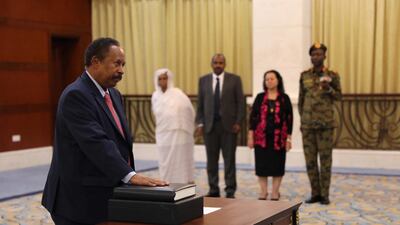
epa07784904 Sudan's new Prime Minister Abdalla Hamdok (L) swears in during a ceremony at the presidential palace in Khartoum, Sudan, 21 August 2019. The Sudanese opposition and military council signed on 17 August a power sharing agreement. The agreement sets up a sovereign council made of five generals and six civilians, to rule the country until general elections. Protests had erupted in Sudan in December 2018, culminating in a long sit-in outside the army headquarters which ended with more than one hundred people being killed and others injured. Sudanese President Omar Hassan al-Bashir stepped down on 11 April 2019. EPA/MARWAN ALI -
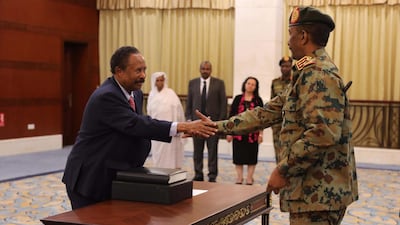
epa07784903 Sudan's new Prime Minister Abdalla Hamdok (L) shakes hands with Abdel Fattah Abdelrahman Burhan (R) after being sworn in during a ceremony at the presidential palace in Khartoum, Sudan, 21 August 2019. The Sudanese opposition and military council signed on 17 August a power sharing agreement. The agreement sets up a sovereign council made of five generals and six civilians, to rule the country until general elections. Protests had erupted in Sudan in December 2018, culminating in a long sit-in outside the army headquarters which ended with more than one hundred people being killed and others injured. Sudanese President Omar Hassan al-Bashir stepped down on 11 April 2019. EPA/MARWAN ALI -
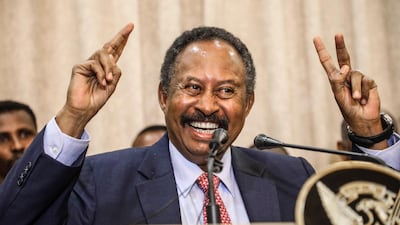
Sudan's new Prime Minister Abdalla Hamdok speaks duringa press conference in Khartoum, Sudan, Wednesday, Aug. 21, 2019. (AP Photo)


The US and Sudan are working together to remove sanctions and unfreeze assets as Sudan agreed to compensate victims of Al Qaeda attacks in Africa carried out with the support of Al Bashir.
'Handing Al Bashir to the ICC is divisive'
Ms Al Mahdi said the issue of handing Al Bashir to the International Criminal Court had become extremely divisive in the joint civilian-military Transitional Partners Council that brings together military and civilian representatives including the prime minister and head of the army.
Speaking to the international press for the first time since last week’s failed coup blamed on Al Bashir loyalists within the military’s ranks, Ms Al Mahdi described it as a bid to “dampen the beacon of real democracy flashing in Sudan”.
She said the incident showed the Sudanese people that there are divisions in the army because of remnants of the old regime. But she said she believes that Sudan, which has witnessed repeated military takeovers since its independence in 1956, has become coup-proof.
“The citizens on the street will never allow any coup against their revolution,” she said.
Al Bashir has been convicted of corruption and faces a number of other charges in Sudan but is also wanted for genocide, war crimes and crimes against humanity by the ICC for the conflict in Darfur that left more than 300,000 dead and 2.5 million displaced.
-
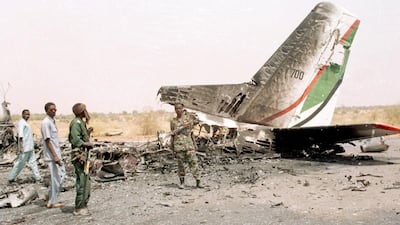
Sudanese soldiers look at a plane destroyed by the rebels on the North Darfur state capital of Al-Fasher 29 April 2003. Thousands of villagers have reportedly fled their villages since April 11 after fighting between government forces and the Sudan Liberation Army (SLA). Khartoum has refused to acknowledge any political motivation for unrest in the Darfur states, blaming it instead on "armed criminal gangs and outlaws," who it says are aided by tribes from neighboring Chad. AFP PHOTO/Salah OMAR (Photo by SALAH OMAR / AFP) -

Members of the southern-based rebel Sudan People's Liberation Army (SPLA) sit in the forest in Sudan's western region of Darfur in April 2004. Fighting in the area that has erupted in February 2003 between the Sudanese government and Darfur rebels has claimed at least 10,000 lives and raised the spectre of a devastating humanitarian crisis that could see up to one million die, the UN and international officials have said. The pro-Sudanese government "Janjaweed" militia have been accused of ethnic cleansing against the black population of the Darfur region. AFP -
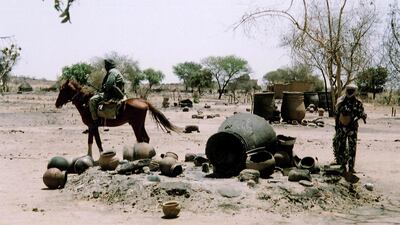
The village of Khair Wajid is seen after being burnt by the pro-Sudanese government "Janjaweed" militias in the western Darfur region of Sudan in in April 2004. The Arab "Janjaweed" militia have been accused of ethnic cleansing against the black population of the Darfur region. AFP -

Malnourished children are fed at the Medecins Sans Frontiers (MSF) nutrition centre on June 21, 2004 in the Mornay camp, in western Darfur, Sudan. More than 80,000 displaced people reached this town to try to escape ethnic violence in the Darfur region. After surviving massacres carried out by pro-government militias on their villages, these refugees are now virtual prisoners in the camp as the same militias now control the camp's periphery conducting violent attacks and rapes on villagers who go out looking for food and essential items according to MSF. AFP -

Relatives mourn over the body of one-year-old Ali, who died of malnutrition in a refugee camp in El-Geneina in the Darfour, Sudan on June 21, 2004. AFP -

A rebel of the Movement for Justice and Equality (MJE), fighting Sudanese troops, mans a post on July 28, 2004 in the northern part of the western Sudanese Darfur region. Sudan is prepared to deploy up to 12,000 policemen to secure the war-torn western region of Darfur, should that become necessary, Information Minister Zahawi Ibrahim Malik told AFP on August 3, 2004. AFP -

A Sudanese woman walks in the Internally Displaced Persons camp of Krindig on the outskirts of the town of El-Geneina on September 13, 2004. More than 500,000 Internally Displaced Persons of an estimated one million in Sudan live in encampments in western Darfur. An estimated 50,000 people have been killed and 1.4 million more uprooted in a campaign against Darfur's black African population, which began in February 2003. AFP -
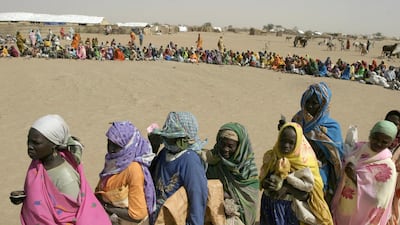
Internally-displaced Sudanese wait to receive food supplies from from the World Food Programme in Kalma Camp, near Nyala town in Sudan's southern Darfur region on January 10, 2005. AFP -
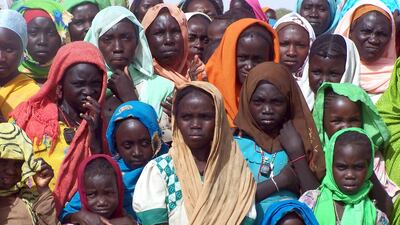
Freshly displaced Darfuris await the arrival of the UN relief coordinator Jan Egeland in the rebel held town of Gereida in southern Darfur on May 7, 2006. AFP -

Rwandan soldiers from the African Union Mission in Sudan (Amis) patrol between Al-Fasher, the capital of Northern Darfur, and Kuma, a town to the north-east on May 18, 2006. Amis is deployed since 2004 in Darfur to bring back peace to this war-torn region. A peace deal was signed on May 5 between one of the three rebel groups and the government of Khartoum. AFP -
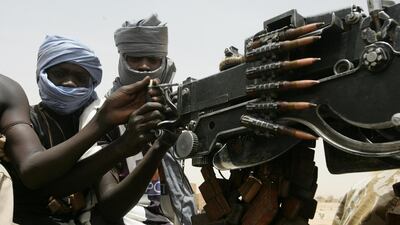
Rebels from the Sudan Liberation Movement (SLM) in Tina, a small village next to Tawila, a town located 70 kms west of al-Fasher, capital of Northern Darfur are pictured on May 20, 2006. This branch of the SLM loyal to Abdulwaheed Mohamed Nur didn't sign the peace deal with Karthoum. They demand more rights, but have been threatened by the UN security council of sanctions if they don't agree to the peace before May 31. AFP -
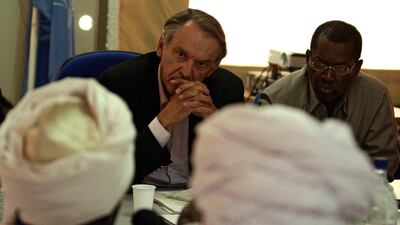
UN Special Envoy for Darfur, Jan Eliasson, left; and Ambassador Boubou Niang of Amis Darfur Peace Agreement Implementation Team (DPAIT) listen to local leaders of an Arab tribe during a meeting at the United Nations Mission in the Sudan (UNIMIS) headquarters in el-Fasher, the capital of North Darfur, August 10, 2007. The deployment of the UN-African Union peacekeeping force to the western Sudanese region of Darfur will be an unprecedented challenge, the UN official in charge of the mission said today. AFP -

AMIS soldiers carry an injured colleague to a helicopter at Haskanita military group site on September 30, 2007 following an attack by a large, organised group of heavily armed men who overran southern Darfur's Haskanita camp. AFP -
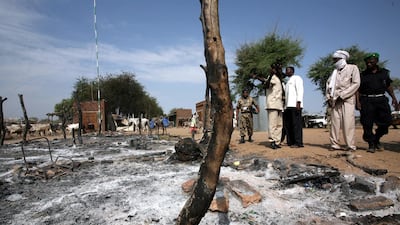
An Amis military observer , left, and Sudan Liberation Army (SLA) members survey the burnt-out marketplace in Muhajariya town in southern Darfur, on October 10, 2007, following violent clashes. The town, which is a stronghold of the SLA Minni Minnawi faction, the only rebel group to sign the May 2006 Darfur Peace Agreement, experienced heavy fighting October 9 in what the SLA said was a Sudanese government-backed attack in which more than 50 people died. The clashes left many homes burnt to the ground and shops destroyed and looted. AFP -
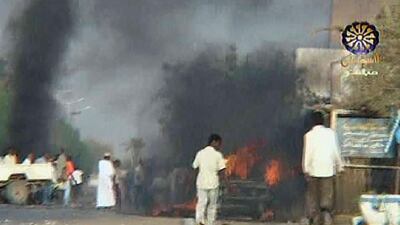
Black smoke billows from burning cars as Sudanese people walk along the streets in Khartoum's twin city Omdurman, following fighting between Darfurian rebels and Sudanese government forces, on May 11, 2008. Sudan today severed diplomatic ties with Chad, accusing Ndjamena of backing a first Darfur rebel assault on Khartoum, and slapped a multi-million dollar price on the head of the alleged mastermind. AFP -
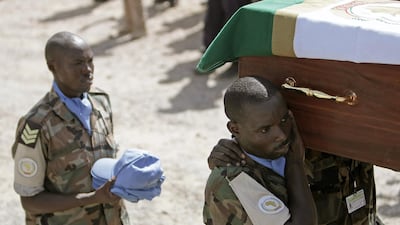
Soldiers and civilian staff serving with the United Nations-African Union Mission in Darfur (UNAMID) pay their respects during a funeral ceremony for seven peacekeepers who were killed in an ambush by armed gunmen while returning from patrol in the Northern Darfur State on July 8, 2008. AFP -
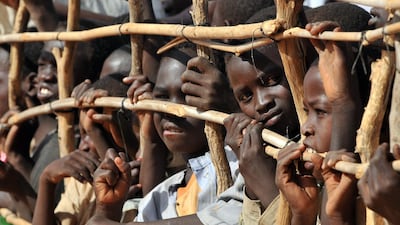
Sudanese refugee children press up against a fence in Djabal refugee camp near Goz Beida southern Chad on March 15, 2009. United Nations forces took over command from European Union peacekeepers to protect refugees and displaced people in Chad and the Central African Republic. AFP -
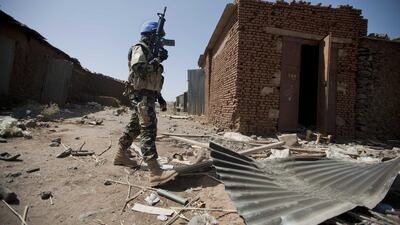
UNAMID shows a peacekeeper from the Nepalese Special Forces patrols in Jawa village, in East Jebel Marra (South Darfur) on March 18, 2011 as most of the population fled some days ago due to the clashes. AFP -
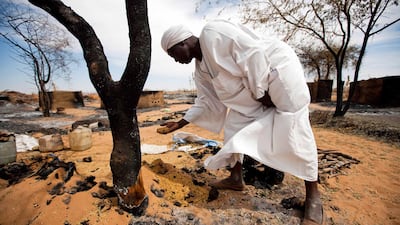
Attahi Mohammed Sigit, the sheikh of Sigili village in North Darfur, shows to UNAMID peacekeepers the damages in the village on November 6, 2012, days after an attack by a local militia during which his 18-year-old son was killed. Militia in Sudan's North Darfur state attacked the village and killed 13 people, a local source told AFP on November 3, adding to an upsurge of deadly violence in the area. AFP -
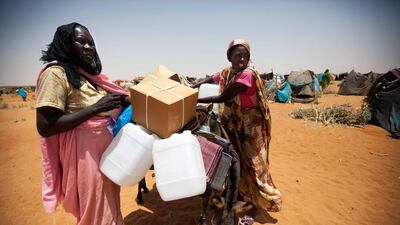
A Sudanese woman carries humanitarian supplies distributed by UN agencies at the new settlement in the Zam Zam camp for Internally Displaced Persons (IDP), in North Darfur in May 2013. Most of the new IDPs arrived recently from Labado and Muhajeria, East Darfur, as a result of clashes between the Sudan Liberation Army - Mini Minawi and the Government of Sudan. AFP -
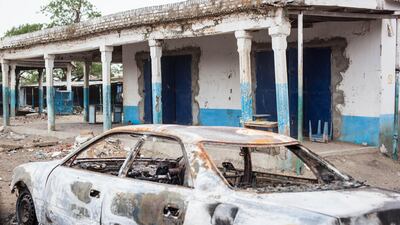
A destroyed car is seen in Malakal, South Sudan, on March 4, 2014. AFP -

Members of UNAMID patrol the area near the city of Nyala in Sudan's Darfur on January 12, 2015. AFP -

A Sudanese boy rides a donkey past a UNAMID armoured vehicle in the war-torn town of Golo in the thickly forested mountainous area of Jebel Marra in central Darfur on June 19, 2017. The town was a former rebel bastion which was recently captured by Sudanese government forces. AFP -

A picture shows the aftermath of violence in the Sudanese village of al-Twail Saadoun, 85 kilometres south of Nyala town, the capital of South Darfur, on February 2, 2021. AFP -
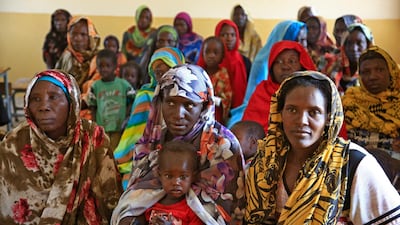
Residents return to the South Darfur village of Hamada, north of the region's capital town Nyala, on February 3, 2021, as Darfuris who have long been displaced are returning to their villages after the October peace deal between Sudan's transitional government and rebel groups. AFP


Ms Al Mahdi said there simply was not any consensus in Sudan about “how to implement the process of handing Al Bashir to the ICC”.
There has been discussion about sending Al Bashir to The Hague to stand trial, forming a hybrid Sudanese-ICC court in Khartoum, or having him stand trial in a Sudanese court with ICC oversight.
“The Transitional Partners Council needs to be clear about this issue and reach consensus, not just on Al Bashir but on a variety of other issues. We as civilian politicians stated clearly our position — namely, our pledge to help hand Al Bashir and other suspects like former minister [of humanitarian affairs] Ahmed Haroun to the ICC,” she said.
“We have a commitment not just to hand Al Bashir over but to do justice to the victims of Al Bashir in Darfur. And we want the ICC to look into the wider time scale of the crimes committed by the regime of Al Bashir and not only to limit the trial to the period from 2002-2004. But unfortunately, there’s no conformity among the members of the Transitional Partners Council on how to put into effect several decisions including handing Al Bashir to the ICC.”
Despite the international arrest warrant and crippling international sanctions, Al Bashir won consecutive elections in 2010 and 2015, which were not seen as free and fair by the international community and which were boycotted by the main opposition parties, including Ms Al Mahdi’s National Umma Party.
Ms Al Mahdi’s father, Sadiq Al Mahdi, was Sudan’s last freely-elected democratic leader until he was ousted by Al Bashir in a coup in 1989, after which he became a leading critic of the regime until his death from Covid-19 last year at 84.

Ms Al Mahdi said US-Sudanese relations had greatly improved since the removal of Al Bashir. She discussed the current administration in a positive light, nine months into Joe Biden’s presidency.
“The Biden administration has been dealing wisely with many issues, to mention but a few - its courageous decision to withdraw from Afghanistan despite the consequences as a superpower and re-join the Paris climate agreement [in February]," Ms Al Mahdi said.
“On Sudan, I do believe the US officials when they say they are fully supporting our transition towards democracy. This is not a mere wish but an objective talk as Sudan’s stability is pivotal for East Africa and the entire region.”

