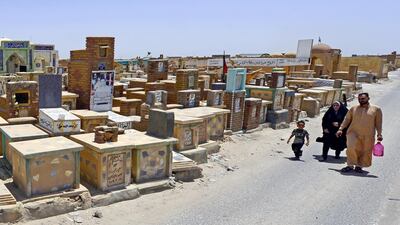
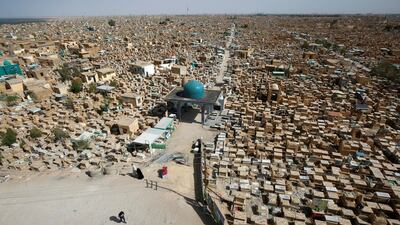
People visit the 'Valley of Peace' cemetery during Eid al Fitr as they mark the end of the fasting month of Ramadan, in Najaf, Iraq. Reuters

How trading in burial plots became a lucrative business in Middle East


  • English
  • Arabic

In war-torn nations of the Middle East, there is no RIP even in death.

An acute shortage of plots over the past two decades has led to surging prices in cemeteries. The coronavirus pandemic has compounded the crisis.

About a million people have been killed in Iraq, Syria, Yemen, Pakistan and Afghanistan and other post-9/11 war zones, the Costs of War Project at Brown University estimated this year. US air strikes alone have killed more than 22,000 civilians across the Middle East and Africa since the attacks, UK watchdog Airwars said in its latest report.

No surprise then that from Syria to Yemen and Iraq, demand for graves has pushed prices up as much as a thousand-fold. Such is the trading frenzy that authorities have permitted caskets to be buried on top of each other as private cemeteries have run out of space in the Syrian capital of Damascus.

Islam, the dominant religion of the region, stipulates the dead should be laid to rest in individual plots. With the affluent preferring a place for the departed within the cities, rather than at public graveyards on the outskirts, investing in cemeteries has become a lucrative business.

“The market right now is in favour of sellers like me,” Khaled, who has space to offer in the much sought-after Sheikh Raslan cemetery in old Damascus, told The National.

The 52-year-old teacher, who preferred not to disclose his real name, bought space for a family graveyard in 1982 while rates were only 20 Syrian pounds for a plot of one square metre. His three daughters moved to North America before the outbreak of the civil war in 2011 and his wife died five years ago.

After leaving room for himself by her side, he has about three square metres to sell.

It is illegal to sell such plots. Although the law states that only relatives can share burial grounds, bribes are usually paid to officials to tweak the letter of law.

The buyer and seller sign a preliminary contract of cession and a consent paper through a lawyer. These agreements then have to be registered, which can take up to 18 months.

In Damascus, a square metre of land starts today at 4 million Syrian pounds ($1,700) in cemeteries such as Al Mazah and Adhdah, increasing to 35 million Syrian pounds ($10,000) in the popular Sheikh Raslan.

It is here that Khaled has a plot with a depth of more than two metres, one that can fit a second casket on top of his.

“I've got multiple offers through a broker," said Khaled. "I will go with a family willing to pay cash, not in instalments.”

An agent, who is in league with an official at the Burial Register Office, said signing such a contract would cost 4 million Syrian pounds, of which the lawyer would take anything between 1 million and 3 million pounds.

Buying such plots is a luxury that few can afford in Syria.

“I want to be buried close to my family home in old Damascus," said a woman in her 40s, who preferred anonymity. "These cemeteries contain the remains of famous people who are descendants of our Prophet Mohammed and his companions. I feel good to think about it."

Location, location, location

It is a similar story in Iraq, where prices in the cemetery in the holy Shiite city of Najaf are on the rise.

The centuries-old burial ground is home to millions of graves of Shiites from Iraq and beyond, preferred due to its proximity to the shrine of Imam Ali, a cousin of Prophet Mohammed and his son-in-law.

The government took control of the burials in Wadi Al Salam, or the Valley of Peace, in the late 1980s. Earlier, families were free to choose where they could bury their loved ones.

The former dictator of Iraq, Saddam Hussein, gave away a plot of 1,000 square metres to each gravedigger, who charged only for the burial service. Those who wanted a special plot of 50 square meters could pay the municipality only 100 Iraqi dinars (7 US cents). That later rose to 100,000 dinars.

But soon after the US-led invasion in 2003 that toppled the Saddam regime, chaos engulfed the cemetery as people started grabbing plots illegally to sell them later to the families, gravedigger Fuad Al Amiya Al Kaabi, 25, told The National.

The price then surged to 10 million Iraqi dinars for a 50 square-metre plot.

  • The sprawling cemetery of Wadi Al Salam in the holy city of Najaf, where Ayatollah Mohammad Sadiq Al Sadr is burried.
    The sprawling cemetery of Wadi Al Salam in the holy city of Najaf, where Ayatollah Mohammad Sadiq Al Sadr is burried.
  • Graves at Wadi Al Salam in Najaf, May 25, 2020. AFP
    Graves at Wadi Al Salam in Najaf, May 25, 2020. AFP
  • A general view of the almost empty "Valley of Peace" cemetery after coronavirus lockdown measures to contain the coronavirus in the holy city of Najaf. REUTERS
    A general view of the almost empty "Valley of Peace" cemetery after coronavirus lockdown measures to contain the coronavirus in the holy city of Najaf. REUTERS
  • Former opposition leader Ayatollah Mohammad Baqir Al Hakim, assassinated in 2003, after the toppling of Saddam Hussein, and buried in Wadi Al Salam. Reuters
    Former opposition leader Ayatollah Mohammad Baqir Al Hakim, assassinated in 2003, after the toppling of Saddam Hussein, and buried in Wadi Al Salam. Reuters
  • Ayatollah Mohammed Baqer Al Sadr, executed by Saddam Hussein in 1980. Alamy
    Ayatollah Mohammed Baqer Al Sadr, executed by Saddam Hussein in 1980. Alamy
  • Mohammed Sadiq Al Sadr, killed by Saddam's agents in 1999. Mohammed Sadiq was the father of Moqtada Al Sadr, king maker in Iraqi politics. Alamy
    Mohammed Sadiq Al Sadr, killed by Saddam's agents in 1999. Mohammed Sadiq was the father of Moqtada Al Sadr, king maker in Iraqi politics. Alamy
  • A member of the Popular Mobilization Forces (PMF), who volunteered to work in a cemetery wears a protective suit as he burns clothes used for burial of Covid-19 patients near the new Wadi Al-Salam cemetery, which is dedicated to those who died of the coronavirus disease. REUTERS
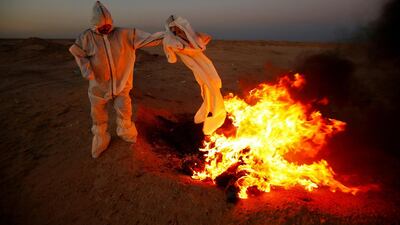
    A member of the Popular Mobilization Forces (PMF), who volunteered to work in a cemetery wears a protective suit as he burns clothes used for burial of Covid-19 patients near the new Wadi Al-Salam cemetery, which is dedicated to those who died of the coronavirus disease. REUTERS
  • A man mourns at the grave of Iraqi paramilitary commander Abu Mahdi Al Muhandis at the Wadi Al Salam cemetery in the Iraq. AFP
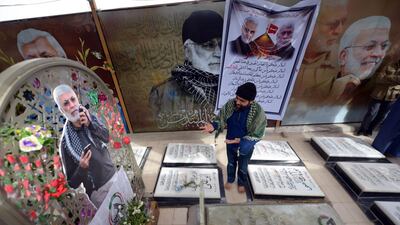
    A man mourns at the grave of Iraqi paramilitary commander Abu Mahdi Al Muhandis at the Wadi Al Salam cemetery in the Iraq. AFP
  • Shiite pilgrims walk outside the shrine of Imam Ali in Najaf, Iraq. AP
    Shiite pilgrims walk outside the shrine of Imam Ali in Najaf, Iraq. AP
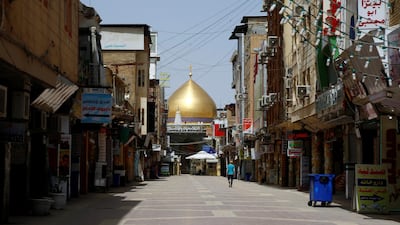
  • Najaf, after the outbreak of the coronavirus pandemic, on March 31, 2020. Reuters
    Najaf, after the outbreak of the coronavirus pandemic, on March 31, 2020. Reuters
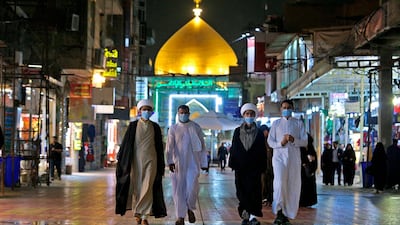
  • A Shiite Muslim man wears a protective face mask as he walks next to religious books during the holy month of Ramadan in Najaf. Reuters
    A Shiite Muslim man wears a protective face mask as he walks next to religious books during the holy month of Ramadan in Najaf. Reuters
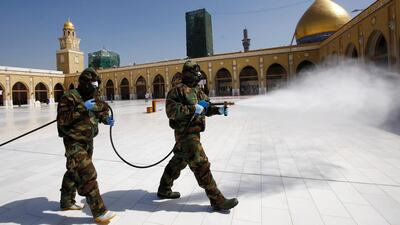
  • Members of the civil defence spray disinfectant to sanitise surrounding of the Kufa mosque in Najaf. Reuters
    Members of the civil defence spray disinfectant to sanitise surrounding of the Kufa mosque in Najaf. Reuters
  • Iraqi medical workers disinfect a ward at the Hakim Hospital in Najaf. AFP
    Iraqi medical workers disinfect a ward at the Hakim Hospital in Najaf. AFP
  • A member of the Iraqi civil defence sprays disinfectant on and around a building where Islamic students are quarantined for having had contact with Iraq's first confirmed case of novel coronavirus infection in the central Najaf on February 26, 2020. AFP
    A member of the Iraqi civil defence sprays disinfectant on and around a building where Islamic students are quarantined for having had contact with Iraq's first confirmed case of novel coronavirus infection in the central Najaf on February 26, 2020. AFP
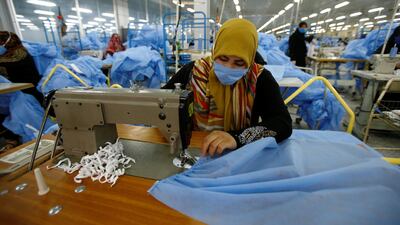
  • A woman sews a protective suit at a factory in Najaf, Iraq. Less than 15 per cent of women are part of the Iraqi workforce. Reuters
    A woman sews a protective suit at a factory in Najaf, Iraq. Less than 15 per cent of women are part of the Iraqi workforce. Reuters
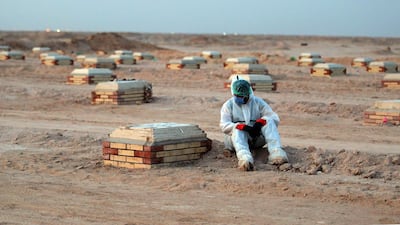
  • An Iraqi man in a hazmat suit mourns over a tombstone at a cemetery for COVID-19 victims, 20 km from the central Iraqi holy city of Najaf. AFP
    An Iraqi man in a hazmat suit mourns over a tombstone at a cemetery for COVID-19 victims, 20 km from the central Iraqi holy city of Najaf. AFP
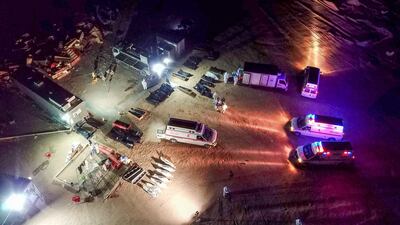
  • An aerial picture taken with a drone shows graves of victims who died with coronavirus at a cemetery in the holy city of Najaf, southern Iraq. EPA
    An aerial picture taken with a drone shows graves of victims who died with coronavirus at a cemetery in the holy city of Najaf, southern Iraq. EPA
  • An aerial picture taken with a drone shows members of Iraqi Shiite group Imam Ali Brigades, which belongs to Shiite Popular Mobilization Forces, preparing to bury victims who died with coronavirus, at a cemetery in the holy city of Najaf, southern Iraq. EPA
    An aerial picture taken with a drone shows members of Iraqi Shiite group Imam Ali Brigades, which belongs to Shiite Popular Mobilization Forces, preparing to bury victims who died with coronavirus, at a cemetery in the holy city of Najaf, southern Iraq. EPA

To meet demand and expand the cemetery, the Najaf administration in recent years started to sell plots to investment companies, which, in turn, sell them to gravediggers and families.

Now, prices range from 2.75 million to 40 million dinars. ($2000-$27,000).

“The location is what determines the price," said Mr Al Kaabi, whose family has been in the burial business for decades. "If it's located on a main road inside the cemetery or near the gates that will push its price.”

The cemetery expanded significantly in the 1980s during the Iraq-Iran war, followed by the 1991 Gulf War. The sectarian warfare of 2003, the 2014 war against ISIS and the pandemic also contributed to its spread.

“Demand for plots is still on the rise so are the prices," Mr Al Kaabi said. "We are still burying an average of 200 bodies a day, thanks to the coronavirus."

Public cemeteries across the Arab world are not for profit. And establishing a new cemetery within a city isn't an option as there is simply no space.

In the Yemeni city of Aden, all plots belong to the Ministry of Religious Endowments. This means they cannot be sold and are given for free.

But some cemetery guards and undertakers sell plots illegally in deserted graveyards. According to activists, they stack caskets and even remove the remains of the dead, charging anything between 50,000 and 100,000 Yemeni riyals ($200-400) per plot.

"Undertakers control the cemeteries behind the ministry's back," said Khaled Al Kamal, a lawyer in the capital of Sanaa. "They handle the prices for the plots and services as the ground is filled to the brim."

Their success has lured the unemployed to make money out of digging graves in a country where six years of conflict has killed more than 18,000 civilians. The phone numbers of many of them are displayed on the walls of Abu Harba, the biggest cemetery in Aden.

"I have been managing this cemetery for more than 20 years," Yaser Abu Ali, 42, told The National. "I have a team of six. We take shifts."

The business boomed in the last couple of years because of the pandemic and the war, he said.

Why does a queen bee feast only on royal jelly?

Some facts about bees:

The queen bee eats only royal jelly, an extraordinary food created by worker bees so she lives much longer

The life cycle of a worker bee is from 40-60 days

A queen bee lives for 3-5 years

This allows her to lay millions of eggs and allows the continuity of the bee colony

About 20,000 honey bees and one queen populate each hive

Honey is packed with vital vitamins, minerals, enzymes, water and anti-oxidants.

Apart from honey, five other products are royal jelly, the special food bees feed their queen 

Pollen is their protein source, a super food that is nutritious, rich in amino acids

Beewax is used to construct the combs. Due to its anti-fungal, anti-bacterial elements, it is used in skin treatments

Propolis, a resin-like material produced by bees is used to make hives. It has natural antibiotic qualities so works to sterilize hive,  protects from disease, keeps their home free from germs. Also used to treat sores, infection, warts

Bee venom is used by bees to protect themselves. Has anti-inflammatory properties, sometimes used to relieve conditions such as rheumatoid arthritis, nerve and muscle pain

Honey, royal jelly, pollen have health enhancing qualities

The other three products are used for therapeutic purposes

Is beekeeping dangerous?

As long as you deal with bees gently, you will be safe, says Mohammed Al Najeh, who has worked with bees since he was a boy.

“The biggest mistake people make is they panic when they see a bee. They are small but smart creatures. If you move your hand quickly to hit the bees, this is an aggressive action and bees will defend themselves. They can sense the adrenalin in our body. But if we are calm, they are move away.”


The specs
Engine: 2.0-litre turbo 4-cyl

Transmission: eight-speed auto

Power: 190bhp

Torque: 300Nm

Price: Dh169,900

On sale: now 

WHY%20AAYAN%20IS%20'PERFECT%20EXAMPLE'
%3Cp%3EDavid%20White%20might%20be%20new%20to%20the%20country%2C%20but%20he%20has%20clearly%20already%20built%20up%20an%20affinity%20with%20the%20place.%3Cbr%3E%3Cbr%3EAfter%20the%20UAE%20shocked%20Pakistan%20in%20the%20semi-final%20of%20the%20Under%2019%20Asia%20Cup%20last%20month%2C%20White%20was%20hugged%20on%20the%20field%20by%20Aayan%20Khan%2C%20the%20team%E2%80%99s%20captain.%3Cbr%3E%3Cbr%3EWhite%20suggests%20that%20was%20more%20a%20sign%20of%20Aayan%E2%80%99s%20amiability%20than%20anything%20else.%20But%20he%20believes%20the%20young%20all-rounder%2C%20who%20was%20part%20of%20the%20winning%20Gulf%20Giants%20team%20last%20year%2C%20is%20just%20the%20sort%20of%20player%20the%20country%20should%20be%20seeking%20to%20produce%20via%20the%20ILT20.%3Cbr%3E%3Cbr%3E%E2%80%9CHe%20is%20a%20delightful%20young%20man%2C%E2%80%9D%20White%20said.%20%E2%80%9CHe%20played%20in%20the%20competition%20last%20year%20at%2017%2C%20and%20look%20at%20his%20development%20from%20there%20till%20now%2C%20and%20where%20he%20is%20representing%20the%20UAE.%3Cbr%3E%3Cbr%3E%E2%80%9CHe%20was%20influential%20in%20the%20U19%20team%20which%20beat%20Pakistan.%20He%20is%20the%20perfect%20example%20of%20what%20we%20are%20all%20trying%20to%20achieve%20here.%3Cbr%3E%3Cbr%3E%E2%80%9CIt%20is%20about%20the%20development%20of%20players%20who%20are%20going%20to%20represent%20the%20UAE%20and%20go%20on%20to%20help%20make%20UAE%20a%20force%20in%20world%20cricket.%E2%80%9D%C2%A0%3C%2Fp%3E%0A
Our family matters legal consultant

Name: Hassan Mohsen Elhais

Position: legal consultant with Al Rowaad Advocates and Legal Consultants.

How to apply for a drone permit
  • Individuals must register on UAE Drone app or website using their UAE Pass
  • Add all their personal details, including name, nationality, passport number, Emiratis ID, email and phone number
  • Upload the training certificate from a centre accredited by the GCAA
  • Submit their request
What are the regulations?
  • Fly it within visual line of sight
  • Never over populated areas
  • Ensure maximum flying height of 400 feet (122 metres) above ground level is not crossed
  • Users must avoid flying over restricted areas listed on the UAE Drone app
  • Only fly the drone during the day, and never at night
  • Should have a live feed of the drone flight
  • Drones must weigh 5 kg or less
The specs: 2018 Infiniti QX80

Price: base / as tested: Dh335,000

Engine: 5.6-litre V8

Gearbox: Seven-speed automatic

Power: 400hp @ 5,800rpm

Torque: 560Nm @ 4,000rpm

Fuel economy, combined: 12.1L / 100km

How will Gen Alpha invest?

Mark Chahwan, co-founder and chief executive of robo-advisory firm Sarwa, forecasts that Generation Alpha (born between 2010 and 2024) will start investing in their teenage years and therefore benefit from compound interest.

“Technology and education should be the main drivers to make this happen, whether it’s investing in a few clicks or their schools/parents stepping up their personal finance education skills,” he adds.

Mr Chahwan says younger generations have a higher capacity to take on risk, but for some their appetite can be more cautious because they are investing for the first time. “Schools still do not teach personal finance and stock market investing, so a lot of the learning journey can feel daunting and intimidating,” he says.

He advises millennials to not always start with an aggressive portfolio even if they can afford to take risks. “We always advise to work your way up to your risk capacity, that way you experience volatility and get used to it. Given the higher risk capacity for the younger generations, stocks are a favourite,” says Mr Chahwan.

Highlighting the role technology has played in encouraging millennials and Gen Z to invest, he says: “They were often excluded, but with lower account minimums ... a customer with $1,000 [Dh3,672] in their account has their money working for them just as hard as the portfolio of a high get-worth individual.”

UAE%20SQUAD
%3Cp%3E%0DJemma%20Eley%2C%20Maria%20Michailidou%2C%20Molly%20Fuller%2C%20Chloe%20Andrews%20(of%20Dubai%20College)%2C%20Eliza%20Petricola%2C%20Holly%20Guerin%2C%20Yasmin%20Craig%2C%20Caitlin%20Gowdy%20(Dubai%20English%20Speaking%20College)%2C%20Claire%20Janssen%2C%20Cristiana%20Morall%20(Jumeirah%20English%20Speaking%20School)%2C%20Tessa%20Mies%20(Jebel%20Ali%20School)%2C%20Mila%20Morgan%20(Cranleigh%20Abu%20Dhabi).%3C%2Fp%3E%0A
Updated: November 01, 2021, 12:57 PM