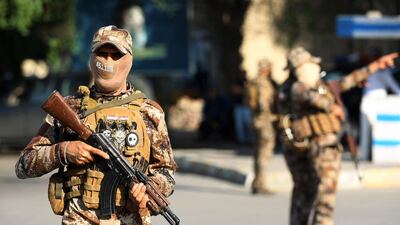
Members of Iraq's Hashed Al Shaabi, or Popular Mobilisation Forces (PMF). AFP

Which Iran-backed militias did the US bomb in Iraq and Syria?


Robert Tollast
  • English
  • Arabic

In the early hours of Monday morning, US airstrikes targeted Iran-backed militia groups at Albu Kamal in Syria and Al Qaim, a small town just across the border in Iraq.

The airstrikes, Pentagon spokesman John Kirby said, were “defensive” and targeted drone storage sites, blowing up explosive “unmanned aerial vehicles”.

Mr Kirby also named the militia groups singled out for attack: Kataib Hezbollah and Kataib Sayyid Al Shuhada, both factions in a militia umbrella organisation linked to the Iraqi state, the Popular Mobilisation Forces, or PMF.

The groups suffered four killed, according to a statement issued by the PMF on Monday.

Both of the militias were given Iraqi state backing in 2014 following an executive order by then PM Nouri Al Maliki, but they had both existed before then, with Kataib Hezbollah fighting US forces in Iraq between 2007 and 2011.

Kataib Sayyid Al Shuhada is thought by some analysts to have been formed to fight in Syria in 2013, alongside Iranian advisors.

The militias become official

In 2014, Iraq’s army was crumbling in the face of a ferocious ISIS advance and, following PM Maliki’s executive order, the revered Shiite cleric Grand Ayatollah Ali Al Sistani issued a fatwa calling on all young Iraqis to join the security forces.

That was a blessing for Iran-backed militias, who used Al Sistani’s fatwa to boost their ranks. Other militia groups were also formed who did not answer to Iran, and are now directly linked to the Iraqi state, such as the Abbas Combat Division.

But the Iran backed groups soon took over the PMF.

Many of those groups support Iran’s system of religious rule, or Guardianship of the Jurists. Sistani, on the other hand, wants Iran to remain a democracy.

These differences have become a major challenge for the Iraqi government, which also wants to remain allied to the US, and has a regular army alongside the PMF.

Many of the PMF groups also stand accused of using murder and intimidation to suppress Iraqis opposed to Iran’s agenda in Iraq, and the Iraqi government has struggled to hold the killers accountable.

Before receiving official Iraqi support through the PMF, Kataib Hezbollah were part of a Shiite insurgency against US and other coalition forces after the 2003 Iraq invasion.

The militia, according to specialist Hamdi Malik at the Washington Institute for Near East Policy, was selected by Iran as the vanguard of anti-US operations.

Specialised Iranian support made them increasingly lethal. In 2011 for example, the group killed 15 US soldiers in the space of a month, even as US forces were in the process of leaving Iraq.

Designated a terrorist organisation by the US in 2009, the group and their leader Abu Mahdi Al Muhandis soon garnered a vicious reputation. Al Muhandis was killed in a US airstrike in 2020, along with Iranian General Qassem Suleimani.

Since then, the group, along with other PMF groups such as Kataib Sayyid Al Shuhada have escalated attacks on US forces, expanding their strategy to using highly targeted drone strikes with equipment supplied by Iran.

Washington seems to have acted to send a warning signal for the groups to stop drone operations.

But heavy US airstrikes against these PMF groups have not deterred them in the past. Only time will tell if Iran and the US can break their current cycle of escalation and counter strike in Iraq.


RESULTS

5pm: Maiden (PA) Dh80,000 1,600m
Winner: Omania, Saif Al Balushi (jockey), Ibrahim Al Hadhrami (trainer)
5.30pm: Conditions (PA) Dh85,000 1,600m
Winner: Brehaan, Richard Mullen, Ana Mendez
6pm: Handicap (TB) Dh100,000 1,600m
Winner: Craving, Connor Beasley, Simon Crisford
6.30pm: The President’s Cup Prep (PA) Dh100,000 2,200m
Winner: Rmmas, Tadhg O’Shea, Jean de Roualle
7pm: Wathba Stallions Cup (PA) Dh70,000 1,200m
Winner: Dahess D’Arabie, Connor Beasley, Helal Al Alawi
7.30pm: Handicap (PA) Dh80,000 1,400m
Winner: Fertile De Croate, Sam Hitchcott, Ibrahim Aseel

Race card

4pm Al Bastakiya Listed US$300,000 (Dirt) 1,900m

4.35pm Mahab Al Shimaal Group 3 $350,000 (D) 1,200m

5.10pm Nad Al Sheba Turf Group 3 $350,000 (Turf) 1,200m

5.45pm Burj Nahaar Group 3 $350,000 (D) 1,600m

6.20pm Jebel Hatta Group 1 $400,000 (T) 1,800m

6.55pm Al Maktoum Challenge Round-3 Group 1 $600,000 (D) 2,000m

7.30pm Dubai City Of Gold Group 2 $350,000 (T) 2,410m

The National selections:

4pm Zabardast

4.35pm Ibn Malik

5.10pm Space Blues

5.45pm Kimbear

6.20pm Barney Roy

6.55pm Matterhorn

7.30pm Defoe

Results

5.30pm: Maiden (TB) Dh82,500 (Turf) 1,400m; Winner: Mcmanaman, Sam Hitchcock (jockey), Doug Watson (trainer)

6.05pm: Handicap (TB) Dh87,500 (T) 1,400m; Winner: Bawaasil, Sam Hitchcott, Doug Watson

6.40pm: Handicap (TB) Dh105,000 (Dirt) 1,400m; Winner: Bochart, Fabrice Veron, Satish Seemar

7.15pm: Handicap (TB) Dh105,000 (T) 1,200m; Winner: Mutaraffa, Antonio Fresu, Musabah Al Muhairi

7.50pm: Longines Stakes – Conditions (TB) Dh120,00 (D) 1,900m; Winner: Rare Ninja, Royston Ffrench, Salem bin Ghadayer

8.25pm: Zabeel Trophy – Rated Conditions (TB) Dh120,000 (T) 1,600m; Winner: Alfareeq, Antonio Fresu, Musabah Al Muhairi

9pm: Handicap (TB) Dh105,000 (T) 2,410m; Winner: Good Tidings, Antonio Fresu, Musabah Al Muhairi

9.35pm: Handicap (TB) Dh92,500 (T) 2,000m; Winner: Zorion, Abdul Aziz Al Balushi, Helal Al Alawi


UAE players with central contracts

Rohan Mustafa, Ashfaq Ahmed, Chirag Suri, Rameez Shahzad, Shaiman Anwar, Adnan Mufti, Mohammed Usman, Ghulam Shabbir, Ahmed Raza, Qadeer Ahmed, Amir Hayat, Mohammed Naveed and Imran Haider.

Barbie
%3Cp%3E%3Cstrong%3EDirector%3A%3C%2Fstrong%3E%20Greta%20Gerwig%3Cbr%3E%3Cstrong%3EStars%3A%3C%2Fstrong%3E%20Margot%20Robbie%2C%20Ryan%20Gosling%2C%20Will%20Ferrell%2C%20America%20Ferrera%3Cbr%3E%3Cstrong%3ERating%3A%3C%2Fstrong%3E%204%2F5%3Cbr%3E%3C%2Fp%3E%0A
Real estate tokenisation project

Dubai launched the pilot phase of its real estate tokenisation project last month.

The initiative focuses on converting real estate assets into digital tokens recorded on blockchain technology and helps in streamlining the process of buying, selling and investing, the Dubai Land Department said.

Dubai’s real estate tokenisation market is projected to reach Dh60 billion ($16.33 billion) by 2033, representing 7 per cent of the emirate’s total property transactions, according to the DLD.

Mercer, the investment consulting arm of US services company Marsh & McLennan, expects its wealth division to at least double its assets under management (AUM) in the Middle East as wealth in the region continues to grow despite economic headwinds, a company official said.

Mercer Wealth, which globally has $160 billion in AUM, plans to boost its AUM in the region to $2-$3bn in the next 2-3 years from the present $1bn, said Yasir AbuShaban, a Dubai-based principal with Mercer Wealth.

Within the next two to three years, we are looking at reaching $2 to $3 billion as a conservative estimate and we do see an opportunity to do so,” said Mr AbuShaban.

Mercer does not directly make investments, but allocates clients’ money they have discretion to, to professional asset managers. They also provide advice to clients.

“We have buying power. We can negotiate on their (client’s) behalf with asset managers to provide them lower fees than they otherwise would have to get on their own,” he added.

Mercer Wealth’s clients include sovereign wealth funds, family offices, and insurance companies among others.

From its office in Dubai, Mercer also looks after Africa, India and Turkey, where they also see opportunity for growth.

Wealth creation in Middle East and Africa (MEA) grew 8.5 per cent to $8.1 trillion last year from $7.5tn in 2015, higher than last year’s global average of 6 per cent and the second-highest growth in a region after Asia-Pacific which grew 9.9 per cent, according to consultancy Boston Consulting Group (BCG). In the region, where wealth grew just 1.9 per cent in 2015 compared with 2014, a pickup in oil prices has helped in wealth generation.

BCG is forecasting MEA wealth will rise to $12tn by 2021, growing at an annual average of 8 per cent.

Drivers of wealth generation in the region will be split evenly between new wealth creation and growth of performance of existing assets, according to BCG.

Another general trend in the region is clients’ looking for a comprehensive approach to investing, according to Mr AbuShaban.

“Institutional investors or some of the families are seeing a slowdown in the available capital they have to invest and in that sense they are looking at optimizing the way they manage their portfolios and making sure they are not investing haphazardly and different parts of their investment are working together,” said Mr AbuShaban.

Some clients also have a higher appetite for risk, given the low interest-rate environment that does not provide enough yield for some institutional investors. These clients are keen to invest in illiquid assets, such as private equity and infrastructure.

“What we have seen is a desire for higher returns in what has been a low-return environment specifically in various fixed income or bonds,” he said.

“In this environment, we have seen a de facto increase in the risk that clients are taking in things like illiquid investments, private equity investments, infrastructure and private debt, those kind of investments were higher illiquidity results in incrementally higher returns.”

The Abu Dhabi Investment Authority, one of the largest sovereign wealth funds, said in its 2016 report that has gradually increased its exposure in direct private equity and private credit transactions, mainly in Asian markets and especially in China and India. The authority’s private equity department focused on structured equities owing to “their defensive characteristics.”

Match info

Champions League quarter-final, first leg

Liverpool v Porto, Tuesday, 11pm (UAE)

Matches can be watched on BeIN Sports