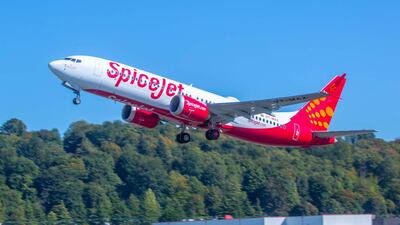
Spicejet began twice per week flights between New Delhi and Ras Al Khaimah on November 26. Courtesy: Boeing

Spice Jet launches affordable flights between Delhi and Ras Al Khaimah


Selina Denman
  • English
  • Arabic

Indian low-cost carrier Spice Jet will launch services to Ras Al Khaimah International Airport on Thursday, November 26.

The airline will initially operate twice-weekly flights from the northern emirate to Delhi’s Indira Gandhi International Airport, with plans to extend to additional destinations within India in the future. Return flights start from Dh730 and include free road transportation from Abu Dhabi, Dubai and Sharjah.

The commencement of Spice Jet passenger flights into RAK Airport is a significant step

“The commencement of Spice Jet passenger flights into RAK Airport is a significant step forward in helping the UAE get back to a normal footing in the wake of the Covid-19 pandemic,” says Sanjay Khanna, chief executive of Ras Al Khaimah International Airport.

“The Indian expatriate community in the UAE numbers almost 3.5 million people and constitutes 27 per cent of the population, making connectivity between our two countries an imperative. With the UAE and India being each other’s largest trading partners, RAK Airport has an essential role to play in the business and economy of the emirate, especially in view of Ras Al Khaimah’s efforts to diversify its economy from heavy industry to one that is knowledge-based and underpinned by human capital and tourism.”

Ras Al Khaimah is focusing on developing its tourism industry, with attractions such as ToroVerde Ras Al Khaimah, the world's longest zipline. Courtesy RAKTDA

Flight SG160 will be operated on a Boeing 737-800, which has a capacity of 189 passengers. It will depart from Indira Gandhi International Airport at 22.30 on Thursdays and Sundays, landing at Ras Al Khaimah International Airport at 00.50 on Fridayss and Monday. The return flight, SG 161, departs RAK Airport at 01.50 on Monday and Friday, landing in Delhi at 06.40.

The airline has already operated about 300 flights from Ras Al Khaimah, having partnered with the Indian government to offer repatriation flights in the early days of the pandemic. It has returned almost 53,000 Indian nationals to their home country from the beginning of June.

“Spice Jet has played a pivotal role in opening up the UAE to Indian travellers and reconnecting families. As we enter the post-coronavirus phase, we are looking forward to continuing to play a vital role in Ras Al Khaimah’s ongoing growth and development, especially its tourist sector, which is anticipated to experience a surge in visitors now that travel restrictions are slowly being eased,” says Ajay Singh, chairman and managing director of Spice Jet.


Tamkeen's offering
  • Option 1: 70% in year 1, 50% in year 2, 30% in year 3
  • Option 2: 50% across three years
  • Option 3: 30% across five years 
You might also like

Mercer, the investment consulting arm of US services company Marsh & McLennan, expects its wealth division to at least double its assets under management (AUM) in the Middle East as wealth in the region continues to grow despite economic headwinds, a company official said.

Mercer Wealth, which globally has $160 billion in AUM, plans to boost its AUM in the region to $2-$3bn in the next 2-3 years from the present $1bn, said Yasir AbuShaban, a Dubai-based principal with Mercer Wealth.

Within the next two to three years, we are looking at reaching $2 to $3 billion as a conservative estimate and we do see an opportunity to do so,” said Mr AbuShaban.

Mercer does not directly make investments, but allocates clients’ money they have discretion to, to professional asset managers. They also provide advice to clients.

“We have buying power. We can negotiate on their (client’s) behalf with asset managers to provide them lower fees than they otherwise would have to get on their own,” he added.

Mercer Wealth’s clients include sovereign wealth funds, family offices, and insurance companies among others.

From its office in Dubai, Mercer also looks after Africa, India and Turkey, where they also see opportunity for growth.

Wealth creation in Middle East and Africa (MEA) grew 8.5 per cent to $8.1 trillion last year from $7.5tn in 2015, higher than last year’s global average of 6 per cent and the second-highest growth in a region after Asia-Pacific which grew 9.9 per cent, according to consultancy Boston Consulting Group (BCG). In the region, where wealth grew just 1.9 per cent in 2015 compared with 2014, a pickup in oil prices has helped in wealth generation.

BCG is forecasting MEA wealth will rise to $12tn by 2021, growing at an annual average of 8 per cent.

Drivers of wealth generation in the region will be split evenly between new wealth creation and growth of performance of existing assets, according to BCG.

Another general trend in the region is clients’ looking for a comprehensive approach to investing, according to Mr AbuShaban.

“Institutional investors or some of the families are seeing a slowdown in the available capital they have to invest and in that sense they are looking at optimizing the way they manage their portfolios and making sure they are not investing haphazardly and different parts of their investment are working together,” said Mr AbuShaban.

Some clients also have a higher appetite for risk, given the low interest-rate environment that does not provide enough yield for some institutional investors. These clients are keen to invest in illiquid assets, such as private equity and infrastructure.

“What we have seen is a desire for higher returns in what has been a low-return environment specifically in various fixed income or bonds,” he said.

“In this environment, we have seen a de facto increase in the risk that clients are taking in things like illiquid investments, private equity investments, infrastructure and private debt, those kind of investments were higher illiquidity results in incrementally higher returns.”

The Abu Dhabi Investment Authority, one of the largest sovereign wealth funds, said in its 2016 report that has gradually increased its exposure in direct private equity and private credit transactions, mainly in Asian markets and especially in China and India. The authority’s private equity department focused on structured equities owing to “their defensive characteristics.”

Living in...

This article is part of a guide on where to live in the UAE. Our reporters will profile some of the country’s most desirable districts, provide an estimate of rental prices and introduce you to some of the residents who call each area home.

Milestones on the road to union

1970

October 26: Bahrain withdraws from a proposal to create a federation of nine with the seven Trucial States and Qatar. 

December: Ahmed Al Suwaidi visits New York to discuss potential UN membership.

1971

March 1:  Alex Douglas Hume, Conservative foreign secretary confirms that Britain will leave the Gulf and “strongly supports” the creation of a Union of Arab Emirates.

July 12: Historic meeting at which Sheikh Zayed and Sheikh Rashid make a binding agreement to create what will become the UAE.

July 18: It is announced that the UAE will be formed from six emirates, with a proposed constitution signed. RAK is not yet part of the agreement.

August 6:  The fifth anniversary of Sheikh Zayed becoming Ruler of Abu Dhabi, with official celebrations deferred until later in the year.

August 15: Bahrain becomes independent.

September 3: Qatar becomes independent.

November 23-25: Meeting with Sheikh Zayed and Sheikh Rashid and senior British officials to fix December 2 as date of creation of the UAE.

November 29:  At 5.30pm Iranian forces seize the Greater and Lesser Tunbs by force.

November 30: Despite  a power sharing agreement, Tehran takes full control of Abu Musa. 

November 31: UK officials visit all six participating Emirates to formally end the Trucial States treaties

December 2: 11am, Dubai. New Supreme Council formally elects Sheikh Zayed as President. Treaty of Friendship signed with the UK. 11.30am. Flag raising ceremony at Union House and Al Manhal Palace in Abu Dhabi witnessed by Sheikh Khalifa, then Crown Prince of Abu Dhabi.

December 6: Arab League formally admits the UAE. The first British Ambassador presents his credentials to Sheikh Zayed.

December 9: UAE joins the United Nations.

What the law says

Micro-retirement is not a recognised concept or employment status under Federal Decree Law No. 33 of 2021 on the Regulation of Labour Relations (as amended) (UAE Labour Law). As such, it reflects a voluntary work-life balance practice, rather than a recognised legal employment category, according to Dilini Loku, senior associate for law firm Gateley Middle East.

“Some companies may offer formal sabbatical policies or career break programmes; however, beyond such arrangements, there is no automatic right or statutory entitlement to extended breaks,” she explains.

“Any leave taken beyond statutory entitlements, such as annual leave, is typically regarded as unpaid leave in accordance with Article 33 of the UAE Labour Law. While employees may legally take unpaid leave, such requests are subject to the employer’s discretion and require approval.”

If an employee resigns to pursue micro-retirement, the employment contract is terminated, and the employer is under no legal obligation to rehire the employee in the future unless specific contractual agreements are in place (such as return-to-work arrangements), which are generally uncommon, Ms Loku adds.

Heavily-sugared soft drinks slip through the tax net

Some popular drinks with high levels of sugar and caffeine have slipped through the fizz drink tax loophole, as they are not carbonated or classed as an energy drink.

Arizona Iced Tea with lemon is one of those beverages, with one 240 millilitre serving offering up 23 grams of sugar - about six teaspoons.

A 680ml can of Arizona Iced Tea costs just Dh6.

Most sports drinks sold in supermarkets were found to contain, on average, five teaspoons of sugar in a 500ml bottle.

GREATEST ROYAL RUMBLE CARD

The line-up as it stands for the Greatest Royal Rumble in Saudi Arabia on April 27

50-man Royal Rumble

Universal Championship
Brock Lesnar (champion) v Roman Reigns

Casket match
The Undertaker v Rusev

Intercontinental Championship
Seth Rollins (champion) v The Miz v Finn Balor v Samoa Joe

SmackDown Tag Team Championship
The Bludgeon Brothers v The Usos

Raw Tag Team Championship
Sheamus and Cesaro v Bray Wyatt and Matt Hardy

United States Championship
Jeff Hardy (champion) v Jinder Mahal

Singles match
Triple H v John Cena

To be confirmed
AJ Styles will defend his WWE World Heavyweight title and Cedric Alexander his Cruiserweight Championship, but matches have yet to be announced