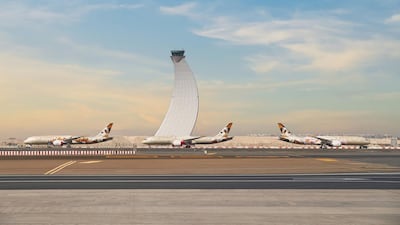

On March 23, 2020, UAE authorities announced that passenger flights in and out of the country would be grounded. Part of the country's efforts to prevent the spread of Covid-19 via air travel, the initial two-week ban on commercial flights departing from and arriving in the UAE transformed the sky above one of the world's busiest travel hubs into a silent pathway.
As Etihad Airways, Emirates, Air Arabia, flydubai and other airlines grounded their jets on the tarmac of airports across the country, as airlines around the world did the same, it signalled the beginning of the end for the second golden age of travel.
Two weeks later, the blanket ban on passenger travel was eased and bookings reopened, firstly for repatriation flights via Dubai International Airport and Abu Dhabi International Airport.
As the weeks rolled on, restrictions loosened and airlines slowly began to reopen routes to destinations across their networks. But despite the country's airlines returning to the skies, air travel as we once knew it had changed dramatically.
In a year in which the aviation industry has faced its worst crisis, the logistics of travelling by air have been widely altered.
In Abu Dhabi, Etihad has weathered the pandemic by implementing several new policies designed to keep travellers safe. The country's national airline was the first in the world to require 100 per cent of travellers to show a negative coronavirus test result before boarding any flight.
From having to take a PCR test before flying to changes with in-flight services, here are nine aspects of travel that have changed since the Covid-19 pandemic began.
How Covid-19 has changed travel
1. Compulsory face masks and PPE

Catching a flight now comes with a new must-have accessory: an obligatory face mask.
A ruling by the International Civil Aviation Organisation's (ICAO) Council Aviation Recovery Taskforce states that travellers must wear face masks for the duration of flights, and when navigating through airports. Some passengers – mostly young children or people with health conditions – may be exempt and rules are relaxed a little when people are eating or drinking, but other than that, if you do not have your face mask on, you're not flying.
In the UAE, both Emirates and Etihad introduced hygiene kits for travellers containing face masks and hand sanitiser. Etihad also designed an antimicrobial snood as a stylish option for premium passengers to wear on flights. And at DXB, new vending machines that dispense PPE have been installed for any travellers that need to pick up some last-minute supplies before boarding flights.
2. No more 'chicken or beef?'

Major changes in how airlines serve food and drinks in the air have also been ushered in by the pandemic.
Gone is the standard choice of "chicken or beef?" served by a smiling crew member from a trolley that rolled up and down the aircraft aisle. Instead, airlines worked to cut down interaction between crew and passengers by offering pre-packaged meal options, and scrapping some service elements altogether.
Non-essential services – such as in-flight magazines or premium offerings such as shower spas and on-board lounges – were also halted as rules were introduced to prevent cross-contamination where possible.
While some of these services have now been reintroduced, upgraded hygiene measures and a preference for pre-packaged meals that can be more easily distributed are set to remain post-pandemic.
3. Sunscreen, check. Nasal swab, check

As the pandemic raged on, several countries introduced rules relating to Covid-19 testing. Travellers flying into many destinations, including the UAE, must now show negative test results for the virus before being allowed to visit.
This has led to PCR tests and nasal swabs becoming an important step in the travel process. The timings for when these tests must be carried out varies greatly, from a relaxed seven-day time frame for anyone flying to Mauritius, to a hectic 48-hour time limit for those headed to China.
Abu Dhabi's Etihad requires all travellers to show a negative test result no matter where they're flying to, and in October 2020, the airline announced the cost of PCR tests for all tickets from the capital would be included in the airfare.
Other airlines, including Emirates, have partnered with testing clinics to offer travellers discounted rates on PCR tests when the purpose is for international travel.
4. Socially distanced seating on planes

Online check-in for many airlines was initially suspended during the pandemic so that airlines could carefully manage load capacity and place passengers in seats that were spaced well apart from other travellers.
While this has been largely phased out because of the high financial costs associated with the policy, some airlines – for example, Delta Air Lines – continue to ensure travellers are socially distanced on flights.
Several other airlines, including Emirates, have introduced new policies that allow travellers to pay more to purchase an empty seat next to them.
Where online check-in has resumed, travellers' choices of where to sit are not quite as unrestricted as they were before the pandemic.
5. Do I have to quarantine?

Pre-pandemic, picking where you wanted to travel to was often based on where you'd been before, a hotel you wanted to visit or a tourist attraction that had been on your bucket list for a long time. Today, these things are secondary considerations, with travel instead being dictated by which countries are open for tourism and how long we might need to quarantine.
While Dubai has remained largely open for tourists for much of the pandemic, Abu Dhabi has been more reserved. In December, the UAE capital announced its gradual reopening with a list of countries where travellers can fly from, and back into the UAE, without having to quarantine.
This "green" list has been updated every two weeks and currently welcomes travellers from 12 territories for quarantine-free visits. Flying out of the country remains limited from the capital, with only two of those 12 destinations being viable options for a quarantine-free holiday.
6. Covid-19 insurance

Travel insurance is nothing new, but policies that cover Covid-19 are another by-product of the pandemic.
In a bid to boost customer confidence and attempt to get people travelling again, several airlines introduced Covid-19 travel insurance options. In July, Emirates was the first airline in the world to offer free insurance to protect travellers against medical and quarantine expenses if diagnosed with the virus when overseas. In September, Etihad, too, introduced Covid-19 insurance, including it in the airfare of every ticket booked.
Some countries require travellers to have Covid-19 insurance when they visit, while others – such as Aruba and Cambodia – have taken this a step further and require any travellers planning a visit to purchase mandatory insurance policies for Covid-19 upon arrival.
7. Flexible airline tickets

One of the more positive changes to arise from the pandemic for travellers has been the loosening of restrictions on flight tickets. Before Covid-19, date changes on airline tickets often came with hefty administration fees or penalties.
Today, most airlines offer travellers the option to purchase a ticket that comes with more flexibility. Some airlines, such as Emirates, now allow several changes on tickets with no additional fees.
While it's unclear whether this change will remain in place when the pandemic is over and demand for travel has picked up, the policy has raised questions over why airlines needed to charge such hefty fees in the first place, if they have been financially able to drop them when the industry is at its lowest.
8. To vaccinate, or not to vaccinate

On February 10, 2021, Etihad marked a world first when it flew a flight staffed entirely by a Covid-19 vaccinated crew. From the pilots to the cabin crew, everyone working on Etihad flights have been inoculated.
As countries continue to roll out vaccine programmes, there’s much discussion as to whether these jabs will be a necessary part of future travel.
Earlier this week, Qantas chief executive Alan Joyce said that Australia's national airline would require international travellers to have a Covid-19 vaccine before they board a flight. The World Health Organisation disputes this, stating that it does not want a vaccine to be the prerequisite for travel for fear that citizens from poorer countries or those with less access will be discriminated against.
The European Commission last week set out plans to digitally reopen travel via certificates that prove travellers have been vaccinated or have negative PCR test results. And several other countries – including Iceland, Estonia and Georgia – have reopened their doors to tourists, but only to those who have been vaccinated.
9. The transformation of travel tech
At a time when the travel industry was in crisis, innovation was key. Airlines, airports, travel operators and destinations led the way by introducing lasting changes to operations that aimed to both protect travellers and boost customer satisfaction.
From self bag-drop stations to iris scanners and facial recognition software at check-in, the pandemic accelerated the world of travel technology at a lightning pace. In the space of a year, it has progressed at a pace that would likely have taken a decade to get to if there was no pandemic.
At Abu Dhabi airport, touchless systems were installed in elevators and Etihad trialled contactless technology that could monitor passengers' vital health signs, such as temperature, heart rate and respiratory rate at check-in.
From more familiar technologies such as digital passport kiosks becoming more widespread, to leading-edge inventions such as robots to enforce social distancing policies, the future of travel beyond the pandemic looks set to be very much tech-driven.

