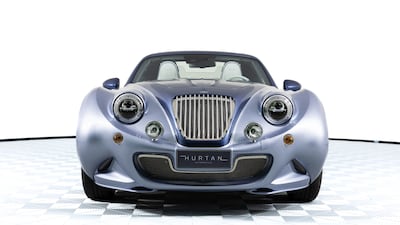
Hurtan Grand Albaycin takes design cues from 1950s and 1960s vehicles. Photo: Hurtan

Retro-style Hurtan Grand Albaycin tears into Gulf, priced Dh599,000


  • English
  • Arabic

The Hurtan Grand Albaycin has finally made landfall in the Middle East, more than a year after the wild-styled vehicle was first unveiled to the world in 2021.

The new arrival, unveiled in Dubai, is the brand’s flagship vehicle and it is a mass of over-the-top, but strangely pleasing big curves and chrome accents.

As such, if standing out on the roads is something you’re after, the Grand Albaycin is certainly worthy of your attention.

It isn’t the only vehicle on the road today that aims to evoke a sense of nostalgia, but it makes most of the others seem tame by comparison.

Hurtan, a Spanish company that has been in business for 30 years, has a history of making vehicles that take inspiration from classic cars while incorporating enough modern technology to ensure they're actually useable in a contemporary setting.

The Grand Albaycin is no different in this regard, with design cues from 1950s and 1960s vehicles being there for all to see.

  • The Hurtan Grand Albaycin has arrived in the Middle East. All photos: Hurtan
    The Hurtan Grand Albaycin has arrived in the Middle East. All photos: Hurtan
  • The Grand Albaycin is a heavily modified version of Mazda's MX-5
    The Grand Albaycin is a heavily modified version of Mazda's MX-5
  • The Grand Albaycin is not a budget option, but few could deny it's unusual and stylish
    The Grand Albaycin is not a budget option, but few could deny it's unusual and stylish
  • Like any small sports car worth its salt, the Grand Albaycin only has room for two
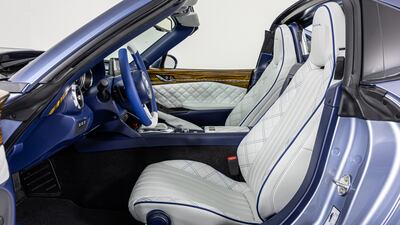
    Like any small sports car worth its salt, the Grand Albaycin only has room for two
  • The Hurtan's UAE insignia
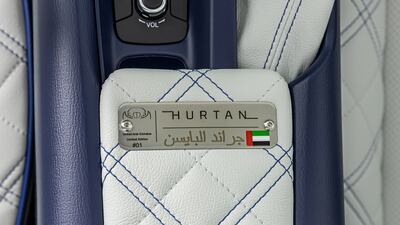
    The Hurtan's UAE insignia
  • The dashboard is all very analogue... aside from the touchscreen, of course
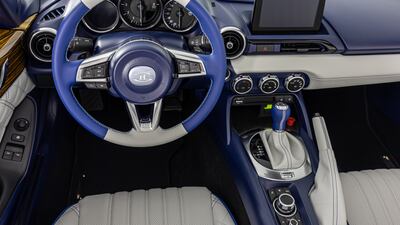
    The dashboard is all very analogue... aside from the touchscreen, of course

It is a modified and rebuilt version of Mazda’s MX-5, a lightweight sporty number that has been popular on the world’s roads since it was first introduced in 1989.

The Grand Albaycin is powered by a two-litre turbocharged engine that will produce 184 horsepower and 205Nm of torque, which should be plenty in a car of this size.

The sporty theme continues inside, with the cabin being decked out in neatly stitched leather and shiny wood.

Conversely, if we're looking at what's in here that nods to the modern, there is a touchscreen infotainment system, climate control and a high-end audio setup.

If you’re wondering about the name, the Albaycin was named after a neighbourhood in the old Moorish quarter in Granada, Spain, and Hurtan says the car’s design has been inspired by the cultural heritage and architecture in that area.

Hurtan is taking orders for the Grand Albaycin in the UAE now, but, despite it being a retro vehicle, don't expect an old-fashioned price ― the cars start at Dh599,000.


Tips to keep your car cool
  • Place a sun reflector in your windshield when not driving
  • Park in shaded or covered areas
  • Add tint to windows
  • Wrap your car to change the exterior colour
  • Pick light interiors - choose colours such as beige and cream for seats and dashboard furniture
  • Avoid leather interiors as these absorb more heat
Company%20profile
%3Cp%3EName%3A%20Tabby%3Cbr%3EFounded%3A%20August%202019%3B%20platform%20went%20live%20in%20February%202020%3Cbr%3EFounder%2FCEO%3A%20Hosam%20Arab%2C%20co-founder%3A%20Daniil%20Barkalov%3Cbr%3EBased%3A%20Dubai%2C%20UAE%3Cbr%3ESector%3A%20Payments%3Cbr%3ESize%3A%2040-50%20employees%3Cbr%3EStage%3A%20Series%20A%3Cbr%3EInvestors%3A%20Arbor%20Ventures%2C%20Mubadala%20Capital%2C%20Wamda%20Capital%2C%20STV%2C%20Raed%20Ventures%2C%20Global%20Founders%20Capital%2C%20JIMCO%2C%20Global%20Ventures%2C%20Venture%20Souq%2C%20Outliers%20VC%2C%20MSA%20Capital%2C%20HOF%20and%20AB%20Accelerator.%3Cbr%3E%3C%2Fp%3E%0A

Mercer, the investment consulting arm of US services company Marsh & McLennan, expects its wealth division to at least double its assets under management (AUM) in the Middle East as wealth in the region continues to grow despite economic headwinds, a company official said.

Mercer Wealth, which globally has $160 billion in AUM, plans to boost its AUM in the region to $2-$3bn in the next 2-3 years from the present $1bn, said Yasir AbuShaban, a Dubai-based principal with Mercer Wealth.

Within the next two to three years, we are looking at reaching $2 to $3 billion as a conservative estimate and we do see an opportunity to do so,” said Mr AbuShaban.

Mercer does not directly make investments, but allocates clients’ money they have discretion to, to professional asset managers. They also provide advice to clients.

“We have buying power. We can negotiate on their (client’s) behalf with asset managers to provide them lower fees than they otherwise would have to get on their own,” he added.

Mercer Wealth’s clients include sovereign wealth funds, family offices, and insurance companies among others.

From its office in Dubai, Mercer also looks after Africa, India and Turkey, where they also see opportunity for growth.

Wealth creation in Middle East and Africa (MEA) grew 8.5 per cent to $8.1 trillion last year from $7.5tn in 2015, higher than last year’s global average of 6 per cent and the second-highest growth in a region after Asia-Pacific which grew 9.9 per cent, according to consultancy Boston Consulting Group (BCG). In the region, where wealth grew just 1.9 per cent in 2015 compared with 2014, a pickup in oil prices has helped in wealth generation.

BCG is forecasting MEA wealth will rise to $12tn by 2021, growing at an annual average of 8 per cent.

Drivers of wealth generation in the region will be split evenly between new wealth creation and growth of performance of existing assets, according to BCG.

Another general trend in the region is clients’ looking for a comprehensive approach to investing, according to Mr AbuShaban.

“Institutional investors or some of the families are seeing a slowdown in the available capital they have to invest and in that sense they are looking at optimizing the way they manage their portfolios and making sure they are not investing haphazardly and different parts of their investment are working together,” said Mr AbuShaban.

Some clients also have a higher appetite for risk, given the low interest-rate environment that does not provide enough yield for some institutional investors. These clients are keen to invest in illiquid assets, such as private equity and infrastructure.

“What we have seen is a desire for higher returns in what has been a low-return environment specifically in various fixed income or bonds,” he said.

“In this environment, we have seen a de facto increase in the risk that clients are taking in things like illiquid investments, private equity investments, infrastructure and private debt, those kind of investments were higher illiquidity results in incrementally higher returns.”

The Abu Dhabi Investment Authority, one of the largest sovereign wealth funds, said in its 2016 report that has gradually increased its exposure in direct private equity and private credit transactions, mainly in Asian markets and especially in China and India. The authority’s private equity department focused on structured equities owing to “their defensive characteristics.”

Updated: May 04, 2023, 7:16 AM