



The deserts of Abu Dhabi may have stood in for Arrakis, the resource-rich fictional planet in Dune, but a real-life futuristic project is set to take off in nearby Dubai.
Architecture and design studio Isto has unveiled plans for Dragonfly, a nine-bedroom, 2,500 square metre villa inspired by the ornithopters or winged aircraft used in the sci-fi blockbuster. To be built in La Mer, the residential building will be made predominantly of metal to highlight its "manoeuvrability and sharp architecture" the company said.
“The design inspiration lies in imitating the structure of the dragonfly wings, from the long and flat roofline and the architectural silhouette of two open wings," says lead designer Anton Yaroshenko.
Lighting installations, metal decorations on the facade and a wall-mounted pergola of the inner part of the villa will help replicate the intricately veined, membranous wings and coloured markings of a dragonfly's wings.
Meanwhile, floor-to-ceiling windows will flood the home's interiors with natural light and also offer striking views of the sea and the Dubai cityscape.

"A significant emphasis is devoted to the villa's surrounding landscape. Water features are positioned around the entire perimeter of the Dragonfly," says Yaroshenko.
A water feature in the villa's right wing, which will have a stream of water falling onto a stone sculpture, aims to simulate the feeling of teleporting to the universe of Dune, he adds.
It is currently in the initial stages of implementation and construction is expected to be completed by the end of the year. It is meant for a big family and valued between $35-$40 million, according to Isto, which has its headquarters in Dubai.

In his 1965 novel Dune, Frank Herbert describes ornithopters as "aircraft capable of sustained wing-beat flight in the manner of birds". While various film and TV adaptations have been made in the past, it was director Denis Villeneuve who interpreted the aircraft as having the shape of a dragonfly, telling IGN that they would be "muscular and feel realistic and close to the spirit of a helicopter".
Villeneuve's first adaptation, released in 2021, was a massive box office success. Its sequel, Dune: Part Two, is set to be released on February 29.
Villeneuve and cast members Dave Bautista and Josh Brolin were in Abu Dhabi on Sunday for the Middle Eastern premiere of the film. The sequel will continue from where the first film ended when Paul Atreides (Timothee Chalamet) and his family were attacked by the Harkonnens over control of Arrakis. Paul and his mother Lady Jessica (Rebecca Ferguson) then flee and seek assistance from the Fremen, who live in the dunes of Arrakis.
-
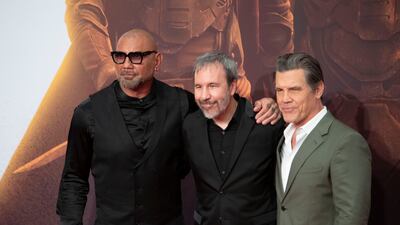
Dave Bautista, director Dennis Villeneuve and Josh Brolin at the Dune: Part Two Middle East premiere in Abu Dhabi. All photos: Ruel Pableo for The National -

Brolin at the Abu Dhabi event -

Bautista said he was looking to explore the Empty Quarter in Abu Dhabi -

Fans lined up to see their favourite stars at the premiere -

Sameer Al Jaberi, Head of Abu Dhabi Film Commission at the premiere -
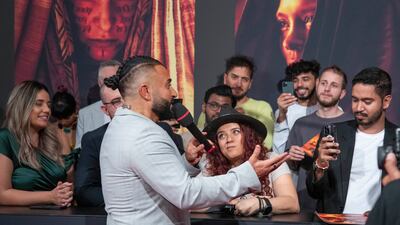
The premiere was hosted by radio presenter Kris Fade -

Bautista interacts with fans at the event -

Mohamed Dobay, Creative Media Authority acting director-general at the premiere



