



There is more to Moroccan cuisine than couscous.
That's the message from the sprawling culinary offerings at the kingdom's pavilion in the Opportunity District at Expo 2020 Dubai.
Head chef Faycal Hajjar has created a formidable menu encompassing not only gastronomy and street food, but dishes touching upon the various regions of the North African country.
Visitors have the option of dining within restaurants at the pavilion.
Scroll through the gallery above to see photos of the pavilion's best dishes.
-

Designed by Moroccan architect Tarik Oualalou, the pavilion uses the traditional technique of rammed-earth construction to create 22 stacked rectangular spaces. Expo Morocco -
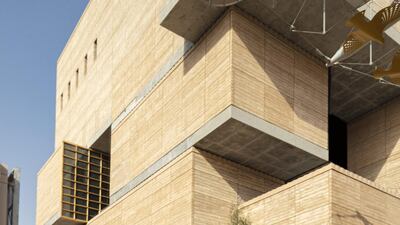
The building’s 4,000 square metre rammed earth facade, which measures 33 metres in height, visually references villages in Morocco -
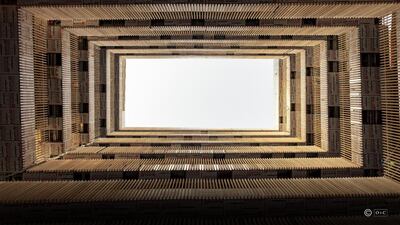
The pavilion has an inner courtyard, an important spatial element in traditional Moroccan architecture. Expo 2020 Dubai -
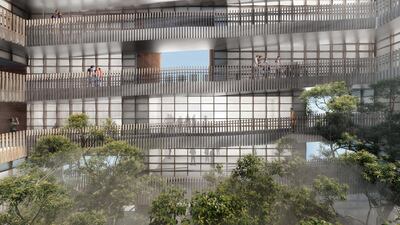
The 14 exhibition spaces inside the pavilion are connected by a continuous ‘inner street’, which begins at the building’s uppermost floor and gradually descends to the ground. Expo Morocco -
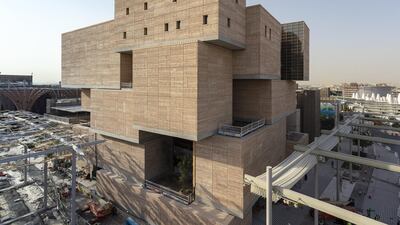
The Morocco pavilion under construction in the Opportunity District of the Expo 2020 Dubai site. Expo Morocco -

The Moroccan pavilion will have a theme of ‘Legacies for the future - from inspiring origins to sustainable progress’


On the ground floor is Le Medina, dedicated to popular and street dishes such as the couscous with seven vegetables and hearty lamb and chicken tagines.
The seventh floor is the fine-dining restaurant Taste of Morocco, which serves modern and sophisticated twists on classic staples such as the lamb shank with dried fruits and popular pastry Kaab El Ghazal.
"We want to demonstrate to people the history of Moroccan cuisine which dates back over 1,200 years," Hajjar tells The National. "It is a proud and rich culture with specific food dedicated to weddings, large gatherings, Eid, desserts and every day food. A lot of the dishes have meaning and we want to show that here at the Expo."
If you are making your way to the Moroccan Pavilion and fancy a bite, Hajjar recommends nine dishes, which he describes below. All are available at Le Medina, unless stated otherwise.
1. Moroccan tea
“It is a green tea that is not only the Moroccan daily drink, it has this wonderfully deep attachment with home and family.
“Every household has their own way of making the drink and the tea in each region of Morocco also tastes different because of the kind of water that is available. Our tea here at the pavilion is simple, in that it is made with mint, and it is refreshing.”
2. Tangia

“This is a special dish from Marrakesh and it's traditionally made for men for dinner or for a gathering of men.
“It is made in a clay pot and with tender beef. The flavour comes from the preserved lemon and some ghee. It's not very heavy and when it’s done well it tastes very juicy.”
3. Pastilla
“One of Morocco's favourite dishes and can be served with pigeon or seafood. Pastilla is a dish normally served in weddings and the cooking begins almost three days before because of the work involved.
“You have to first make the sauce which is made from a lot of onions that’s mixed in with egg in a way similar to an omelette.
“Then we cook the pigeon or seafood and add it to sauce before adding in fried almonds, honey and cinnamon. Finally, after layering it all we wrap it up in filo pastry and after it's baked we add sugar and cinnamon.
“This is a wonderful dish that is reserved for special occasions. It is not something that Moroccans consider as a daily staple.”
4. Tagine chicken meslalla
“The beauty of tagines is that it can be presented in different ways. In this version it is done with olives that have been preserved in salt and water for a few days.
“While the tagine is cooked normally, the new addition is a tomato paste that really brings the flavour of the chicken and olives together.”
5. Lamb shank with dried fruits
“Now this is an example of some of the food you will find in our fine dining restaurant Taste of Morocco”.
“The lamb shank is cooked like a tagine, basically in a form of a stew, and then we place it in an oven to give it an extra crunch. Then we add a sauce that is dry fruits cooked with cinnamon and sugar. The end result is flavour that is salty and sweet.”
6. Lamb Mechoui
“It's made of whole lamb, about 12 or 13 kilograms, and cooked overnight outdoors in a pit with charcoal.
“The lamb is served only with salt and some cumin and with no accompanying sauces. The flavour all comes from the tenderness of the meat.
“Because this is a dish that takes a lot of work, it is normally served for a group of 10 people in major events. Families who are expecting important visitors will also make a lamb mechoui in honour of their guests.”
7. Couscous with seven vegetables
“One of the most popular forms of couscous dishes. Why do we put seven vegetables? It is just one of those things that goes back in our history.
“For this dish, the vegetables and couscous are served with caramelised onions on top as well as almonds.”
8. Kaab El Ghazal
“In English it means the gazelle’s horns and it is one of the most famous pastries in Morocco.
"It is primarily made with almonds, eggs and not too much flour. Drizzled with some orange blossom water it is supposed to taste crunchy on the outside and soft inside. This is also available at Taste of Morocco.”
9. Msemen
“This is a traditional flat bread fried in a pan with some butter, then we place it in the oven for a small amount of time before serving it with honey and more butter.
“The origin of this dish is that we eat it in Eid Al Fitr in the mornings with some tea. Now it has become a common street food you can find anywhere.”
10 unusual and authentic dishes to try at Expo 2020 Dubai — in pictures:
-

Expo 2020 Dubai is home to more than 200 restaurants. The Brazil Pavilion serves a traditional pato no tucupi, boiled duck in yellow sauce. All photos: Victor Besa / The National -
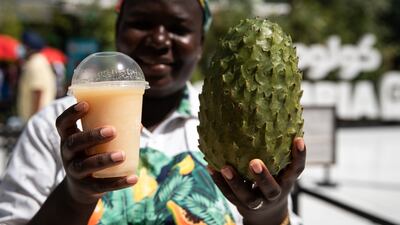
A woman presents the soursop gelato at the Colombia Pavilion. -
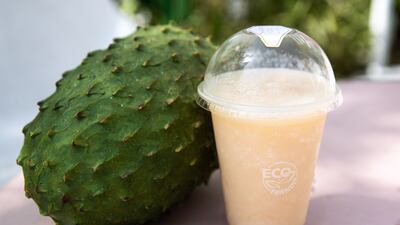
Soursop is a a prickly green fruit with a creamy texture and zesty flavour comparable to pineapple and strawberry. -
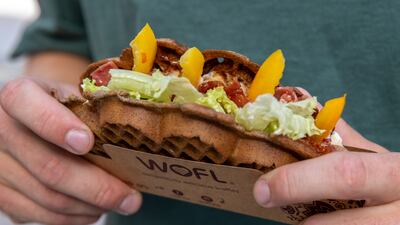
Available at the Wofl food truck outside the Norway Pavilion, dragon’s breath is a waffle (buckwheat or gluten-free) packed with sweet chilli beef, crispy yellow bell peppers, romaine lettuce and spring onions on a bed of sour cream. -

The Wofl food cart and staff outside the Norway Pavilion. -
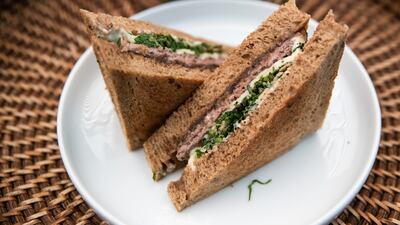
A modern take on a Saudi staple, hashi almashi, served at the Saudi Arabia Pavilion, comes with a camel meat patty rubbed in Saudi coffee, almond and sesame sauce.



