There are few retailers so synonymous with a single address. Since 1849, Harrods has occupied its corner of Knightsbridge, evolving from a department store into an international destination where fashion, culture, food and luxury converge.
For Michael Ward, its managing director since 2005, that sense of place is fundamental to the business. At a time when luxury brands are expanding their physical footprints around the world, Harrods remains firmly committed to its London home.
Its ambitions, however, extend far beyond Britain. Through Harrods Hive, the retailer has built relationships with emerging creative communities in mainland China, Hong Kong and the Middle East, sharing its expertise and industry connections.

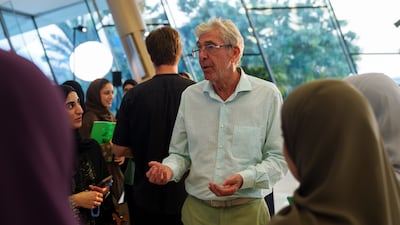
Now in its fourth year in Dubai, the initiative returned this week, bringing together students, entrepreneurs and established figures from fashion, beauty, culture and business for a day of workshops, discussions and networking at the Etihad Museum.
Working with Zayed University, the programme gave students the opportunity to learn from industry professionals and tackle real-world briefs set by Olivia Phillips, founder of The Desk; Lamia Abbas, creator marketing director at Miral Destinations; and Khairunisa Suhail, head of design at The Giving Movement.
With students earning credit towards their final exams, the aim is to bridge the gap between academic theory and professional practice.

“Understanding the practicalities of what their job will be when they leave academia is really important,” Ward says. “How do you take the principles your lecturers have taught you and apply them to a live brief? I hope we can get students to think through that process.”
Against a backdrop of regional unrest this year, the return of Harrods Hive also signals a deeper commitment. Ward insists that international relationships should not be maintained only when circumstances are favourable, but cultivated over time.
“In all of the regions where we do this, it is important to have consistency,” he says. “What we do over that period is build communities. Each year builds on the relationships established the year before. It is not simply about the commercial terms, it is about building the next generation and trying to help them.
“You have a commitment to the region. You are not just a fair-weather friend; you are part of that community."

He recalls travelling to China during the pandemic, spending 15 days in isolation before Shanghai Fashion Week, where Harrods was the only European brand participating. “We had been there for years, and you just don't walk away from it," he says. "This is something we feel very seriously about, and we want to continue giving back to some of our great clients across the world.”
It is a philosophy rooted in the institution's longevity. “We're not here for the next 18 months," he adds. "This is a 176-year-old brand, and it will be here for the next 176 years because we always take the very long-term view.”
That perspective has shaped the transformation of the Knightsbridge store under Ward's leadership. His ambition was to position Harrods at the very top of the international luxury market, catering to what he describes as the wealthiest 0.1 per cent of the world's population. Achieving that required rethinking everything from its brand mix to its architecture.

Some of the most significant changes have been subtle. Black granite entrances installed during the 1960s and 1970s were removed, the original Belle Epoque doors reinstated and traditional awnings dating to the 1890s restored. Together, Ward believes, these decisions have returned a sense of architectural coherence to the building.
“People might not consciously notice it, but they feel differently because everything now fits with the architecture," Ward says. "Nothing fights against anything else. It feels absolutely right.”
The same curatorial philosophy extends beyond fashion. Ward recalls consultants advising Harrods to abandon categories including homeware, furniture and children's clothing. He disagreed. Today, its strongest-selling homeware brands include Dior, Hermes, Loro Piana and Fendi, while its children's department offers a concentration of luxury labels rarely found together elsewhere.
“We are curators of people's lifestyles,” he says. “We curate across every touchpoint of that person's life.”
It also explains why Ward has resisted exporting the Harrods model. Asked whether the department store might one day open in the Middle East, his answer is unequivocal: no.

“Harrods survives because it sits at the crossroads of the world. We are at the centre of the Americas, the Far East and the Middle East, and London is this extraordinary cultural experience that everybody wants to be part of. There isn't anything like it anywhere in the world.”
For Ward, replicating Harrods elsewhere would risk diluting the qualities that make it distinctive. Its Britishness is not something to adapt for international customers, but a central part of its appeal.
“They don't come to experience a version of something else. They come for the Britishness of Harrods, and that's what we celebrate.”
That pride extends to Britain's cultural institutions. Having served on the board of the Royal Opera and Ballet and as an adviser to the Victoria and Albert Museum, Ward believes the country often undervalues its cultural assets.
“We have the finest ballet and opera, some of the finest plays and museums in the world, yet we are incredibly self-deprecating about it,” he says. His frustration is evident. “Why don't we look after all these amazing things that we do?”
The same confidence informs Harrods' approach to buying. When Ward decided to establish the Salon de Parfums, a dedicated space for niche and independent perfumers he had discovered while travelling in Paris, the idea was met with scepticism. It has since become a major commercial success, with Harrods accounting for 55 per cent of UK sales of fragrances priced above £150 ($197).
“It is all about having authority,” he says. “You have to understand the customer, and nothing is done without being absolutely for that customer.”
That understanding also shapes Harrods' support for emerging international designers. Through partnerships with initiatives such as Fashion Trust Arabia, the store offers regional talent the opportunity to be showcased in Knightsbridge. Similar programmes operate in China and Hong Kong through Shanghai Fashion Week, while a recent collaboration with Africa 69 introduced a selection of African designers to a global audience.
Ward recalls one designer describing how securing a Harrods listing transformed her prospects. After struggling to establish her label, she suddenly found herself being approached by retailers across Europe.
“That is the power of having a platform,” he says. “Suddenly, every department store in Europe wants your brand. If we can give designers that opportunity to grow and put them on the world stage, then that is part of what we should be doing.”
There is a commercial benefit, too. Ward acknowledges that supporting emerging talent strengthens Harrods' relationships with international customers. The Africa initiative, for example, generated significant coverage across the continent, reinforcing the store's appeal among wealthy African consumers visiting London.
Yet he is wary of turning these programmes into overt marketing exercises. “We don't shout about it. That's not what we do. Once you start shouting about it, it changes the whole dynamic.”
For Ward, the value of Harrods Hive lies in that balance between commercial ambition and long-term commitment. Its fourth event in Dubai may have lasted only a day, but the relationships formed and opportunities created are intended to endure.
For a retailer whose identity is inseparable from its 176-year history, the future depends not simply on knowing what to preserve and what to reinvent, but on understanding whom to bring along.

