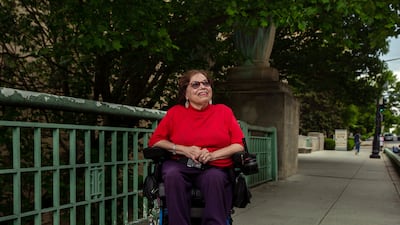

In June 2016, disability rights advocates joined government representatives at the UN in New York to discuss the challenges facing young women and girls with disabilities.
Among them was Judy Heumann, an American activist whose campaigns had helped change the law in her home country.
A decade later, her fight for equality has reached the screen in Being Heumann, a film starring British actress Ruth Madeley. Directed by Coda filmmaker Sian Heder, it focuses on a 1977 protest that established Heumann as a leading figure in the US disability rights movement.

At the time as the UN event, Heumann was serving as the US State Department’s special adviser for international disability rights. She spoke about the role of national and local governments, stressing that women and girls with disabilities needed to be included in conversations about disability.

The discussion was convened by the UAE and US missions to the UN, in partnership with UN Women and the non-profit organisation World Enabled. It brought together advocates and representatives of international organisations to consider the barriers women and girls with disabilities faced in education and employment.
Lana Nusseibeh, then the UAE’s permanent representative to the UN, highlighted the discrimination they could face because of their disability, gender and age. The event took place alongside a conference on the rights of people with disabilities.
The following year, the UAE announced a national strategy to empower people with disabilities. The policy addressed education, employment and accessibility, among other areas, and introduced the term “people of determination”.

Heumann’s appearance at the UN was one moment in a career that took her from a protest in San Francisco to roles at the US Department of Education, the World Bank and the State Department. She had spent much of her life fighting barriers she first encountered as a child.
Growing up in Brooklyn, Heumann was denied a place at her local school because she used a wheelchair. Her parents were told she was a “fire hazard”, according to her website. A teacher was sent to her home instead, and she did not attend school until fourth grade.
After graduating from university, she applied for a teaching licence but was rejected on medical grounds. She sued the New York Board of Education and was eventually granted a licence, becoming the first wheelchair user to teach in the state.
In 1977, Heumann and fellow activist Kitty Cone were among the leaders of a sit-in at a federal building in San Francisco. Protesters demanded that the US government sign regulations implementing Section 504 of the Rehabilitation Act, which prohibited discrimination against disabled people by organisations receiving federal funding.
The law had been passed in 1973, but the regulations needed to enforce it remained unsigned. Following protests across the US, they were signed on April 28, 1977.
Heumann died in 2023, aged 75. Speaking to The National about playing her, Madeley said she hoped the film would introduce the activist to people unfamiliar with her work and reach disabled viewers who might feel isolated.
“The work’s not done, and I’m very, very much committed to carrying on Judy’s legacy,” she said.

