

Thursday, February 22, marks Saudi Arabia's Founding Day, a new annual holiday to commemorate the founding of the first Saudi state.
The holiday was established with a royal decree issued by King Salman in 2022 through the official Saudi Press Agency.
It said the holiday will commemorate the history of Saudi rule dating back hundreds of years.
It is a different event to Saudi National Day, which falls on September 23.
What does Founding Day commemorate?
Saudi Arabia’s new annual holiday commemorates the ascent to power of Mohammed bin Saud, who founded the First Saudi State.
In February 1727, he inherited leadership over the central Arabian town of Diriyah, which had been established by his ancestors in the 15th century.
He oversaw the expansion of Diriyah from a city-state to an emirate, conquering territories in central Arabia and uniting them under his family’s rule.
His dynasty became known as Al Saud, named after his father, Saud bin Mohammed Al Muqrin, who had ruled Diriyah from 1720, the date often cited as the founding of the dynasty.
Founding Day commemorates these origins and aims to highlight the important part Al Saud dynasty has played in the history of Arabia.
-
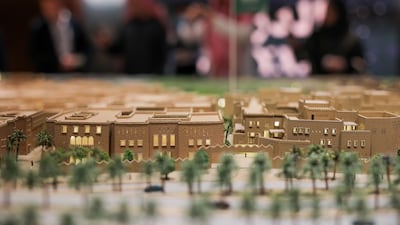
A model of a local construction and renovation project in the Diriyah Gate Development Authority (DGDA) headquarters, Saudi Arabia. All photos: Bloomberg -

Crown Prince Mohammed bin Salman is trying to turn the conservative kingdom into an investment powerhouse and attract businesses as part of his Vision 2030 plan to diversify from oil -
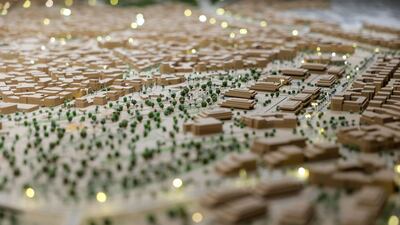
A model of a construction project in Diriyah -
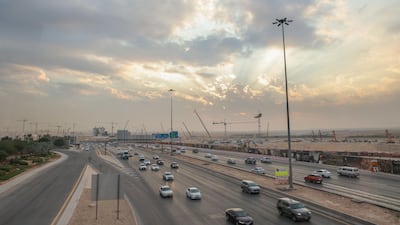
A motorway runs past the site -
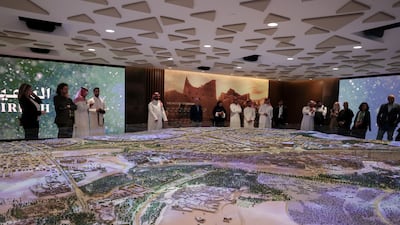
Visitors look at a model of the project -
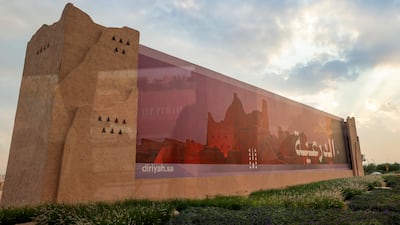
The gateway to Diriyah -

Visitors at Salwa Palace -
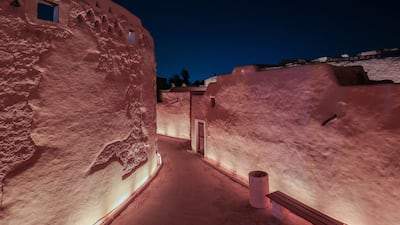
A path at Salwa Palace -

Part of the palace lit up at night -

Salwa Palace is a tourist attraction -

Salwa Palace in the At-Turaif district of Diriyah, Saudi Arabia. -
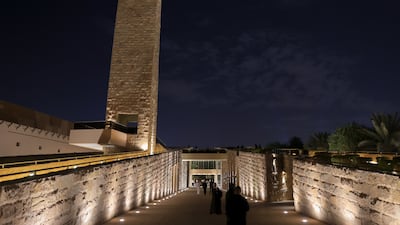
The visitor centre in At-Turaif, Diriyah -
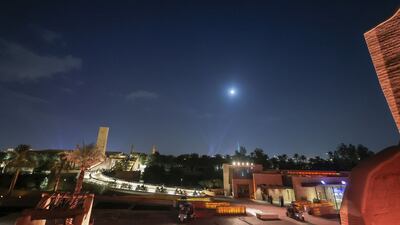
Electric carts transport visitors to Salwa Palace


What was the First Saudi State?
Although Mohammed bin Saud came to power in Diriyah in 1727, the establishment of the First Saudi State is usually dated to 1744.
It was in this year that he allied with Mohammed bin Abdul Wahab, a religious scholar who led a movement that called for a return to the “true” version of Islam.
This alliance was at the heart of the First Saudi State, also known as the Emirate of Diriyah, the first of three Saudi states.
-

Al Nassr's Cristiano Ronaldo celebrates Saudi Arabia's Founding Day wearing local traditional clothes at Al Nassr Football Club in Riyadh, Saudi Arabia. Reuters -

Al Nassr's Cristiano Ronaldo drinking Saudi coffee during Saudi Arabia's Founding Day celebrations. Reuters -

Cristiano Ronaldo joins in the celebrations. Reuters -

Al Nassr and Portugal striker Cristiano Ronaldo celebrates Saudi Arabia's Founding Day in Riyadh, Saudi Arabia, February 22, 2023. Reuters -
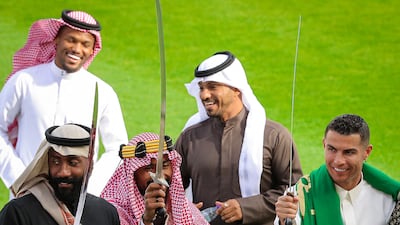
Cristiano Ronaldo joins in the celebrations on Saudi Arabia's Founding Day. Reuters -
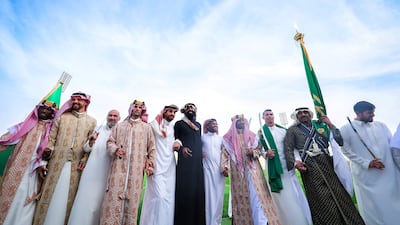
Cristiano Ronaldo celebrates Saudi Arabia's Founding Day wearing local traditional clothes. Reuters


From Diriyah, the Al Saud dynasty quickly expanded to conquer much of the Arabian Peninsula, including the Hejaz region, home to the holy cities of Makkah and Madinah.
This expansion was seen as a threat by the Ottoman Empire, the region’s major power, which sought to restore its influence in Arabia.
After a seven-year war, Ottoman-allied forces led by Egypt’s Ibrahim Pasha defeated the Al Saud and destroyed Diriyah, bringing an end to the First Saudi State in 1818.
From the First Saudi State to the modern kingdom
Al Saud re-established their state six years later with a capital at Riyadh, close to Diriyah.
Throughout the 19th century, they competed with the Al Rashid dynasty for supremacy over central Arabia. Internal conflicts and military defeats eventually weakened the position of Al Saud, leading to the capture of Riyadh by the Al Rashid in 1891 and the end of the Second Saudi State.
Imam Abdulrahman Al Saud, who led Al Saud at the time, sought refuge with Bedouin in the deserts of the Empty Quarter before taking his family to Kuwait.
His son, Abdulaziz, recaptured Riyadh in 1902 in a raid, laying the foundations for the expansion of Saudi rule across Arabia. In 1932, Abdulaziz formalised his reign by establishing the Kingdom of Saudi Arabia, with himself as its first king.
His sons, including the current King Salman, have ruled the kingdom since.
How is Saudi Arabia’s National Day different from its Founding Day?
Saudi National Day is celebrated annually on September 23. It marks the 1932 decree, issued by King Abdulaziz, which renamed the Kingdom of Najd and the Hejaz as the Kingdom of Saudi Arabia.
The unification of the kingdom took place on the 21st of Jumada Al Ula in 1351 H – which corresponds to September 23, 1932.
Today, National Day is celebrated through fireworks displays, ceremonies and parades.
What will happen on Founding Day?
Events to show off traditional crafts, culture and heritage are planned across the kingdom.
Live music and dance performances are scheduled in cities including Riyadh, Jeddah and Dammam.
Festivities are expected to three days, with both public and private sectors given a long weekend until February 25.

