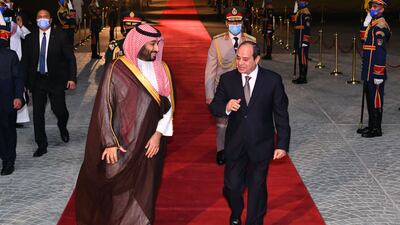
Egyptian President Abdel Fattah El Sisi and Saudi Crown Prince Mohammed bin Salman met in Cairo on Tuesday for talks on a wide range of regional and bilateral issues as the two nations signed deals worth $7.7 billion.
Prince Mohammed also announced the kingdom's intention to invest $30 billion in Egypt, according to a joint communique at the end of his two-day visit. No details or timeline for this investment were immediately available.
An Egyptian presidential statement said the prince and Mr El Sisi met at Cairo's presidential Ittahadiyah palace, where the Saudi royal was given a state reception, complete with a guard of honour and the playing of the two countries' national anthems.
Prince Mohammed arrived in Cairo on Monday night and was scheduled to leave for Jordan later on Tuesday.
During their talks, the statement said, Mr El Sisi and the Saudi prince were in agreement on the “importance” of next month's meeting in Saudi Arabia between US President Joe Biden and leaders of the GCC — Saudi Arabia, the United Arab Emirates, Kuwait, Bahrain, Qatar and Oman — as well as Iraqi prime minister Mustafa Al Kadhimi, Jordan's King Abdullah II and President El Sisi.
It did not give any details, but the meeting in the Saudi Red Sea city of Jeddah was expected to focus on energy supplies, the war in Yemen, Iran's perceived meddling in the Arab world and the fallout from Ukraine war on the region.
“The president emphasised (to Prince Mohammed), Egypt's commitment to the security of the Gulf region as an extension of Egypt's own national security and the rejection of practices designed to undermine its stability,” the statement said.
The two leaders, continued the statement, discussed their countries' stand against the “interference in the internal affairs of Arab nations that's designed to undermine the stability of the region and its people.”
Egypt and Saudi Arabia have been close allies for decades, with both Cairo and Riyadh working closely on foreign policy and security issues. Cairo, moreover, has consistently looked to Riyadh for economic support and investments, while Saudi businessmen found the market in Egypt — the most populous Arab nation with 103 million people _ a lucrative proposition given its size.
The militaries of both nations also frequently stage war games and coordinate patrolling the strategic Red Sea. At least three million Egyptians live and work in Saudi Arabia whose remittances are a major source of foreign currency.
The deals signed earlier on Tuesday between are testimony to the close economic ties between the two regional powerhouses.
The deals cover sectors that include renewable energy, green hydrogen, pharmaceuticals and e-commerce, according to Egypt's official Middle East News Agency.
Saudi Arabian investment in Egypt’s private sector has exceeded $35bn, according to Bandr Al Amri, head of the Saudi Business Council, citing latest statistics.
This investment is expected to increase by about $10bn in the next five years, Mr Al Amri said in a statement broadcast by the Al Ekhbariya TV channel.
“We are witnessing a big economic boom in Saudi Arabia and we are inviting the Egyptian investors to invest in Saudi Arabia,” he said.
“We will provide them with the needed facilities based on the strategic relation with Egypt. We also invite the Saudis to invest in Egypt as it has great and unique investment opportunities.”
Trade volume between Saudi Arabia and Egypt reached 54 billion Saudi Riyals ($14.40) in 2021, with an 87 per cent increase from 2020, said the Federation of Saudi Chambers, an umbrella organisation representing the kingdom's business community in all sectors.
The countries have signed more than 160 bilateral agreements over the years, indicate FSC statistics cited by the Arabic economic service of the Saudi news agency.
Egyptian investment in Saudi Arabia reached $5bn on the eve of Prince Mohammed's visit to Cairo.
The value of remittance from Egyptians working in Saudi Arabia reached $9.6bn during the fiscal year 2019-2020, compared with $8.5bn during the previous year, an increase of 12.4 per cent, according to Capmas.

Zayed Sustainability Prize
Ten tax points to be aware of in 2026
1. Domestic VAT refund amendments: request your refund within five years
If a business does not apply for the refund on time, they lose their credit.
2. E-invoicing in the UAE
Businesses should continue preparing for the implementation of e-invoicing in the UAE, with 2026 a preparation and transition period ahead of phased mandatory adoption.
3. More tax audits
Tax authorities are increasingly using data already available across multiple filings to identify audit risks.
4. More beneficial VAT and excise tax penalty regime
Tax disputes are expected to become more frequent and more structured, with clearer administrative objection and appeal processes. The UAE has adopted a new penalty regime for VAT and excise disputes, which now mirrors the penalty regime for corporate tax.
5. Greater emphasis on statutory audit
There is a greater need for the accuracy of financial statements. The International Financial Reporting Standards standards need to be strictly adhered to and, as a result, the quality of the audits will need to increase.
6. Further transfer pricing enforcement
Transfer pricing enforcement, which refers to the practice of establishing prices for internal transactions between related entities, is expected to broaden in scope. The UAE will shortly open the possibility to negotiate advance pricing agreements, or essentially rulings for transfer pricing purposes.
7. Limited time periods for audits
Recent amendments also introduce a default five-year limitation period for tax audits and assessments, subject to specific statutory exceptions. While the standard audit and assessment period is five years, this may be extended to up to 15 years in cases involving fraud or tax evasion.
8. Pillar 2 implementation
Many multinational groups will begin to feel the practical effect of the Domestic Minimum Top-Up Tax (DMTT), the UAE's implementation of the OECD’s global minimum tax under Pillar 2. While the rules apply for financial years starting on or after January 1, 2025, it is 2026 that marks the transition to an operational phase.
9. Reduced compliance obligations for imported goods and services
Businesses that apply the reverse-charge mechanism for VAT purposes in the UAE may benefit from reduced compliance obligations.
10. Substance and CbC reporting focus
Tax authorities are expected to continue strengthening the enforcement of economic substance and Country-by-Country (CbC) reporting frameworks. In the UAE, these regimes are increasingly being used as risk-assessment tools, providing tax authorities with a comprehensive view of multinational groups’ global footprints and enabling them to assess whether profits are aligned with real economic activity.
Contributed by Thomas Vanhee and Hend Rashwan, Aurifer
Some of Darwish's last words
"They see their tomorrows slipping out of their reach. And though it seems to them that everything outside this reality is heaven, yet they do not want to go to that heaven. They stay, because they are afflicted with hope." - Mahmoud Darwish, to attendees of the Palestine Festival of Literature, 2008
His life in brief: Born in a village near Galilee, he lived in exile for most of his life and started writing poetry after high school. He was arrested several times by Israel for what were deemed to be inciteful poems. Most of his work focused on the love and yearning for his homeland, and he was regarded the Palestinian poet of resistance. Over the course of his life, he published more than 30 poetry collections and books of prose, with his work translated into more than 20 languages. Many of his poems were set to music by Arab composers, most significantly Marcel Khalife. Darwish died on August 9, 2008 after undergoing heart surgery in the United States. He was later buried in Ramallah where a shrine was erected in his honour.
Museum of the Future in numbers
- 78 metres is the height of the museum
- 30,000 square metres is its total area
- 17,000 square metres is the length of the stainless steel facade
- 14 kilometres is the length of LED lights used on the facade
- 1,024 individual pieces make up the exterior
- 7 floors in all, with one for administrative offices
- 2,400 diagonally intersecting steel members frame the torus shape
- 100 species of trees and plants dot the gardens
- Dh145 is the price of a ticket
Where to Find Me by Alba Arikha
Alma Books
The%20trailblazers
%3Cp%3ESixteen%20boys%20and%2015%20girls%20have%20gone%20on%20from%20Go-Pro%20Academy%20in%20Dubai%20to%20either%20professional%20contracts%20abroad%20or%20scholarships%20in%20the%20United%20States.%20Here%20are%20two%20of%20the%20most%20prominent.%0D%3C%2Fp%3E%0A%3Cp%3E%3Cstrong%3EGeorgia%20Gibson%20(Newcastle%20United)%3C%2Fstrong%3E%0D%3Cbr%3EThe%20reason%20the%20academy%20in%20Dubai%20first%20set%20up%20a%20girls%E2%80%99%20programme%20was%20to%20help%20Gibson%20reach%20her%20potential.%20Now%20she%20plays%20professionally%20for%20Newcastle%20United%20in%20the%20UK.%0D%3C%2Fp%3E%0A%3Cp%3E%3Cstrong%3EMackenzie%20Hunt%20(Everton)%3C%2Fstrong%3E%0D%3Cbr%3EAttended%20DESS%20in%20Dubai%2C%20before%20heading%20to%20the%20UK%20to%20join%20Everton%20full%20time%20as%20a%20teenager.%20He%20was%20on%20the%20bench%20for%20the%20first%20team%20as%20recently%20as%20their%20fixture%20against%20Brighton%20on%20February%2024.%0D%3C%2Fp%3E%0A
Rock in a Hard Place: Music and Mayhem in the Middle East
Orlando Crowcroft
Zed Books
COMPANY PROFILE
Founders: Alhaan Ahmed, Alyina Ahmed and Maximo Tettamanzi
Total funding: Self funded
'Moonshot'
Director: Chris Winterbauer
Stars: Lana Condor and Cole Sprouse
Rating: 3/5
Indoor cricket in a nutshell
Indoor Cricket World Cup - Sep 16-20, Insportz, Dubai
16 Indoor cricket matches are 16 overs per side
8 There are eight players per team
9 There have been nine Indoor Cricket World Cups for men. Australia have won every one.
5 Five runs are deducted from the score when a wickets falls
4 Batsmen bat in pairs, facing four overs per partnership
Scoring In indoor cricket, runs are scored by way of both physical and bonus runs. Physical runs are scored by both batsmen completing a run from one crease to the other. Bonus runs are scored when the ball hits a net in different zones, but only when at least one physical run is score.
Zones
A Front net, behind the striker and wicketkeeper: 0 runs
B Side nets, between the striker and halfway down the pitch: 1 run
C Side nets between halfway and the bowlers end: 2 runs
D Back net: 4 runs on the bounce, 6 runs on the full
The specs
Engine: four-litre V6 and 3.5-litre V6 twin-turbo
Transmission: six-speed and 10-speed
Power: 271 and 409 horsepower
Torque: 385 and 650Nm
Price: from Dh229,900 to Dh355,000