Abdullah Al Alimi called for people to leave personal interests behind in the pursuit of peace. Photo: Marib Governorate

Yemen's new leadership council 'pushing for peace' with Houthis


  • English
  • Arabic

Yemen's new presidential council is putting peace first but is “ready for war” should the Iran-backed Houthi rebels fail to meet demands, a senior official has said.

Powerful figures from the country's military and political sectors have been included in the eight-member council, with some having fighters on the ground in the conflict.

The council has been given the task of running the country after President Abdrabu Mansur Hadi stepped down earlier this month.

“Our first option is peace, but we are ready for war,” Abdullah Al Alimi, one of the council's members and Mr Hadi's former chief of staff, told AFP in the Saudi capital Riyadh.

“We believe the council is in a position, with the coalition support, to score a decisive military victory.”

Mr Hadi's internationally recognised government had been locked in conflict for seven years against the Iran-backed Houthis, who control the capital Sanaa and most of the north despite a Saudi-led coalition's military intervention, launched in 2015.

The war has killed hundreds of thousands directly or indirectly, causing what the UN calls the world's worst humanitarian crisis, with millions on the brink of famine.

Mr Hadi's April 7 announcement handing power to the council came at the end of talks in the Saudi capital Riyadh that brought together anti-Houthi factions but were boycotted by the Houthis themselves.

The developments followed the start of a renewable two-month truce that has brought a rare respite from violence and led to cautious hopes the war could finally end.

Mr Hadi said the council would be given the task of “negotiating with the Houthis for a permanent ceasefire".

“We hope the dire situation in Yemen will make people have a desire to leave personal and partisan interests behind in pursuit of peace,” said Mr Al Alimi.

He said council leaders are due to meet in the coming days with UN special envoy to Yemen Hans Grundberg, who last week visited Sanaa for the first time during his mandate and held talks with Houthi leaders.

After meeting Mr Grundberg, the council will travel to Yemen to be sworn in, though Mr Al Alimi refused to specify exactly where.

The council has not yet decided how long it will give the Houthis to join talks, Mr Al Alimi said.

The UN on Monday said the Houthis had agreed to stop the recruitment and use of child soldiers, and to end attacks on schools or hospitals or otherwise risk the safety of youngsters.

Virginia Gamba, the UN’s envoy on protecting children in war zones, said the Houthis’ agreement to a UN action plan was a “positive and encouraging step”.

Under the deal, the Houthis will clean their ranks of children within six months.

More than 10,200 children have been killed or maimed during seven years of grinding conflict and nearly 3,500 have been forced to fight, the UN says.

Rebel resistance

The Houthi rebels refused to participate in the negotiations in Riyadh, which they consider enemy territory, but Mr Al Alimi said future talks could take place in a more neutral location such as Oman.

So far, however, the Houthis have been dismissive, denouncing the new council.

  • Missiles on display at a Houthi exhibition. The terrorist group has claimed responsibility for a spate of attempted attacks on the UAE leading to global condemnation. Reuters
    Missiles on display at a Houthi exhibition. The terrorist group has claimed responsibility for a spate of attempted attacks on the UAE leading to global condemnation. Reuters
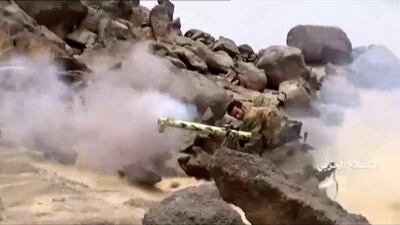
  • A Houthi fighter fires an anti-tank missile in an August offensive near the south-west Saudi region of Najran along the Yemeni border. AFP
    A Houthi fighter fires an anti-tank missile in an August offensive near the south-west Saudi region of Najran along the Yemeni border. AFP
  • A Houthi ballistic missile aimed at Saudi Arabia. The kingdom thwarted a bid by Houthi militias to target civilians and civilian sites in the city of Khamis Mushait. Reuters
    A Houthi ballistic missile aimed at Saudi Arabia. The kingdom thwarted a bid by Houthi militias to target civilians and civilian sites in the city of Khamis Mushait. Reuters
  • A file picture of the Quds cruise missile launch from an unidentified location in Yemen. Reuters
    A file picture of the Quds cruise missile launch from an unidentified location in Yemen. Reuters
  • Missiles and drone aircraft are on display at a Houthi exhibition in Yemen. Reuters
    Missiles and drone aircraft are on display at a Houthi exhibition in Yemen. Reuters

A Saudi-led coalition entered the war in March 2015 at the request of Mr Hadi’s government after the rebels pushed the government into exile.

If the push for peace goes nowhere, the newly aligned anti-Houthi forces are in a position to pursue “a concerted multi-front campaign” against the rebels — provided the council's diverse membership can hold together — said Peter Salisbury, senior Yemen analyst for the International Crisis Group.

“They (the leadership council) have the potential to more aggressively pursue peace and more aggressively pursue war, and the most likely outcome is they do a little bit of one and a little bit of the other,” he said.

- AFP contributed to this report.

Ten tax points to be aware of in 2026

1. Domestic VAT refund amendments: request your refund within five years

If a business does not apply for the refund on time, they lose their credit.

2. E-invoicing in the UAE

Businesses should continue preparing for the implementation of e-invoicing in the UAE, with 2026 a preparation and transition period ahead of phased mandatory adoption. 

3. More tax audits

Tax authorities are increasingly using data already available across multiple filings to identify audit risks. 

4. More beneficial VAT and excise tax penalty regime

Tax disputes are expected to become more frequent and more structured, with clearer administrative objection and appeal processes. The UAE has adopted a new penalty regime for VAT and excise disputes, which now mirrors the penalty regime for corporate tax.

5. Greater emphasis on statutory audit

There is a greater need for the accuracy of financial statements. The International Financial Reporting Standards standards need to be strictly adhered to and, as a result, the quality of the audits will need to increase.

6. Further transfer pricing enforcement

Transfer pricing enforcement, which refers to the practice of establishing prices for internal transactions between related entities, is expected to broaden in scope. The UAE will shortly open the possibility to negotiate advance pricing agreements, or essentially rulings for transfer pricing purposes. 

7. Limited time periods for audits

Recent amendments also introduce a default five-year limitation period for tax audits and assessments, subject to specific statutory exceptions. While the standard audit and assessment period is five years, this may be extended to up to 15 years in cases involving fraud or tax evasion. 

8. Pillar 2 implementation 

Many multinational groups will begin to feel the practical effect of the Domestic Minimum Top-Up Tax (DMTT), the UAE's implementation of the OECD’s global minimum tax under Pillar 2. While the rules apply for financial years starting on or after January 1, 2025, it is 2026 that marks the transition to an operational phase.

9. Reduced compliance obligations for imported goods and services

Businesses that apply the reverse-charge mechanism for VAT purposes in the UAE may benefit from reduced compliance obligations. 

10. Substance and CbC reporting focus

Tax authorities are expected to continue strengthening the enforcement of economic substance and Country-by-Country (CbC) reporting frameworks. In the UAE, these regimes are increasingly being used as risk-assessment tools, providing tax authorities with a comprehensive view of multinational groups’ global footprints and enabling them to assess whether profits are aligned with real economic activity. 

Contributed by Thomas Vanhee and Hend Rashwan, Aurifer

COMPANY%20PROFILE
%3Cp%3E%3Cstrong%3EName%3A%20%3C%2Fstrong%3EElmawkaa%3Cbr%3E%3Cstrong%3EBased%3A%3C%2Fstrong%3E%20Hub71%2C%20Abu%20Dhabi%3Cbr%3E%3Cstrong%3EFounders%3A%3C%2Fstrong%3E%20Ebrahem%20Anwar%2C%20Mahmoud%20Habib%20and%20Mohamed%20Thabet%3Cbr%3E%3Cstrong%3ESector%3A%3C%2Fstrong%3E%20PropTech%3Cbr%3E%3Cstrong%3ETotal%20funding%3A%3C%2Fstrong%3E%20%24400%2C000%3Cbr%3E%3Cstrong%3EInvestors%3A%20%3C%2Fstrong%3E500%20Startups%2C%20Flat6Labs%20and%20angel%20investors%3Cbr%3E%3Cstrong%3ENumber%20of%20employees%3A%3C%2Fstrong%3E%2012%3Cbr%3E%3C%2Fp%3E%0A
Updated: April 18, 2022, 6:40 PM