Saudi Arabia’s Ministry of Education has announced the end of remote learning for all children in the kingdom

Saudi children rejoice at news of return to school after Covid-19 suspension


  • English
  • Arabic

Saudi Arabia’s Ministry of Education announced on Tuesday that all pupils would return to in-classroom learning and that it would lift Covid-19 measures including social distancing.

Most children have been studying remotely for almost two years, but with the Covid-19 recovery rate up to 90 per cent, from March 20, children will return to school and will not have to practise social distancing during assembly, prayer, sports, playtime or lessons.

“It has been the most challenging two years with all parents stuck at home due to online learning which was so difficult. They didn’t enjoy being at home all the time and missed the real interaction and the classroom atmosphere,” she said.

“My 6-year-old daughter was jumping with joy when I told her she can go back and be with her classmates. I can finally get around to doing things for myself, like working out, while the kids are at school. It was absolutely essential for parents and children.”

Her daughter Alia said: “I missed my friends.”

The Ministry of Education has issued guidelines on how to limit the spread of Covid-19.

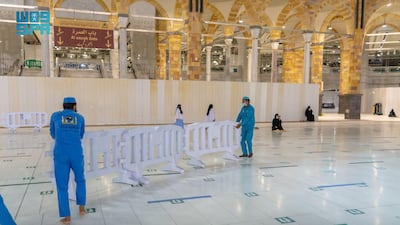
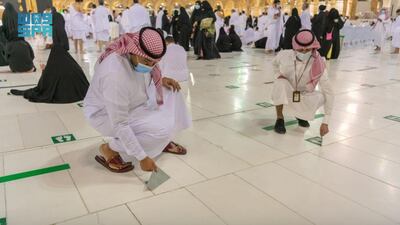
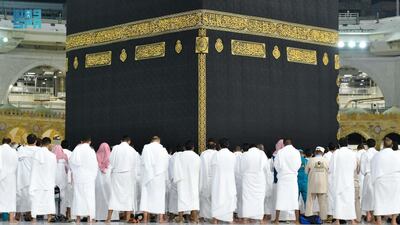
  • Physical distancing stickers are removed from the Grand Mosque after Saudi Arabia lifted the requirement to wear masks and observe social distancing in open spaces. All photos: SPA
    Physical distancing stickers are removed from the Grand Mosque after Saudi Arabia lifted the requirement to wear masks and observe social distancing in open spaces. All photos: SPA
  • The move came after the number of Covid-19 cases in the kingdom continued to decrease, Saudi Arabia’s official press agency (SPA) said.
    The move came after the number of Covid-19 cases in the kingdom continued to decrease, Saudi Arabia’s official press agency (SPA) said.
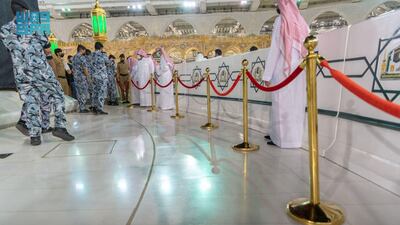
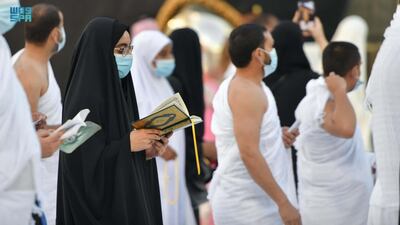
  • Pilgrims are warned they must still wear masks and use the Tawakkalna mobile app to confirm their immunity status when entering the kingdom’s two Holy Mosques.
    Pilgrims are warned they must still wear masks and use the Tawakkalna mobile app to confirm their immunity status when entering the kingdom’s two Holy Mosques.
  • The lifting of restrictions is the latest in a series of moves by Saudi Arabia after it reopened its borders to travellers in May.
    The lifting of restrictions is the latest in a series of moves by Saudi Arabia after it reopened its borders to travellers in May.
  • There is now widespread hope that primary schoolchildren will soon be allowed to attend classrooms across the country.
    There is now widespread hope that primary schoolchildren will soon be allowed to attend classrooms across the country.
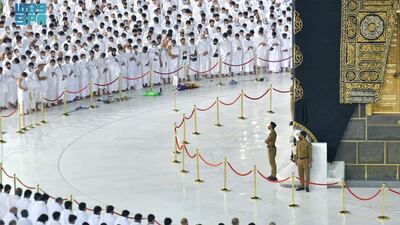
  • Dawn prayer at the Grand Mosque after the cancelling of physical distance.
    Dawn prayer at the Grand Mosque after the cancelling of physical distance.
  • More than 20.6 million of the country's 34.8 million population have been vaccinated against the coronavirus.
    More than 20.6 million of the country's 34.8 million population have been vaccinated against the coronavirus.
  • Saudi Arabia recorded two deaths and 45 new cases of Covid-19 on Saturday.
    Saudi Arabia recorded two deaths and 45 new cases of Covid-19 on Saturday.
  • There was positive reaction to the latest lifting of restrictions. ‘This is great news,’ said Naushad Mohammed, a British citizen who lives in Saudi Arabia.
    There was positive reaction to the latest lifting of restrictions. ‘This is great news,’ said Naushad Mohammed, a British citizen who lives in Saudi Arabia.
  • Mr Mohammed praised the kingdom’s response to the virus. ‘Saudi Arabia has done an impressive and tremendous job in taking care of its people, be it residents or citizens during the pandemic. We were all given free medical care and vaccines and are really lucky to have been here during the pandemic.’
    Mr Mohammed praised the kingdom’s response to the virus. ‘Saudi Arabia has done an impressive and tremendous job in taking care of its people, be it residents or citizens during the pandemic. We were all given free medical care and vaccines and are really lucky to have been here during the pandemic.’
  • 'I am glad we are turning a new chapter and hope the world can go back to normal," Mr Mohammed said.
    'I am glad we are turning a new chapter and hope the world can go back to normal," Mr Mohammed said.

“My students were very happy when I let them know they will be playing sports together and everything is going back to normal. There were cheers and excitement all around,” said Abbas Al Wayli, an Egyptian physical education instructor living in Jeddah.

“We are all really happy to be able to go back to normal and engage in daily activities like we did pre-corona.”

“It makes sense for contact sports especially. Kids want to play and interact with their teammates, which was impossible with their masks and social distancing.”

The ministry said children under the age of 12, even those at kindergarten, will return to school in the third semester of this year, which will start on March 20.

This month, the Saudi government scrapped Covid-19 restrictions with masks no longer required in open spaces, and no social distancing.

Tourists no longer need to quarantine or provide PCR tests.

How%20to%20avoid%20getting%20scammed
%3Cul%3E%0A%3Cli%3ENever%20click%20on%20links%20provided%20via%20app%20or%20SMS%2C%20even%20if%20they%20seem%20to%20come%20from%20authorised%20senders%20at%20first%20glance%3C%2Fli%3E%0A%3Cli%3EAlways%20double-check%20the%20authenticity%20of%20websites%3C%2Fli%3E%0A%3Cli%3EEnable%20Two-Factor%20Authentication%20(2FA)%20for%20all%20your%20working%20and%20personal%20services%3C%2Fli%3E%0A%3Cli%3EOnly%20use%20official%20links%20published%20by%20the%20respective%20entity%3C%2Fli%3E%0A%3Cli%3EDouble-check%20the%20web%20addresses%20to%20reduce%20exposure%20to%20fake%20sites%20created%20with%20domain%20names%20containing%20spelling%20errors%3C%2Fli%3E%0A%3C%2Ful%3E%0A

Mercer, the investment consulting arm of US services company Marsh & McLennan, expects its wealth division to at least double its assets under management (AUM) in the Middle East as wealth in the region continues to grow despite economic headwinds, a company official said.

Mercer Wealth, which globally has $160 billion in AUM, plans to boost its AUM in the region to $2-$3bn in the next 2-3 years from the present $1bn, said Yasir AbuShaban, a Dubai-based principal with Mercer Wealth.

Within the next two to three years, we are looking at reaching $2 to $3 billion as a conservative estimate and we do see an opportunity to do so,” said Mr AbuShaban.

Mercer does not directly make investments, but allocates clients’ money they have discretion to, to professional asset managers. They also provide advice to clients.

“We have buying power. We can negotiate on their (client’s) behalf with asset managers to provide them lower fees than they otherwise would have to get on their own,” he added.

Mercer Wealth’s clients include sovereign wealth funds, family offices, and insurance companies among others.

From its office in Dubai, Mercer also looks after Africa, India and Turkey, where they also see opportunity for growth.

Wealth creation in Middle East and Africa (MEA) grew 8.5 per cent to $8.1 trillion last year from $7.5tn in 2015, higher than last year’s global average of 6 per cent and the second-highest growth in a region after Asia-Pacific which grew 9.9 per cent, according to consultancy Boston Consulting Group (BCG). In the region, where wealth grew just 1.9 per cent in 2015 compared with 2014, a pickup in oil prices has helped in wealth generation.

BCG is forecasting MEA wealth will rise to $12tn by 2021, growing at an annual average of 8 per cent.

Drivers of wealth generation in the region will be split evenly between new wealth creation and growth of performance of existing assets, according to BCG.

Another general trend in the region is clients’ looking for a comprehensive approach to investing, according to Mr AbuShaban.

“Institutional investors or some of the families are seeing a slowdown in the available capital they have to invest and in that sense they are looking at optimizing the way they manage their portfolios and making sure they are not investing haphazardly and different parts of their investment are working together,” said Mr AbuShaban.

Some clients also have a higher appetite for risk, given the low interest-rate environment that does not provide enough yield for some institutional investors. These clients are keen to invest in illiquid assets, such as private equity and infrastructure.

“What we have seen is a desire for higher returns in what has been a low-return environment specifically in various fixed income or bonds,” he said.

“In this environment, we have seen a de facto increase in the risk that clients are taking in things like illiquid investments, private equity investments, infrastructure and private debt, those kind of investments were higher illiquidity results in incrementally higher returns.”

The Abu Dhabi Investment Authority, one of the largest sovereign wealth funds, said in its 2016 report that has gradually increased its exposure in direct private equity and private credit transactions, mainly in Asian markets and especially in China and India. The authority’s private equity department focused on structured equities owing to “their defensive characteristics.”

Key recommendations
  • Fewer criminals put behind bars and more to serve sentences in the community, with short sentences scrapped and many inmates released earlier.
  • Greater use of curfews and exclusion zones to deliver tougher supervision than ever on criminals.
  • Explore wider powers for judges to punish offenders by blocking them from attending football matches, banning them from driving or travelling abroad through an expansion of ‘ancillary orders’.
  • More Intensive Supervision Courts to tackle the root causes of crime such as alcohol and drug abuse – forcing repeat offenders to take part in tough treatment programmes or face prison.
RESULTS

6.30pm: Handicap (rated 95-108) US$125,000 2000m (Dirt).
Winner: Don’t Give Up, Gerald Mosse (jockey), Saeed bin Suroor (trainer).

7.05pm: Handicap (95 ) $160,000 2810m (Turf).
Winner: Los Barbados, Adrie de Vries, Fawzi Nass.

7.40pm: Handicap (80-89) $60,000 1600m (D).
Winner: Claim The Roses, Mickael Barzalona, Salem bin Ghadayer.

8.15pm: UAE 2000 Guineas Trial (Div-1) Conditions $100,000 1,400m (D)
Winner: Gold Town, William Buick, Charlie Appleby.

8.50pm: Cape Verdi Group 2 $200,000 1600m (T).
Winner: Promising Run, Patrick Cosgrave, Saeed bin Suroor.

9.25pm: UAE 2000 Guineas Conditions $100,000 1,400m (D).
Winner: El Chapo, Luke Morris, Fawzi Nass.

Dengue%20fever%20symptoms
%3Cp%3EHigh%20fever%20(40%C2%B0C%2F104%C2%B0F)%3Cbr%3ESevere%20headache%3Cbr%3EPain%20behind%20the%20eyes%3Cbr%3EMuscle%20and%20joint%20pains%3Cbr%3ENausea%3Cbr%3EVomiting%3Cbr%3ESwollen%20glands%3Cbr%3ERash%26nbsp%3B%3C%2Fp%3E%0A
Updated: March 15, 2022, 6:00 PM