

Millions of worshippers poured into the grand mosques in Makkah and Madinah on Monday night to perform prayers that lasted well into the night.
Muslims observe Laylat Al Qadr, a significant event in the Islamic faith, on the night of the 27th day of Ramadan.
Nearly one and a half million Umrah pilgrims and other worshippers attended the special night prayers of Taraweeh and Qiyam Al Layl that ended with the special supplication, led by Sheikh Sudais, at the Grand Mosque.
The main prayer each evening during Ramadan is taraweeh. It is an extra prayer that Muslims are advised to perform, at a mosque, among fellow worshippers.
Many also perform Qiyam Al Layl — or night prayers — during the final 10 nights of Ramadan. These prayers are often organised after midnight at mosques.
-
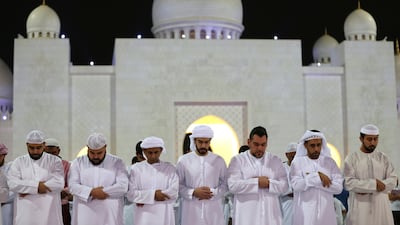
Muslims pray during Laylat Al Qadr at Sheikh Zayed Grand Mosque, Abu Dhabi, during the 27th night of Ramadan. EPA -
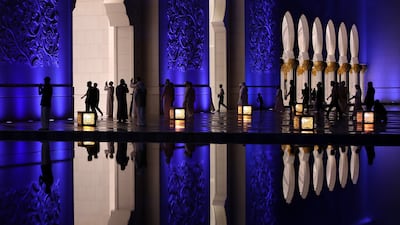
Worshippers gather at the UAE landmark. EPA -

Tens of thousands of worshippers pray near the Dome of the Rock at Al Aqsa Mosque, Jerusalem. AFP -
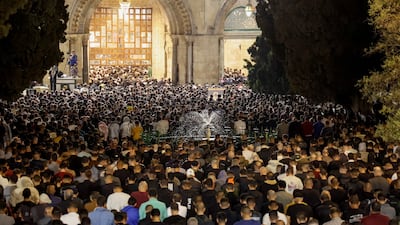
Palestinian worshippers at Al Aqsa. Reuters -
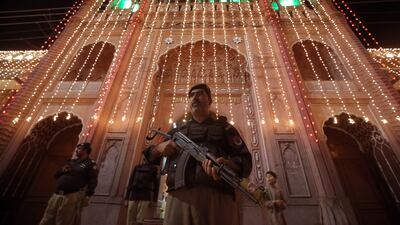
Pakistani security officials stand guard outside a mosque during the 27th night of Ramadan in Peshawar. EPA -
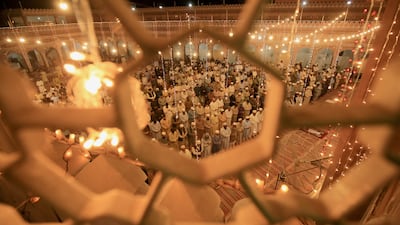
Muslims offer special Tarawih prayers at the mosque. EPA -

Worshippers at Al Azhar Mosque, Cairo. Reuters -

Children join their parents at Amr Ibn El Aas Mosque, Cairo, the first and oldest mosque built in Egypt. Reuters -

A Palestinian Muslim worshipper recites verses from the Quran at Sayed Hashim Mosque in Gaza City. AP Photo -

Palestinian worshippers pray at Al Awda Mosque in Rafah. AFP -

Muslims pray at Gazi Husrev Beg's Mosque, Sarajevo, Bosna and Herzegovina. EPA


The General Presidency for the Affairs of the Grand Mosque and the Prophet's Mosque said there were 4,000 workers on hand at the Grand Mosque in Makkah and that the mosque was being cleaned around the clock by 70 field teams.
What is special about Laylat Al Qadr?
Laylat Al Qadr — or the night of destiny — is one of the odd-numbered nights during the final 10 days of Ramadan in which the first verses of the Quran were revealed to Prophet Mohammed.
An entire chapter is devoted to the night of destiny in the final part of the Quran, wherein that night is described as “better than a thousand months” where the angels and the holy spirit Gabriel engulf the Earth.
The exact day of Laylat Al Qadr is not known, but Prophet Mohammed said it falls in the last 10 nights of the holy month, on an odd-numbered night.
The 21st, 23rd, 25th, 27th and 29th nights of Ramadan could be the night of destiny, so the period takes on great significance for Muslims.

