
The Saudi-led coalition fighting in Yemen has said it intercepted eight drones launched by the Iran-supported Houthi rebels out of Sanaa International Airport.
“We have observed and are following a hostile escalation via the use of drones by the Houthis. A number of explosive drones were launched from Sanaa International Airport,” the coalition said on its official Twitter account.
The coalition said it intercepted and destroyed the drones launched by the rebels towards the southern areas of Saudi Arabia.
Saudi Arabia has previously said that the airport was being used by the Houthis as a launching point for attacks. In December, the Saudi Arabian Air Force conducted precision strikes on buildings around the airport, which were assessed as housing Houthi military equipment.
"The operation comes in response to threats and the use of the airport’s facilities to launch cross-border attacks," the coalition said at the time.
"Destroying these targets will not have any effect on the operational capacity of the airport, and will not affect managing the airspace, the air traffic, and ground handling operations," it added.
In pictures: wreckage of Houthi drones
-
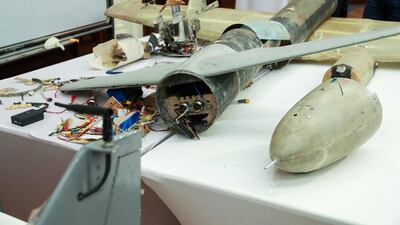
An Iranian-built Qasef-1 drone used by Houthi rebels in Yemen. -

A shot down drone on display. All photos by Victor Besa / The National -
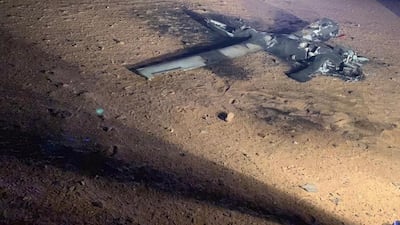
The remains of a Houthi drone intercepted by the Saudi Arabian Air Force. @SPAregions -
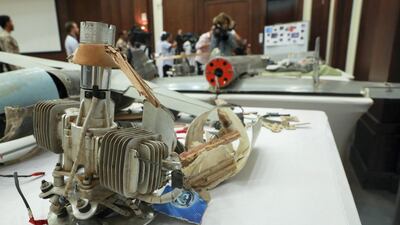
The engine of a Qasef-1 drone shot down by Arab Coalition forces in Yemen. -

A drone used by Houthi rebels to launch attacks on Saudi Arabia. AP -
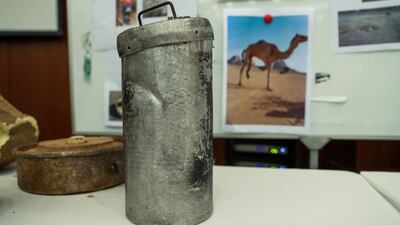
An IED built with Iranian components and camouflaged as a cooking pot recovered by Arab Coalition forces in Yemen. -
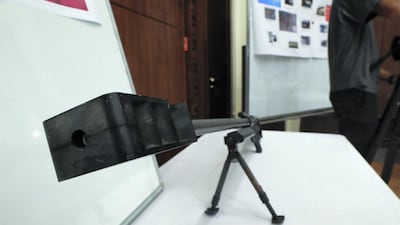
An Iranian-supplied STEYR .50 Calibre sniper riffle being used by the Houthi rebels in Yemen. -
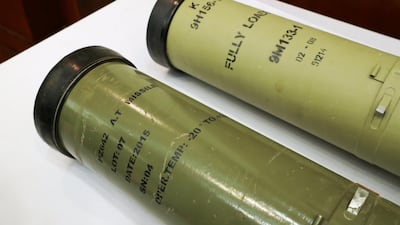
Two anti-tank guided missiles (ATGM). The one on the right is a Russian-made Kornet, and on the left is an Iranian imitation. Markings show they were built in 2015 indicating they were smuggled to Yemen after the UN arms embargo. -
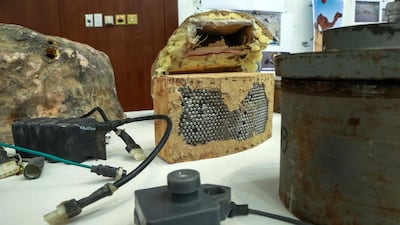
IEDs camouflaged inside a fake rock. Arab Coalition officials estimate they have defused up to 30,000 such devices since the war began. -
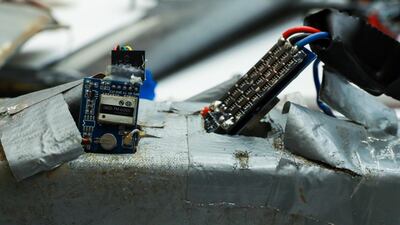
Farsi language was found enscribed on the wiring of this drone battery from a Qasef-1 UAV indicating its Iranian origins. -
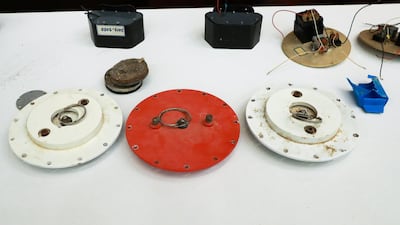
Limpet mines. -
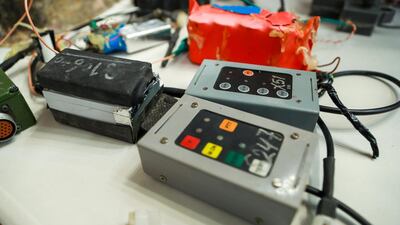
Electronics of an IED. -
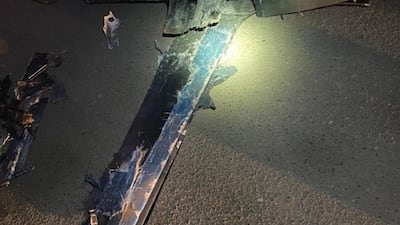
Remains of Houthi drone which the coalition shot down. @SPAregions -
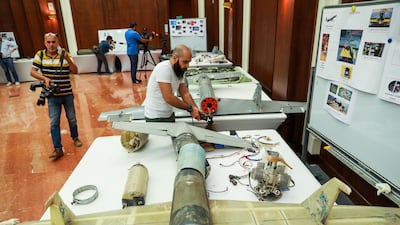
Weapons supplied by Iran to the Houthi militias in Yemen were put on display at a press conference by the Saudi-led Arab coalition. Victor Besa / The National
US versus China
Sulaiman Hakemy: Who really deserves to rule the Arctic?
Ni Jian: Covid-19 origins are a matter for science, not politics
Editorial: Global collaboration for a vaccine is the way to go
RESULTS
You might also like
Mercer, the investment consulting arm of US services company Marsh & McLennan, expects its wealth division to at least double its assets under management (AUM) in the Middle East as wealth in the region continues to grow despite economic headwinds, a company official said.
Mercer Wealth, which globally has $160 billion in AUM, plans to boost its AUM in the region to $2-$3bn in the next 2-3 years from the present $1bn, said Yasir AbuShaban, a Dubai-based principal with Mercer Wealth.
“Within the next two to three years, we are looking at reaching $2 to $3 billion as a conservative estimate and we do see an opportunity to do so,” said Mr AbuShaban.
Mercer does not directly make investments, but allocates clients’ money they have discretion to, to professional asset managers. They also provide advice to clients.
“We have buying power. We can negotiate on their (client’s) behalf with asset managers to provide them lower fees than they otherwise would have to get on their own,” he added.
Mercer Wealth’s clients include sovereign wealth funds, family offices, and insurance companies among others.
From its office in Dubai, Mercer also looks after Africa, India and Turkey, where they also see opportunity for growth.
Wealth creation in Middle East and Africa (MEA) grew 8.5 per cent to $8.1 trillion last year from $7.5tn in 2015, higher than last year’s global average of 6 per cent and the second-highest growth in a region after Asia-Pacific which grew 9.9 per cent, according to consultancy Boston Consulting Group (BCG). In the region, where wealth grew just 1.9 per cent in 2015 compared with 2014, a pickup in oil prices has helped in wealth generation.
BCG is forecasting MEA wealth will rise to $12tn by 2021, growing at an annual average of 8 per cent.
Drivers of wealth generation in the region will be split evenly between new wealth creation and growth of performance of existing assets, according to BCG.
Another general trend in the region is clients’ looking for a comprehensive approach to investing, according to Mr AbuShaban.
“Institutional investors or some of the families are seeing a slowdown in the available capital they have to invest and in that sense they are looking at optimizing the way they manage their portfolios and making sure they are not investing haphazardly and different parts of their investment are working together,” said Mr AbuShaban.
Some clients also have a higher appetite for risk, given the low interest-rate environment that does not provide enough yield for some institutional investors. These clients are keen to invest in illiquid assets, such as private equity and infrastructure.
“What we have seen is a desire for higher returns in what has been a low-return environment specifically in various fixed income or bonds,” he said.
“In this environment, we have seen a de facto increase in the risk that clients are taking in things like illiquid investments, private equity investments, infrastructure and private debt, those kind of investments were higher illiquidity results in incrementally higher returns.”
The Abu Dhabi Investment Authority, one of the largest sovereign wealth funds, said in its 2016 report that has gradually increased its exposure in direct private equity and private credit transactions, mainly in Asian markets and especially in China and India. The authority’s private equity department focused on structured equities owing to “their defensive characteristics.”
Innotech Profile
Date started: 2013
Founder/CEO: Othman Al Mandhari
Based: Muscat, Oman
Sector: Additive manufacturing, 3D printing technologies
Size: 15 full-time employees
Stage: Seed stage and seeking Series A round of financing
Investors: Oman Technology Fund from 2017 to 2019, exited through an agreement with a new investor to secure new funding that it under negotiation right now.
Persuasion
Company profile
Company name: Dharma
Date started: 2018
Founders: Charaf El Mansouri, Nisma Benani, Leah Howe
Based: Abu Dhabi
Sector: TravelTech
Funding stage: Pre-series A
Investors: Convivialite Ventures, BY Partners, Shorooq Partners, L& Ventures, Flat6Labs



