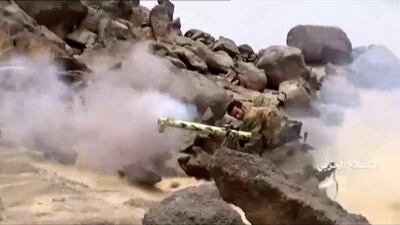
Houthi militias in Yemen launched ballistic missiles at Abu Dhabi and Saudi Arabia on Monday in the latest attack on neighbouring states.
Two missiles were destroyed in mid-flight during the attempted terrorist attack on Abu Dhabi, while in Saudi Arabia, one was shot down and another missile wounded two civilians in an industrial area.
The northern Yemeni militia has, over the past seven years, developed an increasingly sophisticated ballistic missile arsenal, despite a UN arms embargo on the country.
The bulk of the Houthis' arsenal today appears to be made up of the Burkan-3 for longer-range strikes up to 1,200 kilometres, the shorter range Badr P-1 rockets, with a 150km range and the Soviet-era Frog-7, which Houthis call the Zelzal, with a 65km range.
Today, they are known to possess a number of medium-range ballistic missiles — these are weapons defined by the US Centre for Arms Control as having a range of between 1,000km and 3,000km.
Experts and officials have said this can only have happened with external help from Iran and Hezbollah.
What ballistic missiles do the Houthis in Yemen have?
The longest-range ballistic missile in Houthi possession is the Burkan-3.
The Burkan-3 missile is a modified Iranian Qiam missile that can hit targets 1,200km away, the Washington Institute for Near East Policy think tank says.
That estimate is based on analysis by Ralph Savelsberg, a ballistic missile expert at the Netherlands Defence Academy.
It is also inaccurate, especially at the furthest extent of its range, Mr Savelsberg says.
While the Burkan is very similar to the Qiam, the latter is based on a Soviet-era Scud C missile, once feared by US-led coalition forces during the First Gulf War in 1991.
Modern air defence systems such as the US-made Patriot Air Defence and Terminal High Altitude Air Defence systems are highly capable of intercepting such missiles.
These systems have been perfected with more advanced radar and guidance systems over several decades.
The Houthi missiles may sound high-tech, having such a long range, but their ancestry is relatively primitive. The Scud C traces its evolution back to the Nazi V-2 rocket, 1,400 of which hit London in 1944.
The V-2s were terrifying but thankfully the Houthis don't have anything like this number of missiles. Furthermore, the Burkan has a much smaller warhead than the V-2, although the blast would be capable of levelling a house.
In 1947, Joseph Stalin ordered Russian engineers to work with captured Nazi scientists and surviving examples of the V-2 to develop a new Soviet missile.
The V-2 design was reworked into the R1 missile, known by Nato as the SS-1, which was then upgraded with new engines to the R11.
The concept evolved into the Scud missile family, which entered service in the 1970s.
Various countries, including Iran, Iraq (under the Saddam Hussein regime) and North Korea, have all modified Scuds and the Houthi use of the Burkan is only the latest example of this trend.
They, in effect, remain an imprecise projectile that can be fired a long way but with little or no certainty of where they will land.
But attacks have taken a terrible toll within Yemen, where the Houthis have used them at shorter range against civilians.
On October 13, a missile struck a petrol station near the contested city of Marib, killing “dozens”, one of several similar attacks this year. A later attack struck a tribal meeting, killing at least 13 people while another in Marib struck a mosque.
The strikes may seem random but Yemeni government officials say they are aimed at influential local leaders and vital economic infrastructure, breaking international humanitarian law – the Geneva Conventions, for example, prohibits the targeting of civilian infrastructure, or "civilian objects".
How do the Houthis obtain their missiles?
Numerous reports, including a comprehensive UN Panel of Experts investigation in 2020, show strong links between the Houthi missile programme and weapons designed and supplied by Iran.
Tehran has long displayed expertise in building ballistic missiles but in recent years it has improved its accuracy dramatically.
So, too, have the Houthi rebels, who have gone from firing relatively unreliable projectiles blindly towards government-held areas to being able to strike with greater accuracy, as seen in the homing in on specific targets around the government’s last northern stronghold of Marib.
But at greater range, accuracy suffers and warhead size has to be reduced to accommodate more fuel.
The Houthis' missile arsenal
UN weapons inspectors, ballistics experts and the Saudi Arabia-led coalition have analysed evidence, including debris left after strikes and the Yemeni rebels' regular displays of projectiles in propaganda videos, to gain a fair picture of the situation.
During the opening phases of the war in 2014 and 2015 as the rebels seized Sanaa and the international coalition intervened at the request of the government of Yemen, much of the group's weapons systems came from raided military stockpiles and modifications to the plentiful munitions on the battlefield.
However, that has changed over time and experts have increasingly spoken of Iran's hand in helping the Yemeni rebel group to develop and build increasingly sophisticated missiles.
Missiles are modelled on known Iranian weapons and were most likely made in Iran in pieces, smuggled by boat into Yemen then reassembled.
This was confirmed by a US briefing in February 2020 on the seizure of a dhow, which was loaded with missile components bound for Yemen.
"Several components in the interdicted SAMS include the air data computer, the INS, and the vertical gyro, which have all been identified on other Iranian weapons systems," said Centcom, the US general headquarters for the Middle East.

Living in...
This article is part of a guide on where to live in the UAE. Our reporters will profile some of the country’s most desirable districts, provide an estimate of rental prices and introduce you to some of the residents who call each area home.
Mercer, the investment consulting arm of US services company Marsh & McLennan, expects its wealth division to at least double its assets under management (AUM) in the Middle East as wealth in the region continues to grow despite economic headwinds, a company official said.
Mercer Wealth, which globally has $160 billion in AUM, plans to boost its AUM in the region to $2-$3bn in the next 2-3 years from the present $1bn, said Yasir AbuShaban, a Dubai-based principal with Mercer Wealth.
“Within the next two to three years, we are looking at reaching $2 to $3 billion as a conservative estimate and we do see an opportunity to do so,” said Mr AbuShaban.
Mercer does not directly make investments, but allocates clients’ money they have discretion to, to professional asset managers. They also provide advice to clients.
“We have buying power. We can negotiate on their (client’s) behalf with asset managers to provide them lower fees than they otherwise would have to get on their own,” he added.
Mercer Wealth’s clients include sovereign wealth funds, family offices, and insurance companies among others.
From its office in Dubai, Mercer also looks after Africa, India and Turkey, where they also see opportunity for growth.
Wealth creation in Middle East and Africa (MEA) grew 8.5 per cent to $8.1 trillion last year from $7.5tn in 2015, higher than last year’s global average of 6 per cent and the second-highest growth in a region after Asia-Pacific which grew 9.9 per cent, according to consultancy Boston Consulting Group (BCG). In the region, where wealth grew just 1.9 per cent in 2015 compared with 2014, a pickup in oil prices has helped in wealth generation.
BCG is forecasting MEA wealth will rise to $12tn by 2021, growing at an annual average of 8 per cent.
Drivers of wealth generation in the region will be split evenly between new wealth creation and growth of performance of existing assets, according to BCG.
Another general trend in the region is clients’ looking for a comprehensive approach to investing, according to Mr AbuShaban.
“Institutional investors or some of the families are seeing a slowdown in the available capital they have to invest and in that sense they are looking at optimizing the way they manage their portfolios and making sure they are not investing haphazardly and different parts of their investment are working together,” said Mr AbuShaban.
Some clients also have a higher appetite for risk, given the low interest-rate environment that does not provide enough yield for some institutional investors. These clients are keen to invest in illiquid assets, such as private equity and infrastructure.
“What we have seen is a desire for higher returns in what has been a low-return environment specifically in various fixed income or bonds,” he said.
“In this environment, we have seen a de facto increase in the risk that clients are taking in things like illiquid investments, private equity investments, infrastructure and private debt, those kind of investments were higher illiquidity results in incrementally higher returns.”
The Abu Dhabi Investment Authority, one of the largest sovereign wealth funds, said in its 2016 report that has gradually increased its exposure in direct private equity and private credit transactions, mainly in Asian markets and especially in China and India. The authority’s private equity department focused on structured equities owing to “their defensive characteristics.”
The specs: Lamborghini Aventador SVJ
Price, base: Dh1,731,672
Engine: 6.5-litre V12
Gearbox: Seven-speed automatic
Power: 770hp @ 8,500rpm
Torque: 720Nm @ 6,750rpm
Fuel economy: 19.6L / 100km
Aayan%E2%80%99s%20records
%3Cp%3E%3Cstrong%3EYoungest%20UAE%20men%E2%80%99s%20cricketer%3C%2Fstrong%3E%3Cbr%3EWhen%20he%20debuted%20against%20Bangladesh%20aged%2016%20years%20and%20314%20days%2C%20he%20became%20the%20youngest%20ever%20to%20play%20for%20the%20men%E2%80%99s%20senior%20team.%20He%20broke%20the%20record%20set%20by%20his%20World%20Cup%20squad-mate%2C%20Alishan%20Sharafu%2C%20of%2017%20years%20and%2044%20days.%3Cbr%3E%20%3Cbr%3E%3Cstrong%3EYoungest%20wicket-taker%3C%2Fstrong%3E%3Cbr%3EAfter%20taking%20the%20wicket%20of%20Bangladesh%E2%80%99s%20Litton%20Das%20on%20debut%20in%20Dubai%2C%20Aayan%20became%20the%20youngest%20male%20cricketer%20to%20take%20a%20wicket%20against%20a%20Full%20Member%20nation%20in%20a%20T20%20international.%3Cbr%3E%20%3Cbr%3E%3Cstrong%3EYoungest%20in%20T20%20World%20Cup%20history%3F%3C%2Fstrong%3E%3Cbr%3EAayan%20does%20not%20turn%2017%20until%20November%2015%20%E2%80%93%20which%20is%20two%20days%20after%20the%20T20%20World%20Cup%20final%20at%20the%20MCG.%20If%20he%20does%20play%20in%20the%20competition%2C%20he%20will%20be%20its%20youngest%20ever%20player.%20Pakistan%E2%80%99s%20Mohammed%20Amir%2C%20who%20was%2017%20years%20and%2055%20days%20when%20he%20played%20in%202009%2C%20currently%20holds%20the%20record.%3C%2Fp%3E%0A
A cheaper choice
Vanuatu: $130,000
Why on earth pick Vanuatu? Easy. The South Pacific country has no income tax, wealth tax, capital gains or inheritance tax. And in 2015, when it was hit by Cyclone Pam, it signed an agreement with the EU that gave it some serious passport power.
Cost: A minimum investment of $130,000 for a family of up to four, plus $25,000 in fees.
Criteria: Applicants must have a minimum net worth of $250,000. The process take six to eight weeks, after which the investor must travel to Vanuatu or Hong Kong to take the oath of allegiance. Citizenship and passport are normally provided on the same day.
Benefits: No tax, no restrictions on dual citizenship, no requirement to visit or reside to retain a passport. Visa-free access to 129 countries.
ZAYED SUSTAINABILITY PRIZE
Brighton 1
Gross (50' pen)
Tottenham 1
Kane (48)
'Manmarziyaan' (Colour Yellow Productions, Phantom Films)
Director: Anurag Kashyap
Cast: Abhishek Bachchan, Taapsee Pannu, Vicky Kaushal
Rating: 3.5/5
SPECS
%3Cp%3EEngine%3A%20Supercharged%203.5-litre%20V6%0D%3Cbr%3EPower%3A%20400hp%0D%3Cbr%3ETorque%3A%20430Nm%0D%3Cbr%3EOn%20sale%3A%20Now%0D%3Cbr%3EPrice%3A%20From%20Dh450%2C000%0D%3Cbr%3E%3C%2Fp%3E%0A
The specs: 2018 Nissan 370Z Nismo
Price, base / as tested: Dh182,178
Engine: 3.7-litre V6
Power: 350hp @ 7,400rpm
Torque: 374Nm @ 5,200rpm
Transmission: Seven-speed automatic
Fuel consumption, combined: 10.5L / 100km
Company Fact Box
Company name/date started: Abwaab Technologies / September 2019
Founders: Hamdi Tabbaa, co-founder and CEO. Hussein Alsarabi, co-founder and CTO
Based: Amman, Jordan
Sector: Education Technology
Size (employees/revenue): Total team size: 65. Full-time employees: 25. Revenue undisclosed
Stage: early-stage startup
Investors: Adam Tech Ventures, Endure Capital, Equitrust, the World Bank-backed Innovative Startups SMEs Fund, a London investment fund, a number of former and current executives from Uber and Netflix, among others.
Islamophobia definition
A widely accepted definition was made by the All Party Parliamentary Group on British Muslims in 2019: “Islamophobia is rooted in racism and is a type of racism that targets expressions of Muslimness or perceived Muslimness.” It further defines it as “inciting hatred or violence against Muslims”.
Results
6.30pm: Maiden Dh165,000 (Dirt) 1,600m
Winner: Celtic Prince, David Liska (jockey), Rashed Bouresly (trainer).
7.05pm: Conditions Dh240,000 (D) 1,600m
Winner: Commanding, Richard Mullen, Satish Seemar.
7.40pm: Handicap Dh190,000 (D) 2,000m
Winner: Grand Argentier, Pat Dobbs, Doug Watson.
8.15pm: Handicap Dh170,000 (D) 2,200m
Winner: Arch Gold, Sam Hitchcott, Doug Watson.
8.50pm: The Entisar Listed Dh265,000 (D) 2,000m
Winner: Military Law, Antonio Fresu, Musabah Al Muhairi.
9.25pm: The Garhoud Sprint Listed Dh265,000 (D) 1,200m
Winner: Ibn Malik, Dane O’Neill, Musabah Al Muhairi.
10pm: Handicap Dh185,000 (D) 1,400m
Winner: Midnight Sands, Pat Dobbs, Doug Watson.
WHAT ARE NFTs?
Non-fungible tokens (NFTs) are tokens that represent ownership of unique items. They allow the tokenisation of things such as art, collectibles and even real estate.
An NFT can have only one official owner at one time. And since they're minted and secured on the Ethereum blockchain, no one can modify the record of ownership, not even copy-paste it into a new one.
This means NFTs are not interchangeable and cannot be exchanged with other items. In contrast, fungible items, such as fiat currencies, can be exchanged because their value defines them rather than their unique properties.
The currency conundrum
Russ Mould, investment director at online trading platform AJ Bell, says almost every major currency has challenges right now. “The US has a huge budget deficit, the euro faces political friction and poor growth, sterling is bogged down by Brexit, China’s renminbi is hit by debt fears while slowing Chinese growth is hurting commodity exporters like Australia and Canada.”
Most countries now actively want a weak currency to make their exports more competitive. “China seems happy to let the renminbi drift lower, the Swiss are still running quantitative easing at full tilt and central bankers everywhere are actively talking down their currencies or offering only limited support," says Mr Mould.
This is a race to the bottom, and everybody wants to be a winner.
ALRAWABI%20SCHOOL%20FOR%20GIRLS
%3Cp%3ECreator%3A%20Tima%20Shomali%3C%2Fp%3E%0A%3Cp%3EStarring%3A%C2%A0Tara%20Abboud%2C%C2%A0Kira%20Yaghnam%2C%20Tara%20Atalla%3C%2Fp%3E%0A%3Cp%3ERating%3A%204%2F5%3C%2Fp%3E%0A
More from Neighbourhood Watch: