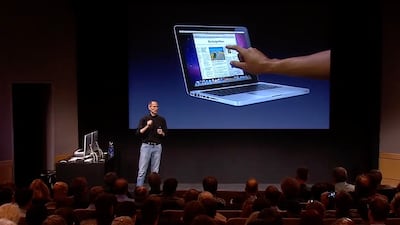

Apple's “pro and tell” event will take place next week, and a significant upgrade to the MacBook line-up is likely to be announced – potentially going against something that Steve Jobs once said.
News outlets have reported that the technology giant will introduce a MacBook that uses an organic light-emitting diode (OLED) display with a touchscreen option.
It would be the first MacBook to contain a touchscreen, and the expected debut starkly contrasts with Apple-cofounder Mr Jobs's stance on portable computer touchscreens.
“We've done tonnes of user testing on this, and it turns out it doesn't work,” the late Apple chief executive said in 2010 during a product launch event, discussing why trackpads worked well with laptops and touchscreens didn't.
“Touch surfaces don't want to be vertical, and it gives a great demo but after a short period of time, you start to fatigue, and after an extended period of time, your arm wants to fall off. It doesn't work, it's ergonomically terrible.”
Apple's current MacBook line-up uses mini-LED displays.
But there is a lengthy list of products that have made debuts years after Apple, and even Mr Jobs, dismissed their concepts.
Those products include video-capable iPods, stylus pens, larger iPhones and medium-sized iPads.
“Asus, Lenovo, HP, and Dell have already helped bring OLED screens to premium notebooks, but Apple’s entry could be a turning point,” said David Naranjo, associate director for technology market analysis firm Counterpoint Research.
He also pointed out that Apple's expertise in establishing dominance in supply chains could help it significantly, and even help other companies.
“Not unlike smartphones, when Apple adopts OLED, it boosts manufacturing capacity, improves yields, and lowers panel costs, making OLED more affordable for a wider range of products,” he explained.
Mr Naranjo said that he believed a 14-inch MacBook with an OLED display, based on the price of materials, might cost between $2,799 and $2,999.
“This higher price would cover the cost of advanced tandem OLED technology, possible touchscreen features, and ongoing memory expenses,” he said.
But he cautioned that although Apple's products tend to exceed expectations, new MacBooks are arriving at a time when overall PC sales are starting to slow, giving the California technology company an additional hurdle to overcome.
According to Bloomberg, Apple will also be changing the MacBook Pro's name to MacBook Ultra.
As has been the case with the company's events in recent years, some are expecting new iMac and iPad models with simple upgrades consisting of faster semiconductors, improved displays and slightly tweaked designs.
Regardless of what transpires at the event on Wednesday, it will cap the busiest Apple product introduction seasons in recent years.
In September, the company announced the keenly awaited foldable iPhone Duo.
Weeks later, it introduced a new device, HomeView, which incorporates AI, Siri and the company's iOS to allow people to interact with various products in their home.
It also announced the Apple TV 4K, the first significant upgrade to the product in several years.

