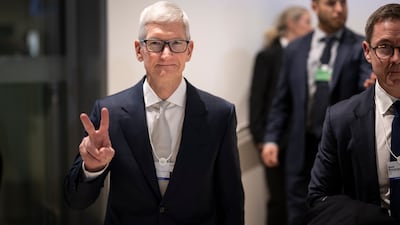

On his last day as Apple's chief executive, Tim Cook expressed his appreciation for the company and its customers.
Less than 24 hours before his successor, John Ternus, takes on the role at Apple, Mr Cook wrote a brief farewell message.
“Sending lots of love to the Apple community on my last day as CEO,” he posted on X, adding that he will remain at Apple as the company's executive chairman.

“My title changes tomorrow, but the love I have for the Apple community never will ... thank you for being a constant source of inspiration.” He added that his “gratitude is endless”, and that he was excited for the next chapter.
Mr Cook was named chief executive of Apple shortly after Steve Jobs resigned due to ill health in 2011, and many analysts saw the shoes of the company's founder as almost too big to fill.
Despite being ousted from Apple in 1985, Mr Jobs had streamlined the company's bloated product line after returning in 1997, introducing the iMac, iPod, and iPhone and ushering in an era of cloud services. He took a firm close to implosion and made it one of the world's most recognisable companies.
During his tenure, Mr Cook significantly strengthened Apple's cloud computing offerings and bolstered the company's other services such as Apple Music and Apple TV, providing the company with a recurring revenue stream that gave it a competitive edge and an alternative to traditional hardware sales.
The introduction of the Apple Watch in 2015, under the oversight of Mr Cook, proved to be a wise move, and Apple remains one of the major players in the wearables sector.
Occasional missteps
In terms of financial health, sales, revenue and company growth, Mr Cook improved on and expanded the vision that Mr Jobs had for the company in 2011.
Mr Cook used his background in inventory management and manufacturing to strengthen Apple's operational efficiency around the world, giving the firm a significant advantage when negotiating with suppliers to build its arsenal of design-focused products.
But there were occasional misfires. Apple Vision Pro, the company's first foray into mixed reality headsets – widely considered to be a pet project of Mr Cook – disappointed analysts in terms of sales.
Media reports of lay-offs affecting the Apple Vision Pro division were plentiful, though many speculate that the company has not abandoned the initiative and is instead working on a cheaper device.
Though speculation swirled for years about Apple's plans for a car, Mr Cook ultimately decided to cancel that expensive project in what was seen as a rare failure for a company that prides itself on exceeding expectations.

As OpenAI's ChatGPT became available in 2022, Mr Cook faced criticism for making Apple late to the artificial intelligence game.
John Ternus's to-do list
Much like the scenario faced by Mr Cook, Apple's eighth chief executive John Ternus faces the daunting task of topping what his predecessor did.
Mr Ternus is no stranger to Apple's culture, and his background gives him an advantage over Mr Cook. The 51 year old previously served as Apple's senior vice president for hardware engineering, and worked his way into the upper echelons of the company since joining in 2001.
Technology analysts say that he played a vital role in the development of products such as the iPad and AirPods, as well as updates to the Mac line and the company's silicon chips.
Though Mr Cook had no problem making sure Apple's iPhone sales continued to grow, many technology experts and loyal Apple customers have been waiting for the company to deliver a foldable iPhone.

Competitors such as Samsung have had foldable phones available for several years, but customers familiar with Apple's famous attention to detail believe that under the supervision of Mr Ternus, the company can deliver a superior experience, especially given his hardware background.
Expectations are high on this front, and speculation abounds that Mr Ternus will announce a foldable iPhone on September 9 during a keenly awaited product event at Apple's headquarters in Cupertino, California.
In Mr Cook's final email to Apple employees on Monday, he gave his successor a vote of confidence. “Few people understand what it takes to build products that change the world the way John does,” he said. He added that he was excited about Mr Ternus taking over.
Though hardware is his expertise, technology experts have also pointed out that Mr Ternus will also need to take a close look at Apple's AI offerings such as Siri and Apple Intelligence, to see where the company still needs to make improvements and not fall behind the competition.
Corporate drama
The ascension of Mr Ternus mirrors that of Mr Cook in terms of drama, but in Apple's 50 years, peaceful transitions have been somewhat rare.
Apple's first chief executive, Michael Scott, was abruptly removed in 1981 amid a series of missteps by the young company.
He was temporarily replaced by one of Apple's first investors, Mike Markkula, as interim boss until Apple's co-founder, Mr Jobs, managed to convince John Sculley, who was the PepsiCo chief executive, to join in 1983.
Though initially viewed as a dynamic partnership, Mr Jobs and Mr Sculley had a major falling out in 1985 as computer sales tanked, leading Apple's board to strip Mr Jobs of his official role at the company.
Mr Sculley met a similar fate in 1993, when Apple executive Michael Spindler took over the role of chief executive, but he only lasted a few years until the board forced him to step aside as the company continued to lose market share.
Gil Amelio, an Apple board member and former chief executive of National Semiconductor, took over afterwards and decided to bring Mr Jobs back into the fold by purchasing his company, NeXT – only for the board to sack Mr Amelio and name Mr Jobs as interim chief executive.