



Oman’s Etlaq spaceport opened its doors to the public for the first time on Monday, hosting a three-day fan zone experience designed to spark interest in space exploration among the country’s youth.
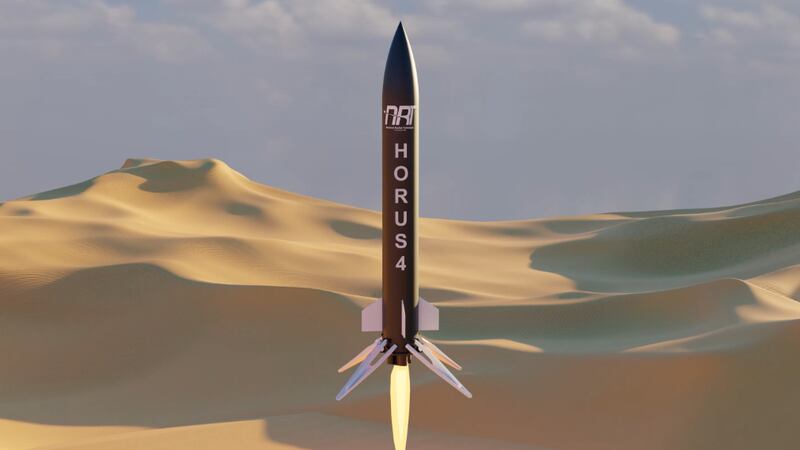
The event had originally been scheduled to culminate with the launch of the Horus-4 experimental rocket, developed by London company Advanced Rocket Technologies (ART).
But unsuitable weather forced the test flight to be delayed, with a new launch date to be announced soon.
Pupils from across Duqm – a coastal town about 550km from Oman's capital city of Muscat – took part in a variety of educational activities.
The fan zone, called Etlaq FX, included four tents that were placed about 3km from the spaceport’s operations team and launch pad, with the site overlooking the Arabian Sea.
Vendors from nearby villages also took part by offering workshops and activities for children.
The fan zone still buzzed with excitement, however, as pupils took part in activities that blended creativity and science.
One of the most popular attractions was hosted by Omani Archives, featuring a "space passport" activity where children collected stamps to complete various stations, including an "approved for launch" stamp.
Another creative corner invited pupils to write about or draw their dreams, which were then placed in a "time capsule" that organisers plan to open at a future fan zone event.
“We thought it was necessary to participate because this is something new that’s happening in Oman and for the first time in the region,” said Jannah Al Towaiya of Omani Archives.
“We think it’s important for children to understand that space exploration is happening here in Oman.”
The second day of the fan zone is meant to host a variety of competitions for the pupils, including in robotics. Organisers said they have planned more educational activities for children on the final day of the event to replace the postponed launch viewing.
The Horus-4 rocket, once launched, will perform a low-altitude hop test to demonstrate the performance of its reusable propulsion system.

Producing about 155 newtons of thrust, the small prototype is expected to reach an altitude of 75 metres and a speed of 24 metres per second before landing back at the site.
“By leveraging the state-of-the-art facilities at Etlaq Spaceport, ART aims to demonstrate the viability of reusable rocket technology, paving the way for more sustainable and cost-effective space missions in the future," ART said in a statement.
Start-ups are taking advantage of Oman’s upcoming spaceport to test their rocket systems, while Omani engineers use the operations to gain experience and prepare the site for full commercial services by the end of the decade.
The spaceport already hosted its first rocket launch in December with a 6.5-metre rocket, which paved the way for more test flights in 2025.
Oman is also involving its youth in the process through experiences such as the fan zone to create a future talent pipeline for its space sector.
It is the first time public launch viewing is being made possible in the Middle East, and reflects the growing investment and interest from the public and private sectors in space.
Launch sites in Florida and Kazakhstan have offered public viewing areas for years, drawing crowds from around the world to witness the thrill of a rocket lifting off.
Apart from Horus-4, Oman plans to host four more test flights this year.
The next is expected in June or July, when the Kea 1 rocket, made by New Zealand company Stellar Kinetics, is due to take off.

