
Oman’s Etlaq Spaceport is getting ready to welcome the public this month, with a fan zone opening so visitors can watch a rocket test flight up close.
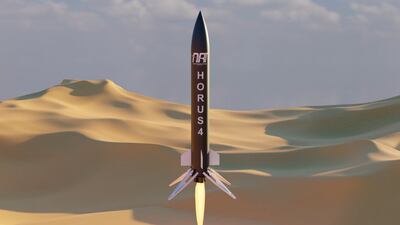
The launch attempt will feature a 1-metre Horus-4 rocket prototype, developed by London company Advanced Rocket Technologies (ART), and is one of five demonstration missions planned at the site this year as Oman positions itself in the commercial space industry. It was initially scheduled for April 24, but has been postponed to April 30.
A three-day fan experience in the free-of-charge zone, called Etlaq FX, will feature a series of activities for different age groups, including a robotics competition.
“It is an interactive area within the spaceport, so we can give the public an opportunity to see the launch and engage them with educational activities,” said Zainab Alsalhi, business development manager for Etlaq, during a webinar this month.

Launch sites in Florida and Kazakhstan have offered public viewing areas for years, drawing crowds from around the world to witness the thrill of a rocket lifting off.
But this will be the first such experience in the Middle East, and it reflects the growing investment and interest from the public and private sectors in space.
Dr Dimitra Atri, an astrophysicist at the New York University Abu Dhabi, said watching launches can inspire people to pursue careers in science and tech.
“The Apollo programme in the US, with public access to space launches, demonstrated the profound impact of public engagement with space exploration, sparking curiosity and driving interest in Stem for decades,” he told The National. “Oman's commitment to public access at its new spaceport is a strategic move that can cultivate a similar long-term enthusiasm in young people, ultimately benefiting the nation's future in science and technology.”
Which rocket is launching?
Horus-4, a small experimental rocket, will perform a “hop test” as part of the Unity-1 mission. It can produce 155 newtons of thrust to reach an altitude of 75 metres with a velocity of about 24 metres per second.
It will lift off and land back at the site, helping the company to measure how the rocket performs through different phases, including the launch, in-flight manoeuvres, landing sequence and touchdown.
“The upcoming launch of Horus-4 represents a significant milestone for ART and the broader space community in the Middle East and Africa,” the company said in a statement. “By leveraging the state-of-the-art facilities at Etlaq Spaceport, ART aims to demonstrate the viability of reusable rocket technology, paving the way for more sustainable and cost-effective space missions in the future.”

What will the fan zone offer?
The fan zone will feature five tents dedicated to reception, hospitality, a live broadcast of the launch, merchandise, and an outdoor viewing area.
“The reception test is going to be the entry point for the visitors,” said Ms Alsalhi. “The safety team will give a briefing first. We have an outdoor viewing area, of course.” She said there will be chairs available, and shaded areas. Visitors can also bring their own small chairs and small tents but barbecues are not allowed.
Specialists will be on site to explain the launch process and timeline. The three-day experience starts on April 28, with the soft opening of the fan zone from 12pm to 6pm.
The Full Etlaq Fan Experience on April 29 will offer activities ranging from a drawing area, games and robotics competitions from 12pm to 6pm. Omani space officials are aiming for a 9am launch on April 30, with the fan zone opening from 7.30am to 2pm.
Advance registration is mandatory and space fans are encouraged to join Etlaq’s newsletter to receive updates on how to register. Ms Alsalhi said slots are limited and will be assigned on a “first come, first served basis”.
How to get there
The spaceport is in Duqm, which is six hours, about 530km, from Muscat by car and 90 minutes by air. Only Oman’s Salam Air operates flights from Muscat to Duqm.
In Duqm, there will be dedicated buses to transport visitors from hotels in the city to the spaceport.
The next launch is expected to take place in June or July, when the Kea 1 rocket, made by New Zealand company Stellar Kinetics, is due to take off.
These are all test launches, allowing start-ups to assess their technology and for Oman to assess what is needed to begin commercial operations later in the decade.

