



It was not only Moroccans wildly celebrating their team's historic World Cup knockout victory over Spain on Tuesday — as fans from across the Middle East and North Africa were left ecstatic at what they saw as a victory for the entire Arab world.
From Baghdad to Casablanca, fans cheered as Morocco became the first Arabic-speaking country to reach the quarter-finals of the World Cup in Qatar, the first held in an Arab country. They won 3-0 on penalties after a 0-0 draw following extra time.
In Rabat, where fans had crowded cafes for hours beforehand to watch the game, people jammed downtown roads leading to a square where fans had partied after previous Morocco victories, flags waving from their windows and horns furiously sounding.
“It is the first time I had this feeling,” said Fahd Belbachir, on his way to the city centre. “We are so proud.”
Leaders from across the Arab world showered praise on the Moroccan side.
“Congratulations to the Atlas lions, you delighted us,” Queen Rania of Jordan wrote on Twitter. “Wow Morocco, you did it again!”
In Rabat, Brahim Ait Belkhit said his joy was so great that he had patched up a feud with somebody he had avoided for years after seeing them in the street.
“It made us forget our old quarrel,” he said.
Cheers also went up in Cairo, Beirut, Tunis, Amman and Ramallah as Arabs rejoiced at the largely unexpected win over highly fancied Spain.
It echoed the pan-Arab pride that has surfaced during several memorable performances by Arab sides at the Qatar World Cup — a contrast to the political disputes that have long divided some Arab states.
Outside the stadium in Doha, where Moroccan fans had appeared to vastly outnumber Spaniards with more than 44,000 people attending, women raised their voices in ululation and men banged drums in a spontaneous dance party.
Hundreds of Moroccan fans had flown into Qatar for the game, joining the large number of resident Moroccans, and there had been some scuffles as people without tickets were unable to enter the stadium.
“I grew up watching big Spanish teams Barcelona and Madrid. So to beat a huge country like Spain is a huge victory for Morocco,” said Taha Lahrougui, 23, a Moroccan who lives in Doha.
Victory over Spain, which ruled large parts of Morocco in the colonial era and where many Moroccans now live, may have felt particularly sweet.
Fans packed Barcelona's Raval district, waving Moroccan flags, cheering and lighting flares. The winning penalty taker, Achraf Hakimi, was himself born in Madrid.
Ahmed Inoubli, who is half-Tunisian and half-Algerian, lives in Doha and is married to a Moroccan woman. He said “nothing is impossible” at the World Cup.
“We have an Arab team. Look at these fans. Do you think they are all Moroccan? No — just Arabs,” he said gesturing towards the enormous, joyful crowd.
An Arab victory
Qatari Emir Sheikh Tamim watched the game in the stadium, giving a thumbs up and holding the Moroccan flag, and congratulations for the winning team quickly poured in from Arab leaders.
Sheikh Mohammed bin Rashid, UAE Vice President and Ruler of Dubai, Iraqi Shiite cleric Moqtada Al Sadr, Lebanese Prime Minister Najib Mikati and Libyan Prime Minister Abdul Hamid Al Dbeibah were among those who congratulated Morocco.
“This is a win for all Arabs, not just Morocco and the joy is even greater since it was achieved on Arab soil,” said Hazem Al Fayez, a Jordanian who was honking his car horn in Amman to celebrate.
In Beirut, Ralph Beydoun, 31, said he thought it was “a great and much-needed win for the youth of the Arab world and especially the youth of Morocco”.

At a Tunis cafe, fans clapped and sang as the game finished.
“It is a historic win and Morocco is honouring all Arabs and Africans,” said Nourredine Sassi.
Egyptian Mohamed Aly, 35, said he felt nervous as he watched the match in Cairo.
“Playing in Qatar helps them a lot, all Arab fans are supporting them there,” he said.
Morocco are also the last African team left in the tournament and only the fourth to ever reach the quarter-finals after Cameroon in 1990, Senegal in 2002 and Ghana in 2010.
Morocco has in recent decades more fully embraced its African and Amazigh, as well as Arab, identity, and the victory was also cheered elsewhere in the continent.
Sudan's Deputy Ruling Council head Mohamed Dagalo tweeted “Thanks to the Atlas lions”, adding “congratulations for the Arab and African fans”.
“This is a dream come true. We won — and Africa won with us,” said Lahcen Damolay, a teacher in the crowd cheering Morocco's victory in central Rabat.
Player ratings: Morocco v Spain - in pictures
-
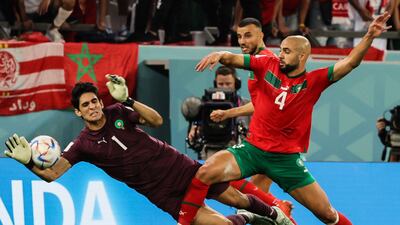
MOROCCO RATINGS: Bono, 9 – The eccentric keeper performed like his namesake with some fantastic saves, but most importantly, he was the saviour in the shootout. AFP -
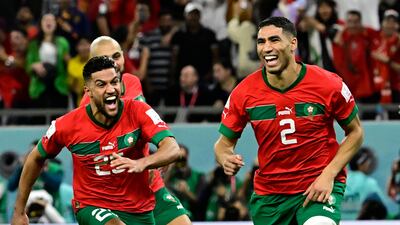
Achraf Hakimi, 9 – The audacious PSG sensation rounded off a great defensive display with a panenka to knock out the Spanish. AFP -

Nayef Aguerd, 8 – The West Ham star was disappointed to hobble off with an injury after showcasing great focus throughout to go alongside some key clearances. AFP -
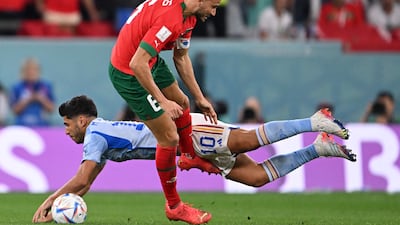
Romain Saiss, 8 – Captain supreme was a vocal leader from start to finish and barely missed a step outside of a needless yellow card. AFP -
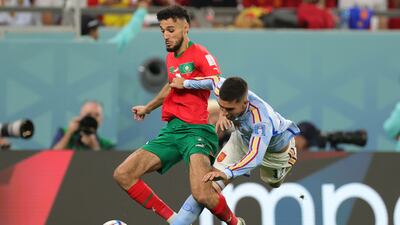
Noussair Mazraoui, 7 – After losing a few early battles, Mazraoui went box to box with great challenges and a nice effort that tested the keeper in the first half. EPA -
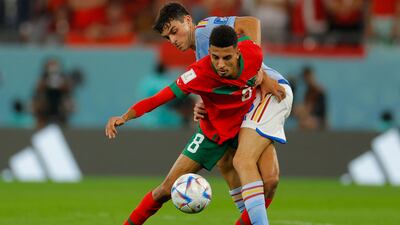
Azzedine Ounahi, 8 – Cleared everything up just in front of the defence and always looked like an important presence on the counter. AFP -
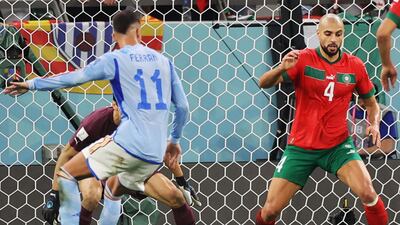
Sofyan Amrabat, 9 – Looked strong whenever he was challenged, never stopped running and prevented several key through balls from reaching the box. EPA -
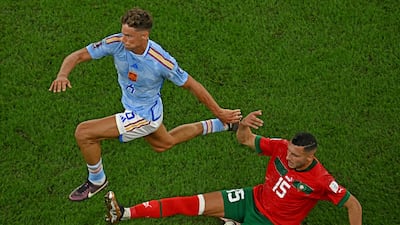
Selim Amallah, 8 – The midfielder provided some smart cover when Morocco needed it and had a few nicely-timed interceptions. AFP -
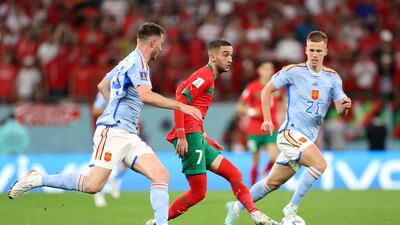
Hakim Ziyech, 8 – Chelsea’s finest came up big with a strong performance at both ends of the pitch, capping it off with a successful penalty. Getty -
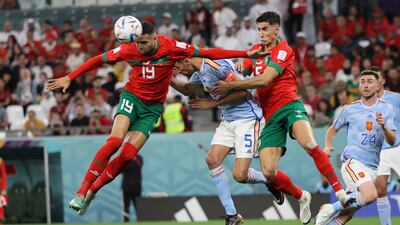
Youssef En-Nesyri, 7 – Outside of a few nice plays on the defensive side of things, the big centre forward barely had a meaningful touch. EPA -

Sofiane Boufal, 7 – While he was forced to drop quite deep to get into the action, Boufal showed solid footwork and did a good job of hunting down the ball. EPA -
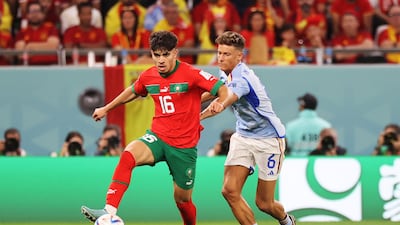
SUBS: Abde Ezzalzouli, 7 – Worked hard to make things happen down the flank despite not having many big opportunities. EPA -
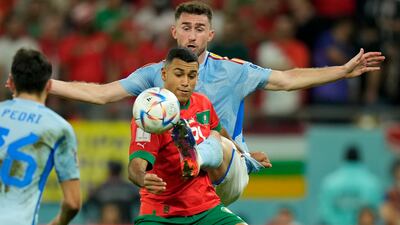
Walid Cheddira, 5 – The substitute forward had three golden opportunities to put Spain away, but unfortunately, he didn’t take any of them. AP -
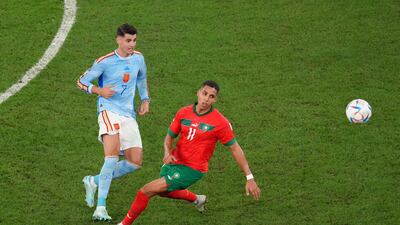
Abdelhamid Sabiri, 8 – After some amazing moments at the back, Sabiri buried his penalty to send Morocco on their way to victory. PA -

Jawad El Yamiq, 7 – Did well to shield the ball every time he was called upon and saved Morocco from late heartbreak at the end of extra time. AP -
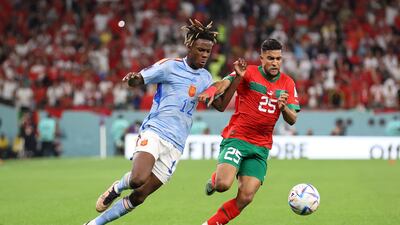
Yahya Attiyat Allah, 7 – The no-nonsense defender held off his man, kept his composure when needed and did his job perfectly. Getty -
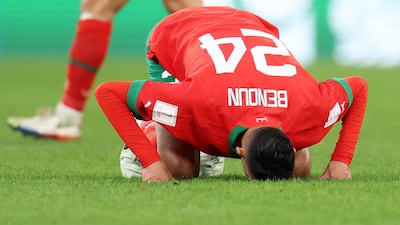
Badr Benoun, N/A – Didn’t have much time to make an impact in what served as a brief cameo prior to the shootout, in which he missed a penalty. Getty -
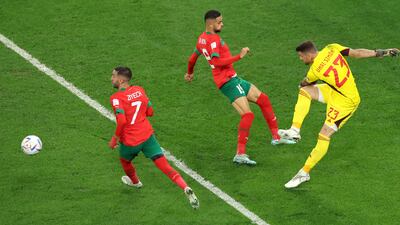
SPAIN RATINGS: Unai Simon, 7 - Couldn’t quite hold a 32nd minute powerful shot from Mazraoui but then grabbed hold of it. Saved a 104th minute shot from Cheddira. Saved Morocco’s third penalty. Getty -
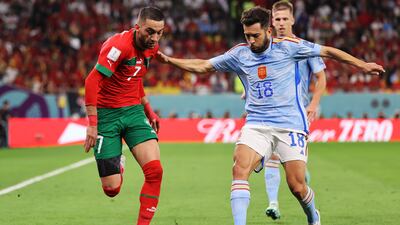
Jordi Alba, 7 - Gave the ball away which led to Morocco’s best chance of the first half. Up against tactically disciplined opponents who limited his advances. EPA -
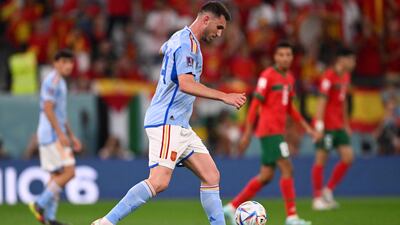
Aymeric Laporte, 8 - Defended well. Key header away in a spell of Moroccan pressure on 43. Booked on 76. Had a free header on 95 minutes and got a touch to stop a Moroccan chance on goal. AFP -
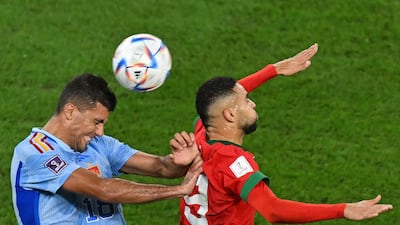
Rodri, 8 - The Manchester City defender and his club teammate Laporte completed more passes than the entire Morocco team. Little got past them, but when they were beaten Morocco had three solid chances. AFP -
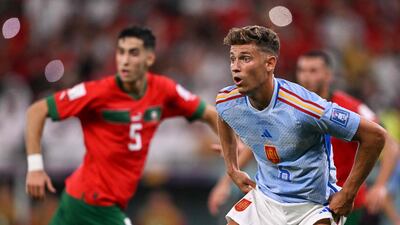
Marcos Llorente, 6 - Not usually a right back, it showed too often in front of the predominantly Moroccan contingent of the 44,667 present. AFP -
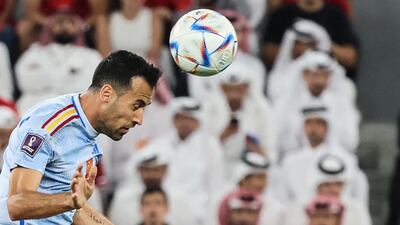
Sergio Busquets, 6 - Spain had 81% of possession but while Busquets normally has one of the highest involvement rates, Morocco squeezed him and his 57 touches (after 90 minutes) compared badly to 168 for Rodri and 149 for Laporte immediately behind him. 120th minute shot blocked as he pushed forward. Had his penalty, Spain’s third, saved. AFP -
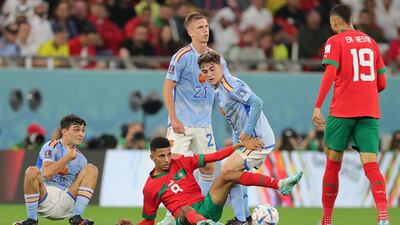
Pedri, 6 - Difficult to advance against the tenacious Amrabat as Spain went to extra time for the fifth successive time in a major tournament. EPA -
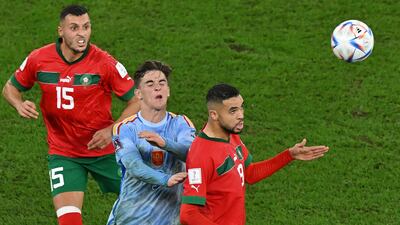
Gavi, 6 - The youngest player to start a knock-out game at the World Cup since Pele, his 25th minute shot was pushed on to the bar – though it was offside. AFP -
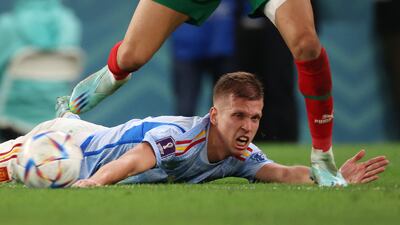
Dani Olmo, 5 - Played in an attack which only had one shot on target in the first half, the lowest ever for Spain in a World Cup match. He made it two on 54 with a strike on target from a tight angle. His 94th minute free-kick was goal-bound and well saved. Reuters -
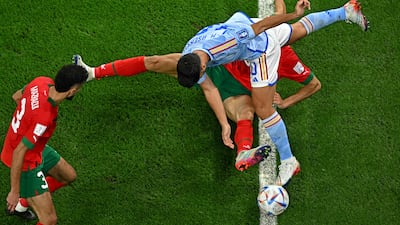
Marco Asensio, 5 - Smashed a shot into the side netting after a brilliant run to beat the offside trap. And that was about it against a highly competent defence. AFP -
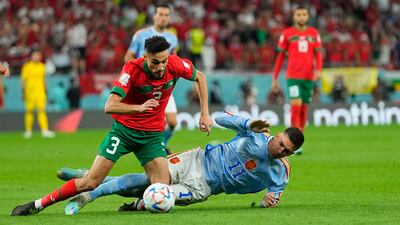
Ferran Torres, 5 - Nutmegged the excellent Mazraoui after 47 and won a free-kick when pulled back. No shots, let alone on target and no key balls as Spain were stifled by their neighbours. AP -
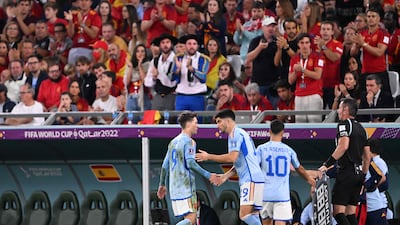
SUBS: Carlos Soler, 6 - On for Gavi on 63. Whipped a 90th minute free-kick in. Took Spain’s second penalty - poor and saved. AFP -
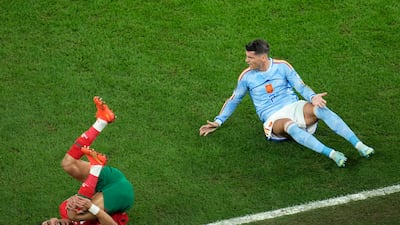
Alvaro Morata, 5 - On for Asensio after 63. Ran into the Morocco box on 69. Struck a shot across goal on 81. Poor header in 90th minute from a Soler cross. Couldn’t find a final pass in a 116th minute attack. AP -
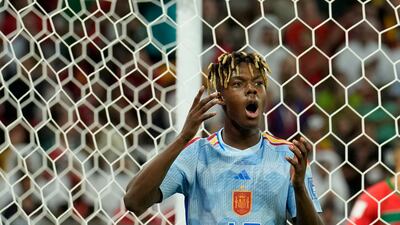
Nico William, 5 - On for Torres after 75. Lively. Set up Morata with a shot. Then brought off himself. AP -
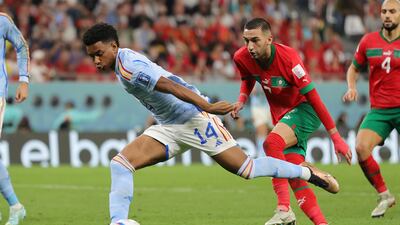
Alejandro Balde, 6 - On for Alba after 97. Shot blocked two minutes later. EPA -
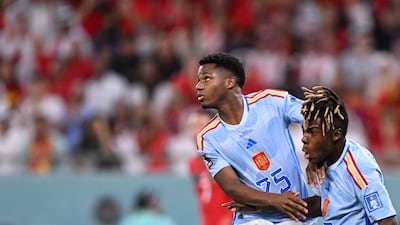
Ansu Fati, 6 - On for Olmo on 97. Brought energy to Spain’s attack. AFP -
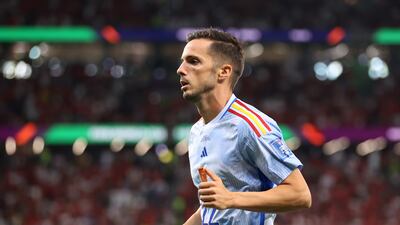
Pablo Sarabia, 6 - On for Williams after 118 and hit a very good ball in – then hit the post with his own shot after 123 minutes, the last play of the game. Missed Spain’s first penalty. Getty



