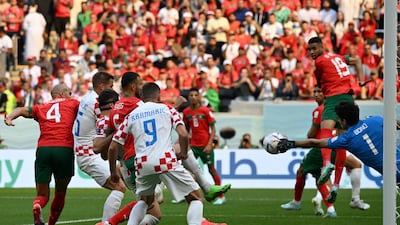
Having battered Belgium but come away with nothing but reputation enhanced, Canada quickly set about rectifying the matter.
In the very next match, in the very first minute and a bit. Alphonso Davies grabbed it, thumping home a header to atone for his penalty miss against the world's No 2-ranked side.
In the process, he extended one of the most remarkable stories at this Fifa World Cup. From being born in refugee camp to escaping to Canada and eventually a Bundesliga and Champions League winner with Bayern Munich, to now, scorer of his adopted country’s first goal at a global finals.
Could it get any more memorable? Well, it arrived 1:07 minutes into Sunday’s Group F encounter with Croatia, the 2018 runners-up, elevating it to the quickest goal scored this whole week in Qatar.
In fact, it was the second-fastest notched in all the World Cups, second only to Mathias Jorgenson’s 57-second strike for Denmark four years ago. Who against? Yup, Croatia.
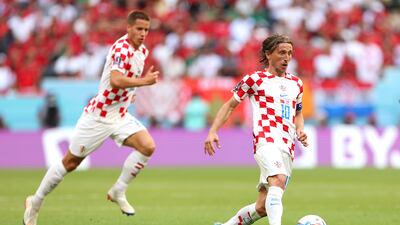
But, just like in Russia, the resolute Europeans turned it around. With captain Luka Modric pushed further forward – he conducted from deep in the goalless opener with Morocco – Zlatko Dalic’s side ultimately made their streetwise savvy tell.
Undeterred by Andrej Kamaric’s correctly disallowed effort, ruled out because Marko Livaja had strayed a fraction offside, Croatia hit back.
In a red-and-white chequered, eight-minute whirl before half-time, they scored twice. First, Ivan Perisic conjured a lovely reverse ball to Kamaric, who slotted his left-footed shot from the angle under Canada goalkeeper Milan Borjan.
Then Josip Juranovic turned a little luck into a smart pass and the comeback was complete. He slipped in Livaja, who finished brilliantly low beyond Borjan at full stretch. The goal sparked wild celebrations on the Croatia bench, with most directing their jubilation towards their Canadian counterparts.
Maybe that was to be expected: in the post-match huddle against Belgium, Canada coach John Herdman used some choice words when sounding the rallying cry for Croatia.
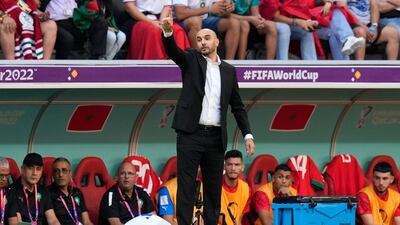
Clearly, it struck a chord with Dalic and troops; the former Al Ain manager subsequently accused Canada of not respecting his typically respected side. So on Sunday, right after Livaja’s strike, tensions boiled over. Thankfully, they quickly dampened.
Canada, though, weren’t done fighting – figuratively – on the pitch. Right at the beginning of the second half, substitute Jonathan Osorio curled an effort inches past the post.
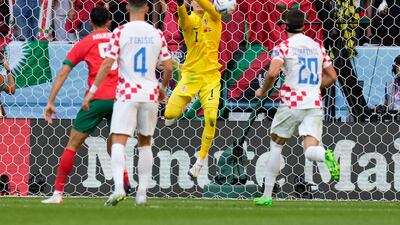
Soon thereafter, Borjan made an incredible save, denying Livaja a surely certain goal. Ditto Croatia goalkeeper Dominik Livakovic from precocious Lille forward Jonathan David.
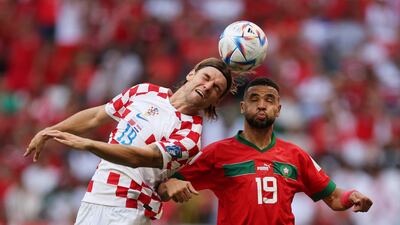
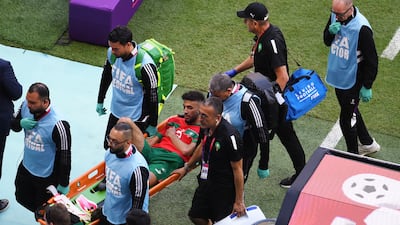
Morocco 0 Croatia 0 - in pictures
But Croatia’s know-how told. Having weathered the early advance, they crept further ahead. With 20 minutes remaining, Perisic crossed to Kramaric at the back-post and, with one sublime touch to sweep inside his marker, with his next the Croat brushed home the ball. Croatia had their cushion.
They would not relinquish it; indeed, they extended. In additional time, Canada’s Kamal Miller miscontrolled, Croatia’s Mislav Orsic raced away, rolled in Lovro Majer and the result was flecked with a final flourish.
With the 4-1 win, Croatia moved joint top of the group heading into the final match day, while Canada, after successive defeats, will exit once this stage culminates next week.
In a tale as old as World Cup 2022 injury-time, the young upstarts were schooled by wiser heads. At their heart, Modric may be 37, but the Real Madrid maestro remains the integral cog in this battle-hardened machine.
And that’s what could carry this Croatia forward, perhaps not quite as far as four years ago, but deep into the tournament nonetheless. Unlike this hugely promising Canada, bright-eyed and contesting their country’s first World Cup in 36 years, they have been there. And, almost, done it.

The candidates
Dr Ayham Ammora, scientist and business executive
Ali Azeem, business leader
Tony Booth, professor of education
Lord Browne, former BP chief executive
Dr Mohamed El-Erian, economist
Professor Wyn Evans, astrophysicist
Dr Mark Mann, scientist
Gina MIller, anti-Brexit campaigner
Lord Smith, former Cabinet minister
Sandi Toksvig, broadcaster
What are the main cyber security threats?
Cyber crime - This includes fraud, impersonation, scams and deepfake technology, tactics that are increasingly targeting infrastructure and exploiting human vulnerabilities.
Cyber terrorism - Social media platforms are used to spread radical ideologies, misinformation and disinformation, often with the aim of disrupting critical infrastructure such as power grids.
Cyber warfare - Shaped by geopolitical tension, hostile actors seek to infiltrate and compromise national infrastructure, using one country’s systems as a springboard to launch attacks on others.
Desert Warrior
Starring: Anthony Mackie, Aiysha Hart, Ben Kingsley
Director: Rupert Wyatt
Rating: 3/5
Gulf Under 19s final
Dubai College A 50-12 Dubai College B
Mercer, the investment consulting arm of US services company Marsh & McLennan, expects its wealth division to at least double its assets under management (AUM) in the Middle East as wealth in the region continues to grow despite economic headwinds, a company official said.
Mercer Wealth, which globally has $160 billion in AUM, plans to boost its AUM in the region to $2-$3bn in the next 2-3 years from the present $1bn, said Yasir AbuShaban, a Dubai-based principal with Mercer Wealth.
“Within the next two to three years, we are looking at reaching $2 to $3 billion as a conservative estimate and we do see an opportunity to do so,” said Mr AbuShaban.
Mercer does not directly make investments, but allocates clients’ money they have discretion to, to professional asset managers. They also provide advice to clients.
“We have buying power. We can negotiate on their (client’s) behalf with asset managers to provide them lower fees than they otherwise would have to get on their own,” he added.
Mercer Wealth’s clients include sovereign wealth funds, family offices, and insurance companies among others.
From its office in Dubai, Mercer also looks after Africa, India and Turkey, where they also see opportunity for growth.
Wealth creation in Middle East and Africa (MEA) grew 8.5 per cent to $8.1 trillion last year from $7.5tn in 2015, higher than last year’s global average of 6 per cent and the second-highest growth in a region after Asia-Pacific which grew 9.9 per cent, according to consultancy Boston Consulting Group (BCG). In the region, where wealth grew just 1.9 per cent in 2015 compared with 2014, a pickup in oil prices has helped in wealth generation.
BCG is forecasting MEA wealth will rise to $12tn by 2021, growing at an annual average of 8 per cent.
Drivers of wealth generation in the region will be split evenly between new wealth creation and growth of performance of existing assets, according to BCG.
Another general trend in the region is clients’ looking for a comprehensive approach to investing, according to Mr AbuShaban.
“Institutional investors or some of the families are seeing a slowdown in the available capital they have to invest and in that sense they are looking at optimizing the way they manage their portfolios and making sure they are not investing haphazardly and different parts of their investment are working together,” said Mr AbuShaban.
Some clients also have a higher appetite for risk, given the low interest-rate environment that does not provide enough yield for some institutional investors. These clients are keen to invest in illiquid assets, such as private equity and infrastructure.
“What we have seen is a desire for higher returns in what has been a low-return environment specifically in various fixed income or bonds,” he said.
“In this environment, we have seen a de facto increase in the risk that clients are taking in things like illiquid investments, private equity investments, infrastructure and private debt, those kind of investments were higher illiquidity results in incrementally higher returns.”
The Abu Dhabi Investment Authority, one of the largest sovereign wealth funds, said in its 2016 report that has gradually increased its exposure in direct private equity and private credit transactions, mainly in Asian markets and especially in China and India. The authority’s private equity department focused on structured equities owing to “their defensive characteristics.”
COMPANY%20PROFILE
%3Cp%3E%3Cstrong%3ECompany%20name%3A%3C%2Fstrong%3E%203S%20Money%3Cbr%3E%3Cstrong%3EStarted%3A%3C%2Fstrong%3E%202018%3Cbr%3E%3Cstrong%3EBased%3A%3C%2Fstrong%3E%20London%3Cbr%3E%3Cstrong%3EFounders%3A%3C%2Fstrong%3E%20Ivan%20Zhiznevsky%2C%20Eugene%20Dugaev%20and%20Andrei%20Dikouchine%3Cbr%3E%3Cstrong%3ESector%3A%3C%2Fstrong%3E%20FinTech%3Cbr%3E%3Cstrong%3EInvestment%20stage%3A%3C%2Fstrong%3E%20%245.6%20million%20raised%20in%20total%3C%2Fp%3E%0A
The specs: Volvo XC40
Price: base / as tested: Dh185,000
Engine: 2.0-litre, turbocharged in-line four-cylinder
Gearbox: Eight-speed automatic
Power: 250hp @ 5,500rpm
Torque: 350Nm @ 1,500rpm
Fuel economy, combined: 10.4L / 100km
How%20champions%20are%20made
%3Cp%3E%0D%3Cstrong%3EDiet%3C%2Fstrong%3E%20%0D%3Cbr%3E7am%20-%20Protein%20shake%20with%20oats%20and%20fruits%0D%3Cbr%3E10am%20-%205-6%20egg%20whites%0D%3Cbr%3E1pm%20-%20White%20rice%20or%20chapati%20(Indian%20bread)%20with%20chicken%0D%3Cbr%3E4pm%20-%20Dry%20fruits%20%0D%3Cbr%3E7.30pm%20-%20Pre%20workout%20meal%20%E2%80%93%20grilled%20fish%20or%20chicken%20with%20veggies%20and%20fruits%0D%3Cbr%3E8.30pm%20to%20midnight%20workout%0D%3Cbr%3E12.30am%20%E2%80%93%20Protein%20shake%20%0D%3Cbr%3E%3Cstrong%3ETotal%20intake%3A%3C%2Fstrong%3E%204000-4500%20calories%20%0D%3Cbr%3E%3Cstrong%3ESaidu%E2%80%99s%20weight%3A%3C%2Fstrong%3E%20110%20kg%0D%3Cbr%3E%3Cstrong%3EStats%3A%3C%2Fstrong%3E%20Biceps%2019%20inches.%20Forearms%2018%20inches%3C%2Fp%3E%0A
Global state-owned investor ranking by size
|
1.
|
United States
|
|
2.
|
China
|
|
3.
|
UAE
|
|
4.
|
Japan
|
|
5
|
Norway
|
|
6.
|
Canada
|
|
7.
|
Singapore
|
|
8.
|
Australia
|
|
9.
|
Saudi Arabia
|
|
10.
|
South Korea
|
Ain Dubai in numbers
126: The length in metres of the legs supporting the structure
1 football pitch: The length of each permanent spoke is longer than a professional soccer pitch
16 A380 Airbuses: The equivalent weight of the wheel rim.
9,000 tonnes: The amount of steel used to construct the project.
5 tonnes: The weight of each permanent spoke that is holding the wheel rim in place
192: The amount of cable wires used to create the wheel. They measure a distance of 2,4000km in total, the equivalent of the distance between Dubai and Cairo.
SUCCESSION%20SEASON%204%20EPISODE%201
%3Cp%3E%3Cstrong%3ECreated%20by%3A%20%3C%2Fstrong%3EJesse%20Armstrong%3C%2Fp%3E%0A%3Cp%3E%3Cstrong%3EStars%3A%3C%2Fstrong%3E%20Brian%20Cox%2C%20Jeremy%20Strong%2C%20Kieran%20Culkin%2C%20Sarah%20Snook%2C%20Nicholas%20Braun%3C%2Fp%3E%0A%3Cp%3E%3Cstrong%3ERating%3A%3C%2Fstrong%3E%204%2F5%3C%2Fp%3E%0A
Building boom turning to bust as Turkey's economy slows
Deep in a provincial region of northwestern Turkey, it looks like a mirage - hundreds of luxury houses built in neat rows, their pointed towers somewhere between French chateau and Disney castle.
Meant to provide luxurious accommodations for foreign buyers, the houses are however standing empty in what is anything but a fairytale for their investors.
The ambitious development has been hit by regional turmoil as well as the slump in the Turkish construction industry - a key sector - as the country's economy heads towards what could be a hard landing in an intensifying downturn.
After a long period of solid growth, Turkey's economy contracted 1.1 per cent in the third quarter, and many economists expect it will enter into recession this year.
The country has been hit by high inflation and a currency crisis in August. The lira lost 28 per cent of its value against the dollar in 2018 and markets are still unconvinced by the readiness of the government under President Recep Tayyip Erdogan to tackle underlying economic issues.
The villas close to the town centre of Mudurnu in the Bolu region are intended to resemble European architecture and are part of the Sarot Group's Burj Al Babas project.
But the development of 732 villas and a shopping centre - which began in 2014 - is now in limbo as Sarot Group has sought bankruptcy protection.
It is one of hundreds of Turkish companies that have done so as they seek cover from creditors and to restructure their debts.