The global population of the already endangered lappet-faced vulture is crashing. Getty Images

Solving the mystery of the UAE's largest bird of prey


  • English
  • Arabic

Show the picture above to shoppers in a mall in Abu Dhabi or Dubai and most wouldn’t have a clue that this striking bird is a UAE species, reckons Basil Roy, conservation officer at Dubai Desert Conservation Reserve.

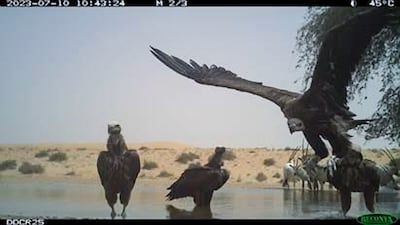
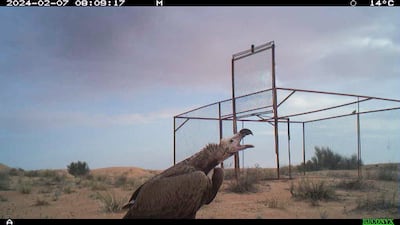
Yet it is found almost daily at the reserve. The image below − of the paler Gulf sub-species − was captured there, taken by a remote camera near a waterhole, only 50km from Dubai’s gleaming towers.

Both photos show endangered lappet-faced vultures. The global population was previously estimated at slightly more than 9,000, with numbers – especially in its African heartland – crashing.

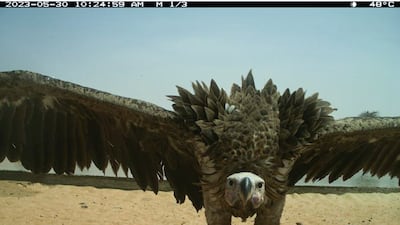
A lappet-faced vulture checks out the remote camera at a Dubai Desert Conservation Reserve waterhole, while a friend looks on. Photo: DDCR

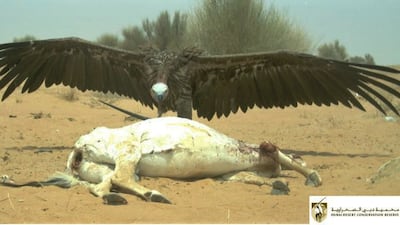
At almost a metre in length, with a three-metre wingspan, it is the largest bird of prey in the Emirates. (The slightly bigger cinereous vulture may dispute this but it’s a much rarer visitor.) But despite its conspicuous size and appearance, the lappet-faced vulture has a very low profile in the country.

“Apart from active birdwatchers and Emiratis who saw vultures growing up, I think the majority of the public in the UAE have no idea that there are lappet-faced vultures in the UAE,” says Mr Roy.

Species such as the dugong, the Arabian oryx, the houbara and green turtle rightly feature prominently in the Emirates' everyday: an Abu Dhabi aquarium star, its outline traced in light on the exterior wall; fibreglass models grazing along the capital’s Al Khaleej Al Arabi St; a swirling mural on a Yas Island building; an image on a supermarket's reusable bag.

Conspicuous by its absence is the lappet-faced vulture. Although extinct across most of the Middle East and North Africa region, it is still found in several Gulf countries.

Adding to its low profile, it is also an enigmatic presence at the reserve; no one’s exactly sure where many come from each day, or where they go.

The lappet-faced vulture has not been recorded nesting in the UAE since the early 1980s, though rumours persist it still raises chicks in remote areas – perhaps in Hatta, in the Hajar mountains. Some birds visiting the reserve are known to cross from Oman, others may be wanderers from Saudi Arabia.

Conservationists at the 225-square-kilometre reserve hope to solve these mysteries and raise the profile of the species through a GPS tracking programme. And ultimately, they hope to persuade the lappet-faced vulture to breed there.

Mr Roy says GPS trackers will “hopefully confirm our suspicions that our daily visitors are breeding and coming from the Hajar mountain range, and more specifically the Hatta region – only about 15km from the reserve”.

The birds descend on the reserve once the sun is high enough for thermals to carry them from their roosts, to dine on carcasses left out at feeding stations. Favourites are oryx and Arabian and sand gazelles that died of natural causes, while they turn their ample beaks up at many livestock carcasses – including such exotic fare as ostrich.

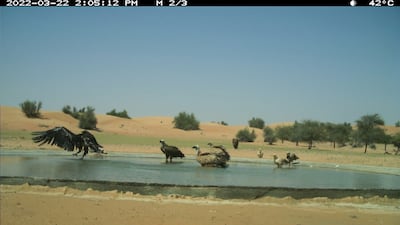
  • Lappet-faced vultures congregate at a waterhole in Dubai Desert Conservation Reserve. Photo: DDCR
    Lappet-faced vultures congregate at a waterhole in Dubai Desert Conservation Reserve. Photo: DDCR
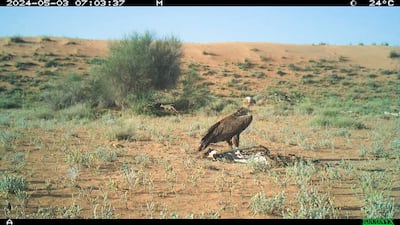
  • A lappet-faced vulture stands over the carcass of an Arabian oryx. The bird has a wingspan of almost three metres. Photo: DDCR
    A lappet-faced vulture stands over the carcass of an Arabian oryx. The bird has a wingspan of almost three metres. Photo: DDCR
  • A lappet-faced vulture investigates a remote camera at a DDCR waterhole. Photo: DDCR
    A lappet-faced vulture investigates a remote camera at a DDCR waterhole. Photo: DDCR
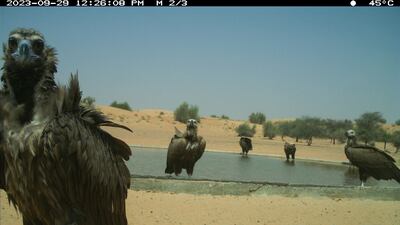
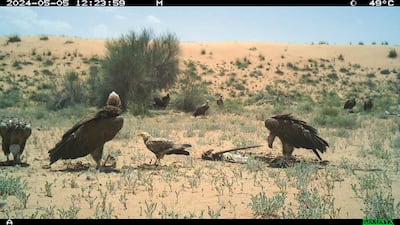
  • A cinereous vulture with lappet-faced vultures at a waterhole. Mystery surrounds where many of the birds come from. Photo: DDCR
    A cinereous vulture with lappet-faced vultures at a waterhole. Mystery surrounds where many of the birds come from. Photo: DDCR
  • Vultures gather at the reserve's waterholes to drink, bathe and bask. Photo: DDCR
    Vultures gather at the reserve's waterholes to drink, bathe and bask. Photo: DDCR
  • DDCR conservation officer Basil Roy checks a remote camera next to a waterhole. Chris Whiteoak / The National
    DDCR conservation officer Basil Roy checks a remote camera next to a waterhole. Chris Whiteoak / The National
  • Remote cameras are a vital tool for the reserve's conservationists in their quest to discover more about their enigmatic visitors. Chris Whiteoak / The National
    Remote cameras are a vital tool for the reserve's conservationists in their quest to discover more about their enigmatic visitors. Chris Whiteoak / The National
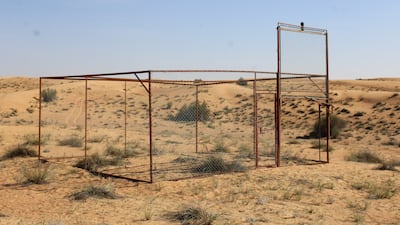
  • The cage constructed at the reserve in a project to capture and fit GPS tracking devices to lappet-faced vultures. Photo: DDCR
    The cage constructed at the reserve in a project to capture and fit GPS tracking devices to lappet-faced vultures. Photo: DDCR
  • A lappet-faced vulture feeds on a carcass at the reserve. Photo: DDCR
    A lappet-faced vulture feeds on a carcass at the reserve. Photo: DDCR
  • A much smaller Egyptian vulture joins lappet-faced vultures picking at the remnants of an oryx carcass. Photo: DDCR
    A much smaller Egyptian vulture joins lappet-faced vultures picking at the remnants of an oryx carcass. Photo: DDCR
  • When installed in December 2023, the wary birds would come no closer than 60 metres from the cage. Now they approach to within five metres. Photo: DDCR
    When installed in December 2023, the wary birds would come no closer than 60 metres from the cage. Now they approach to within five metres. Photo: DDCR

They drink, bathe and bask at waterholes, remote cameras capturing vultures plonked stomach-down on the sand, giant wings stretched out to dry. The birds head off before sundown.

At the end of 2023, conservationists set up a large cage in the centre of the reserve, with carcasses strewn around. The aim is to entice these wary birds into the cage and fit them with GPS trackers and other tags. It’s a long process, requiring a lot of patience, but is coming tantalisingly close to success.

“Right after the cage was set up, vultures were recorded roughly 60 metres from the cage. Today, vultures are recorded five to 10 metres from the cage,” says Mr Roy.

DDCR conservation officer Basil Roy says the capture of the birds is planned for winter, to reduce heat stress. Chris Whiteoak / The National

“Now, they are staying just outside the cage, flying right next to it. I wouldn’t be surprised if we see them going inside the cage by this summer, fingers crossed, in one to three months.”

Welfare of the birds is top priority, says Dr Panos Azmanis, specialist wildlife vet and member of the International Union for Conservation of Nature Vulture Specialist Group and Wildlife Health Specialist Group.

The cage is specially designed for the species and a camera will verify the trapping so the team reaches it immediately to secure the birds in boxes. A remote-control door, a roof net and other adaptations will also feature, he says.

Roy Cooper / The National

“The most important safety is the training and preparation of the team, as well as the supervision of the trapping by an experienced vet to provide first aid in case of injuries and safeguard the welfare of the birds until their release,” says Dr Azmanis, who is scientific lead on the project.

Mr Roy says the operation shouldn’t take more than one hour, with the capture planned for winter to avoid heat stress for birds and researchers alike.

Dr Azmanis says data from the project could solve the mysteries surrounding the lappet-faced vulture in the Emirates, and help in its conservation.

Dr Panos Azmanis with a lappet-faced vulture chick tagged in Oman. The young bird has since been sighted at Dubai Desert Conservation Reserve. Photo: Dr Panos Azmanis

“We hope to learn the movements with UAE, if the bird is breeding in the Emirates and their overall ecology in the country. Moreover, we can assess disease and mortality and act quickly either to rescue a bird or perform a postmortem and identify the cause of death.

“With the movements of the birds, we will find which areas they visit, identify hot-spot risk areas and mitigate possible losses,” says Dr Azmanis.

Following on from the tagging programme will be an initiative to persuade the lappet-faced vulture to breed in the reserve.

Conservationists hope to make the reserve 'not only an area where vultures feed, but also breed'. Photo: DDCR

Likely sites for artificial nesting platforms are some of DDCR's 12 acacia groves. Four of these are ancient, and for centuries provided shade for weary travellers journeying between the mountains and coast. Archaeologists have found traces of their stop-offs in pottery fragments, pendants, seashells, coral pieces and a spearhead.

If successful, the initiative would make the reserve even more important for the lappet-faced vulture, says Mr Roy, as it would “not only be an area where vultures feed, but also breed”. It could also help to create “a regional network where information is shared to help conservation efforts”.

The Environment Society of Oman seeks to raise the profile of the species through education – with a cute cartoon lappet-faced vulture for the classroom. Photo: Environment Society of Oman

Across the border, the Environment Society of Oman has its own lappet-faced vulture tagging projects − with partners such as International Avian Research and the Environment Authority of Oman − and runs raptor education programmes in the community.

ESO research and conservation manager Maia Sarrouf Willson welcomes the Dubai projects. “These initiatives help understand the birds' local and regional movements and their dependency on specific habitats. These habitats need to be protected to allow safe breeding and nesting spaces for the parents,” says Ms Sarrouf Willson.

“Additionally, tracking the birds paves the way for broader conservation efforts between countries.”

But if the project succeeds, where would fledged birds go? Driving along the perimeter fence of DDCR, the contrast is stark. Within the reserve’s boundaries' broom bush – or fire bush – in the north gives way to the rimth shrub in the south. Both offer shade and root systems that provide a home for rodents and reptiles (round entrances made by gerbils; slot-shaped openings excavated by desert monitors and Leptien’s spiny-tailed lizard).

  • The Arabian oryx is the Dubai Desert Conservation Reserve's most famous resident – and the UAE's national animal. All photos: Chris Whiteoak / The National
    The Arabian oryx is the Dubai Desert Conservation Reserve's most famous resident – and the UAE's national animal. All photos: Chris Whiteoak / The National
  • An Arabian oryx calf emerges from a dune on the reserve. The species has been brought back from the brink of extinction, in a huge conservation success story for the UAE
    An Arabian oryx calf emerges from a dune on the reserve. The species has been brought back from the brink of extinction, in a huge conservation success story for the UAE
  • Sand gazelles are perfectly adapted to the reserve's landscape
    Sand gazelles are perfectly adapted to the reserve's landscape
  • A sandfish skink leaves tracks in the sand as it crosses the desert
    A sandfish skink leaves tracks in the sand as it crosses the desert
  • The broom bush, or fire bush, dominates the landscape in the north of the reserve, providing vital shelter for many species
    The broom bush, or fire bush, dominates the landscape in the north of the reserve, providing vital shelter for many species
  • Round entrances to rodent burrows, under the shelter of a bush on the reserve
    Round entrances to rodent burrows, under the shelter of a bush on the reserve
  • The distinctive slot-shaped entrance to the burrow of a Leptien’s spiny-tailed lizard
    The distinctive slot-shaped entrance to the burrow of a Leptien’s spiny-tailed lizard
  • This seemingly barren landscape is in fact teeming with life
    This seemingly barren landscape is in fact teeming with life
  • However, it is a fragile ecosystem
    However, it is a fragile ecosystem

Beyond the boundary, this rich – but fragile – ecosystem is replaced by a grazed landscape, dominated by Sodom’s apple shrubs and desert squash vines.

Human disturbance, loss of habitat and loss of food sources are among the biggest threats facing the lappet-faced vulture, which needs quiet, remote places to raise its chicks over six months. Is the DDCR team concerned that if they do manage to persuade lappet-faced vultures to breed, there will be no habitat for young birds beyond its perimeter?

“Looking at the proximity of the Hatta mountainous region to the DDCR and the reserve’s abundance of antelope and other food sources, at this stage there aren't any apparent concerns for fledged chicks,” says Mr Roy.

A lappet-faced vulture chick in its nest in Oman. Birds from there visit Dubai Desert Conservation Reserve. Photo: Antonia Vegh

Dr Azmanis says this issue already exists, as “fledglings already roam large distances between the UAE and Oman”.

For the lappet-faced vulture to flourish in the Emirates, he says it is vital that residents know this spectacular bird is in their midst, and learn to celebrate and protect it.

“There is still a lot of need for special public awareness to highlight the importance of the lappet-faced vulture and its conservation in the UAE, and the Arabian Peninsula in general. Tagging and breeding will surely boost this awareness,” says Dr Azmanis.


It's up to you to go green

Nils El Accad, chief executive and owner of Organic Foods and Café, says going green is about “lifestyle and attitude” rather than a “money change”; people need to plan ahead to fill water bottles in advance and take their own bags to the supermarket, he says.

“People always want someone else to do the work; it doesn’t work like that,” he adds. “The first step: you have to consciously make that decision and change.”

When he gets a takeaway, says Mr El Accad, he takes his own glass jars instead of accepting disposable aluminium containers, paper napkins and plastic tubs, cutlery and bags from restaurants.

He also plants his own crops and herbs at home and at the Sheikh Zayed store, from basil and rosemary to beans, squashes and papayas. “If you’re going to water anything, better it be tomatoes and cucumbers, something edible, than grass,” he says.

“All this throwaway plastic - cups, bottles, forks - has to go first,” says Mr El Accad, who has banned all disposable straws, whether plastic or even paper, from the café chain.

One of the latest changes he has implemented at his stores is to offer refills of liquid laundry detergent, to save plastic. The two brands Organic Foods stocks, Organic Larder and Sonnett, are both “triple-certified - you could eat the product”.  

The Organic Larder detergent will soon be delivered in 200-litre metal oil drums before being decanted into 20-litre containers in-store.

Customers can refill their bottles at least 30 times before they start to degrade, he says. Organic Larder costs Dh35.75 for one litre and Dh62 for 2.75 litres and refills will cost 15 to 20 per cent less, Mr El Accad says.

But while there are savings to be had, going green tends to come with upfront costs and extra work and planning. Are we ready to refill bottles rather than throw them away? “You have to change,” says Mr El Accad. “I can only make it available.”

The specs

Engine: 4.0-litre V8 twin-turbocharged and three electric motors

Power: Combined output 920hp

Torque: 730Nm at 4,000-7,000rpm

Transmission: 8-speed dual-clutch automatic

Fuel consumption: 11.2L/100km

On sale: Now, deliveries expected later in 2025

Price: expected to start at Dh1,432,000

The%20specs
%3Cp%3E%3Cstrong%3EPowertrain%3A%20%3C%2Fstrong%3ESingle%20electric%20motor%0D%3Cbr%3E%3Cstrong%3EPower%3A%20%3C%2Fstrong%3E201hp%0D%3Cbr%3E%3Cstrong%3ETorque%3A%20%3C%2Fstrong%3E310Nm%0D%3Cbr%3E%3Cstrong%3ETransmission%3A%20%3C%2Fstrong%3ESingle-speed%20auto%0D%3Cbr%3E%3Cstrong%3EBattery%3A%20%3C%2Fstrong%3E53kWh%20lithium-ion%20battery%20pack%20(GS%20base%20model)%3B%2070kWh%20battery%20pack%20(GF)%0D%3Cbr%3E%3Cstrong%3ETouring%20range%3A%20%3C%2Fstrong%3E350km%20(GS)%3B%20480km%20(GF)%0D%3Cbr%3E%3Cstrong%3EPrice%3A%20%3C%2Fstrong%3EFrom%20Dh129%2C900%20(GS)%3B%20Dh149%2C000%20(GF)%0D%3Cbr%3E%3Cstrong%3EOn%20sale%3A%3C%2Fstrong%3E%20Now%3C%2Fp%3E%0A

Engine: 3.5-litre V6

Transmission: eight-speed automatic

Power: 290hp

Torque: 340Nm

Price: Dh155,800

On sale: now

if you go

The flights

Fly to Rome with Etihad (www.etihad.ae) or Emirates (www.emirates.com) from Dh2,480 return including taxes. The flight takes six hours. Fly from Rome to Trapani with Ryanair (www.ryanair.com) from Dh420 return including taxes. The flight takes one hour 10 minutes. 

The hotels 

The author recommends the following hotels for this itinerary. In Trapani, Ai Lumi (www.ailumi.it); in Marsala, Viacolvento (www.viacolventomarsala.it); and in Marsala Del Vallo, the Meliaresort Dimore Storiche (www.meliaresort.it).

Frankenstein in Baghdad
Ahmed Saadawi
​​​​​​​Penguin Press

Know your Camel lingo

The bairaq is a competition for the best herd of 50 camels, named for the banner its winner takes home

Namoos - a word of congratulations reserved for falconry competitions, camel races and camel pageants. It best translates as 'the pride of victory' - and for competitors, it is priceless

Asayel camels - sleek, short-haired hound-like racers

Majahim - chocolate-brown camels that can grow to weigh two tonnes. They were only valued for milk until camel pageantry took off in the 1990s

Millions Street - the thoroughfare where camels are led and where white 4x4s throng throughout the festival

Fifa Club World Cup quarter-final

Kashima Antlers 3 (Nagaki 49’, Serginho 69’, Abe 84’)
Guadalajara 2 (Zaldivar 03’, Pulido 90')

What is safeguarding?

“Safeguarding, not just in sport, but in all walks of life, is making sure that policies are put in place that make sure your child is safe; when they attend a football club, a tennis club, that there are welfare officers at clubs who are qualified to a standard to make sure your child is safe in that environment,” Derek Bell explains.

A State of Passion

Directors: Carol Mansour and Muna Khalidi

Stars: Dr Ghassan Abu-Sittah

Rating: 4/5

Get Out

Director: Jordan Peele

Stars: Daniel Kaluuya, Allison Williams, Catherine Keener, Bradley Whitford

Four stars

The specs

Engine: 4 liquid-cooled permanent magnet synchronous electric motors placed at each wheel

Battery: Rimac 120kWh Lithium Nickel Manganese Cobalt Oxide (LiNiMnCoO2) chemistry

Power: 1877bhp

Torque: 2300Nm

Price: Dh7,500,00

On sale: Now


KEY%20DATES%20IN%20AMAZON'S%20HISTORY
%3Cp%3E%3Cstrong%3EJuly%205%2C%201994%3A%3C%2Fstrong%3E%20Jeff%20Bezos%20founds%20Cadabra%20Inc%2C%20which%20would%20later%20be%20renamed%20to%20Amazon.com%2C%20because%20his%20lawyer%20misheard%20the%20name%20as%20'cadaver'.%20In%20its%20earliest%20days%2C%20the%20bookstore%20operated%20out%20of%20a%20rented%20garage%20in%20Bellevue%2C%20Washington%3C%2Fp%3E%0A%3Cp%3E%3Cstrong%3EJuly%2016%2C%201995%3A%3C%2Fstrong%3E%20Amazon%20formally%20opens%20as%20an%20online%20bookseller.%20%3Cem%3EFluid%20Concepts%20and%20Creative%20Analogies%3A%20Computer%20Models%20of%20the%20Fundamental%20Mechanisms%20of%20Thought%3C%2Fem%3E%20becomes%20the%20first%20item%20sold%20on%20Amazon%3C%2Fp%3E%0A%3Cp%3E%3Cstrong%3E1997%3A%3C%2Fstrong%3E%20Amazon%20goes%20public%20at%20%2418%20a%20share%2C%20which%20has%20grown%20about%201%2C000%20per%20cent%20at%20present.%20Its%20highest%20closing%20price%20was%20%24197.85%20on%20June%2027%2C%202024%3C%2Fp%3E%0A%3Cp%3E%3Cstrong%3E1998%3A%3C%2Fstrong%3E%20Amazon%20acquires%20IMDb%2C%20its%20first%20major%20acquisition.%20It%20also%20starts%20selling%20CDs%20and%20DVDs%3C%2Fp%3E%0A%3Cp%3E%3Cstrong%3E2000%3A%3C%2Fstrong%3E%20Amazon%20Marketplace%20opens%2C%20allowing%20people%20to%20sell%20items%20on%20the%20website%3C%2Fp%3E%0A%3Cp%3E%3Cstrong%3E2002%3A%3C%2Fstrong%3E%20Amazon%20forms%20what%20would%20become%20Amazon%20Web%20Services%2C%20opening%20the%20Amazon.com%20platform%20to%20all%20developers.%20The%20cloud%20unit%20would%20follow%20in%202006%3C%2Fp%3E%0A%3Cp%3E%3Cstrong%3E2003%3A%3C%2Fstrong%3E%20Amazon%20turns%20in%20an%20annual%20profit%20of%20%2475%20million%2C%20the%20first%20time%20it%20ended%20a%20year%20in%20the%20black%3C%2Fp%3E%0A%3Cp%3E%3Cstrong%3E2005%3A%3C%2Fstrong%3E%20Amazon%20Prime%20is%20introduced%2C%20its%20first-ever%20subscription%20service%20that%20offered%20US%20customers%20free%20two-day%20shipping%20for%20%2479%20a%20year%3C%2Fp%3E%0A%3Cp%3E%3Cstrong%3E2006%3A%3C%2Fstrong%3E%20Amazon%20Unbox%20is%20unveiled%2C%20the%20company's%20video%20service%20that%20would%20later%20morph%20into%20Amazon%20Instant%20Video%20and%2C%20ultimately%2C%20Amazon%20Video%3C%2Fp%3E%0A%3Cp%3E%3Cstrong%3E2007%3A%3C%2Fstrong%3E%20Amazon's%20first%20hardware%20product%2C%20the%20Kindle%20e-reader%2C%20is%20introduced%3B%20the%20Fire%20TV%20and%20Fire%20Phone%20would%20come%20in%202014.%20Grocery%20service%20Amazon%20Fresh%20is%20also%20started%3C%2Fp%3E%0A%3Cp%3E%3Cstrong%3E2009%3A%3C%2Fstrong%3E%20Amazon%20introduces%20Amazon%20Basics%2C%20its%20in-house%20label%20for%20a%20variety%20of%20products%3C%2Fp%3E%0A%3Cp%3E%3Cstrong%3E2010%3A%3C%2Fstrong%3E%20The%20foundations%20for%20Amazon%20Studios%20were%20laid.%20Its%20first%20original%20streaming%20content%20debuted%20in%202013%3C%2Fp%3E%0A%3Cp%3E%3Cstrong%3E2011%3A%3C%2Fstrong%3E%20The%20Amazon%20Appstore%20for%20Google's%20Android%20is%20launched.%20It%20is%20still%20unavailable%20on%20Apple's%20iOS%3C%2Fp%3E%0A%3Cp%3E%3Cstrong%3E2014%3A%3C%2Fstrong%3E%20The%20Amazon%20Echo%20is%20launched%2C%20a%20speaker%20that%20acts%20as%20a%20personal%20digital%20assistant%20powered%20by%20Alexa%3C%2Fp%3E%0A%3Cp%3E%3Cstrong%3E2017%3A%3C%2Fstrong%3E%20Amazon%20acquires%20Whole%20Foods%20for%20%2413.7%20billion%2C%20its%20biggest%20acquisition%3C%2Fp%3E%0A%3Cp%3E%3Cstrong%3E2018%3A%3C%2Fstrong%3E%20Amazon's%20market%20cap%20briefly%20crosses%20the%20%241%20trillion%20mark%2C%20making%20it%2C%20at%20the%20time%2C%20only%20the%20third%20company%20to%20achieve%20that%20milestone%3C%2Fp%3E%0A

Heather, the Totality
Matthew Weiner,
Canongate 

Abu Dhabi race card

5pm: Maiden (PA) | Dh80,000 | 1,600m
5.30pm: Maiden (PA) | ​​​​​​​Dh80,000 | 1,400m
6pm: Liwa Oasis (PA) Group 2 |​​​​​​​ Dh300,000 | 1,400m
6.30pm: Arabian Triple Crown Round-2 (PA) Group 3 | Dh300,000 | 2,200m
7pm: Wathba Stallions Cup (PA) Handicap | Dh70,000 | 1,600m
7.30pm: Maiden (TB) |​​​​​​​ Dh80,000 | 2,200m

Kill%20
%3Cp%3E%3Cstrong%3EDirector%3A%3C%2Fstrong%3E%20Nikhil%20Nagesh%20Bhat%3C%2Fp%3E%0A%3Cp%3E%3Cstrong%3EStarring%3C%2Fstrong%3E%3A%20Lakshya%2C%20Tanya%20Maniktala%2C%20Ashish%20Vidyarthi%2C%20Harsh%20Chhaya%2C%20Raghav%20Juyal%3C%2Fp%3E%0A%3Cp%3E%3Cstrong%3ERating%3A%3C%2Fstrong%3E%204.5%2F5%3Cbr%3E%3C%2Fp%3E%0A
Updated: May 29, 2025, 4:30 AM