



Latest news from Cop27 here
As the Cop27 global climate conference began its second week in Sharm El Sheikh on Monday, a new funding initiative to help poorer nations handle the effects of climate change was launched by G7 nations.
Called Global Shield, the new mechanism is backed by the V20 group of climate-vulnerable nations and will initially receive more than €200 million ($206m) in funding, mostly from Germany.
At Cop27, the issue of loss and damage was listed on the agenda for the first time ever at a UN climate conference.
Climate-vulnerable countries say wealthy industrialised nations should help to pay for irreversible damage from floods, storms and rising seas, after decades of emissions caused global temperatures to rise.
What is the Global Shield fund?
The Global Shield, co-ordinated by G7 president Germany, aims to provide climate-vulnerable countries with rapid access to insurance and disaster protection funding after floods or drought.
It is being developed in collaboration with 58 climate-vulnerable economies to bring together climate risk finance and preparedness.
The fund will both help nations prepare for climate change and respond to natural disasters sparked by rising temperatures.
"Climate-related disasters have devastating impacts on poor people in particular," said Svenja Schulze, Germany's Minister for Economic Cooperation and Development.
"They often do not have the means to protect themselves and their homes, fields or businesses against extreme weather and can lose their entire possessions when a disaster strikes."
She stressed that the scheme was not "a tactic" to sidestep calls for a specific loss and damage funding mechanism.
"The Global Shield isn't the one and only solution for loss and damage, certainly not," she said, adding that more funding will be needed to cover more countries.
"Those most affected by climate impacts need practical action now."
Who will pay for the fund?
Germany announced a contribution of €170m to the initiative at Cop27.
Ireland's Taoiseach Micheal Martin also committed €10 million, telling the gathered diplomats and world leaders that what were "once exceptional events are now occurring with increased frequency and ferocity. People in the poorest parts of our planet are being driven from regions that can no longer support and sustain them”.
France stumped up an initial $20 million, saying its total commitment would be $60 million over three years. Canada and Denmark will contribute $7 million and $4.7 million respectively.
US President Joe Biden has also backed the plan.
As the conference continues, Germany will be hoping for more contributions, but some are sceptical.
EU negotiator Jacob Werksman said talks were not ready to agree on a single funding solution, but he hoped the Cop27 summit would achieve more than just scheduling further talks on climate compensation.
"We don't think that this process is ready to agree in principle that a new fund or facility is the right or the only way forward," he said.
Who will benefit from it?
-
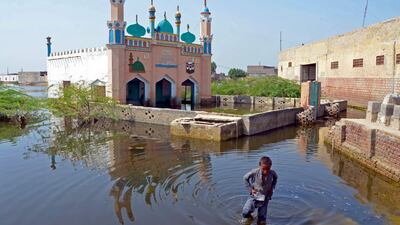
A boy wades through floodwater at Sohbatpur, Balochistan province. AFP -
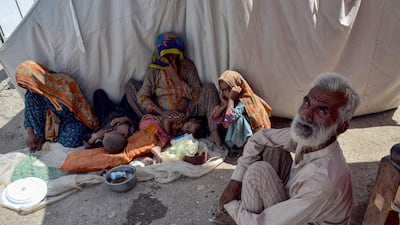
Millions of people were displaced by the floods in Pakistan. AFP -
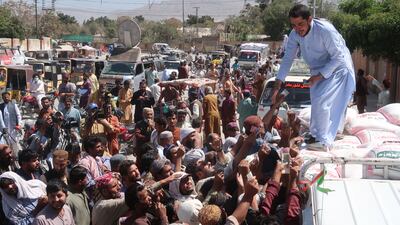
Basic food is in short supply in many areas. EPA -
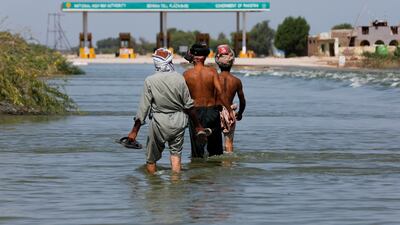
Motorways in Sehwan are flooded, making road travel impossible. Reuters -
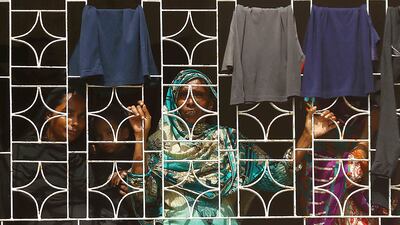
People take shelter inside a school in the aftermath of floods in Karachi. EPA -
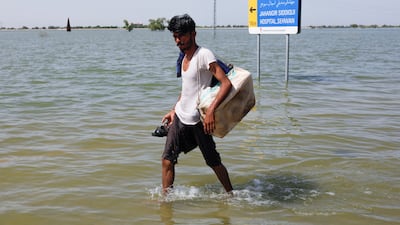
Much of the country remains submerged after torrential monsoon rain. Reuters -

Displaced families queue for relief aid in Jaffarabad. AP -

Actress and humanitarian Angelina Jolie attends a briefing at the National Flood Response and Coordination Centre in Islamabad. She said she was horrified by the aftermath of the flooding. Reuters -
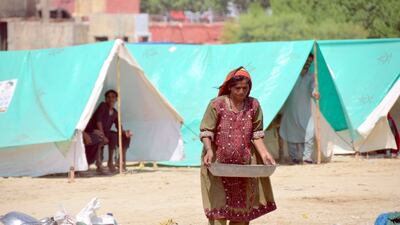
A pregnant woman carries water as she take a refuge at a camp in Jaffarabad. AP -
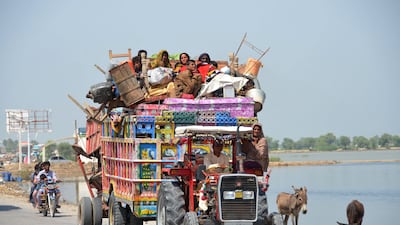
Displaced flood-affected families travel on a tractor trailer with their belongings near a makeshift camp at Dera Allah Yar in Jaffarabad. AFP -

Edhi rescue workers search for bodies of flood victims who were washed away in the Indus river near Hyderabad, Sindh province. EPA -

Food rations to be distributed to flood-affected people are sorted in Larkana. EPA -
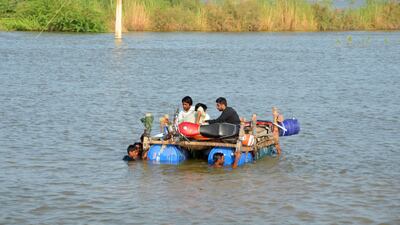
About 160 bridges and 5,000km of roads have been destroyed or damaged, 3.5 million acres of crops affected and about 800,000 livestock lost nationwide. AFP -
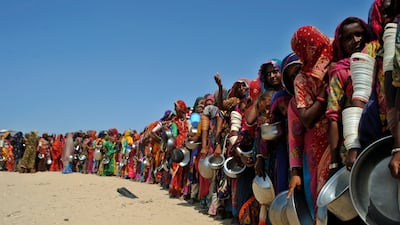
More than 33 million people have been affected by floods in Pakistan. AP


A statement issued by Germany on Monday listed Bangladesh, Costa Rica, Fiji, Ghana, Pakistan, the Philippines and Senegal as some of the initial recipients of Global Shield packages, although 58 nations are in talks over the programme.
Those packages would be developed in the coming months, Germany said.
Ghana’s Finance Minister Ken Ofori-Atta called it “a path-breaking effort” that would help protect communities when lives and livelihoods are lost.
But civil society groups were sceptical, warning that the programme should not be used as a way to distract from the much broader effort to get big polluters to pay for the loss and damage they have already caused with their greenhouse gases.
Poorer, vulnerable nations also want financing to help them shift to clean energy and for projects to adapt to global warming.
Teresa Anderson of ActionAid International said the scheme showed that the global community recognised the need to act on loss and damage, but said it was a "distraction" from negotiations on a dedicated funding mechanism for climate damages.
"Everyone knows that insurance companies, by their very nature, are either reluctant to provide coverage, or reluctant to pay out," she said. "But when it comes to loss and damage, this is a matter of life and death."

