



More than 1,700 people died and over 2 million were displaced in some of the deadliest flooding Pakistan had seen in a decade this year.
The country has since been grappling with repairing damage estimated at more than $30 billion, caused by heavy monsoon rains and glacial melting. But who can be held responsible for these extreme weather events that experts say climate change will only make more frequent across parts of the so-called "developing" world?
The tragic flooding led to renewed debate about climate reparations, the idea that wealthier nations that have emitted vast amounts of carbon should compensate poorer countries for loss and damage owing to climate change.
Grantham Institute on Climate Change and the Environment
In early September, Abdel Fattah El Sisi, President of Egypt, which will host the Cop27 summit next week, said just 20 nations were responsible for 80 per cent of the effects of climate change, and called on them to support developing countries in dealing with these effects.
His comments echo calls for a loss and damage fund to be financed by wealthier nations, and the issue is likely to figure in the discussions at the upcoming gathering in Sharm El Sheikh.
Should rich countries pay for the climate damage they have caused?
In October, the UN General Assembly passed a resolution to improve access to international financing to help the most affected nations mitigate and adapt to increasingly devastating weather events caused by climate change.
Rich countries had previously pledged to provide $100bn a year in climate change financing, beginning 2020, but have yet to fulfil their promises. This figure is only set to rise with the UN estimating that $300bn a year will be needed by affected countries to adapt to climate change by 2030.
UN Secretary General Antonio Guterres implored wealthy nations to take their pledges seriously, saying Cop27 "must be the place for serious action on loss and damage”.
“Cop27 must be the place for clarity on vital funding for adaptation and resilience,” he said.
Writing in September for Carbon Brief, a website funded by the European Climate Foundation, which promotes net zero efforts, John Kerry, the US special presidential envoy for climate, said that “increased efforts must be made to avert, minimise, and address loss and damage associated with the adverse impacts of climate change”.
“We understand the depth of the impacts that climate-vulnerable countries are facing, as well as the priority that they are placing on loss and damage issues in the Paris Agreement process, and have a strong interest in helping to address these issues in solidarity with vulnerable countries and communities,” he said.
Mr Kerry has, however, indicated that the US government would struggle to get plans for loss and damage compensation through the US Congress.
Denmark has been seen to have broken ranks among wealthy nations by recently announcing that it would pay $13.3 million to help parts of the world such as Africa’s Sahel affected by climate change, something that could spark similar moves by other countries.
“It’s become a bit of a divisive issue,” said Bob Ward, of the Grantham Institute on Climate Change and the Environment, part of the London School of Economics and Political Science.
“It’s quite clear it’s unfair that poor countries are suffering damage caused by rich countries. However, it’s not been possible to get to a situation where there’s an opportunity to get compensation.”
The worst culprits
So, who bears the most responsibility for pumping greenhouse gases into the atmosphere, and should, potentially, bear the greatest responsibility for reparations?
The Centre for Global Development has reported that developed nations were responsible for 79 per cent of carbon dioxide emissions from 1850 to 2011.
The US is at the top of the cumulative emissions league table, having released around 0.51 gigatonnes (Gt, where a gigatonne is one billion tonnes) of CO2 between 1850 and 2021, according to figures published by Carbon Brief. This is about 20 per cent of world CO2 emissions to date of around 2.504 Gt.
Cumulative CO2 emissions are important because the gas remains in the atmosphere for “hundreds or even thousands of years”, according to the University of California, Davis.
About four-fifths of US emissions are from fossil fuel burning, with the rest linked to land-use change, such as the clearing and burning of forests.
But the rest of the league table shows that it is not just developed nations that have over time emitted the greatest quantities of carbon.
China is in second place, with cumulative CO2 emissions of about 0.284 Gt (11 per cent of the world total), Russia is third, with about 0.173 Gt (seven per cent of the world total), Brazil is fourth (0.113 Gt or five per cent) and Indonesia is fifth (0.103 Gt or four per cent). Land-use changes account for most of Brazil’s and Indonesia’s emissions.
Taking account of imported or exported goods and services reduces the cumulative emissions of a major exporter like China, while increasing the total of, for example, Japan. However, this has little effect on the league tables of the biggest emitters over time.
A far greater change happens when cumulative emissions are calculated on a per capita basis.
On this basis, using 2021 population figures, Carbon Brief calculated that Canada, the US, Estonia, Australia and Trinidad and Tobago were the biggest emitters.
An alternative way to calculate per capita cumulative emissions, taking account of a country’s population at the time emissions were generated, put New Zealand Canada, Australia, the US and Argentina on top.
Dr Sascha Samadi, a senior researcher in the Wuppertal Institute for Climate, Environment and Energy, a think tank in Wuppertal, Germany, suggests that more recent emissions, particularly those of the last two or three decades, may count for more when it comes to looking at a nation’s responsibility for climate change.
This is because these have been made at a time when the effects of climate change are well known.
“At least since the late 1990s or early 2000s, it was very clear we had a major problem to reduce emissions,” he said.
As well as a country’s cumulative emissions, its GDP is also a factor when considering its obligations to cut emissions and compensate other nations that have suffered from climate change, Dr Samadi said.
Just as assigning responsibility for climate change is complex, so is determining which nations are most heavily affected.
In its 2021 Global Climate Risk Index, Germanwatch, a non-governmental organisation headquartered in Bonn, calculated that Mozambique, Zimbabwe, The Bahamas, Japan and Malawi were most affected by extreme weather in 2019. Afghanistan, India, South Sudan, Niger and Bolivia occupied positions six to 10.
However, rankings vary considerably from year to year according to events experienced in the relevant 12 months, and Germanwatch emphasises that its index is not a complete measure of how a country is affected by climate change.
Given the complexities, and the reluctance of better-off nations to open themselves up to potentially huge financial liabilities, reaching an international consensus on payments for climate change-related loss or damage is not going to be easy.
“It’s not likely in the foreseeable future we’ll see an agreement on how much each country will pay,” Dr Samadi said.
Flooding becoming more likely due to climate change — in pictures
-
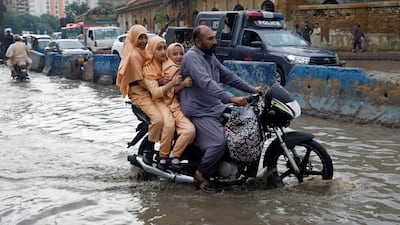
A family ride their motorcycle on a flooded road during the monsoon season in Karachi, Pakistan. Reuters -
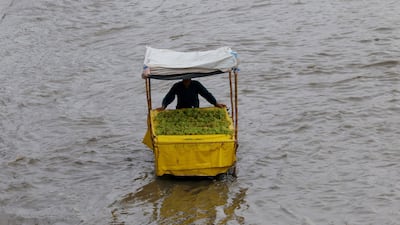
Balochistan and Sindh provinces have been hit by heavy rains that have killed more than 300 in Pakistan during this year's monsoon. EPA -
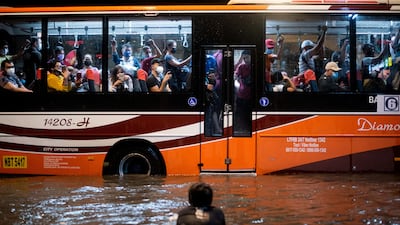
A child plays in a flooded road as a bus passes by in Manila in August. Reuters -

People wade through floodwater in Manila. Reuters -
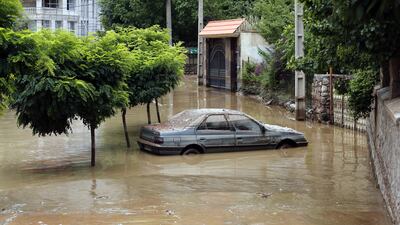
A car submerged by a flash flood in Zayegan village, in the Iranian city of Fasham, north of Tehran. EPA -

The floods swept mud and debris into this home in Zayegan, Iran. EPA -

Rain flooded Death Valley National Park, California this month. Reuters -
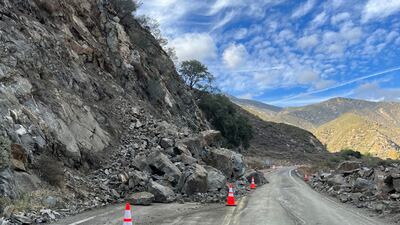
A rockslide on Route 39 in the San Gabriel Mountains of California, US, after a major storm in December. Reuters -
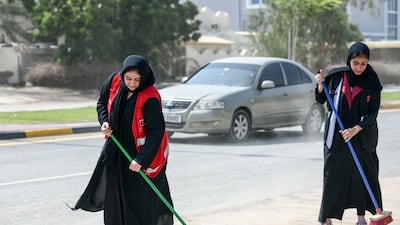
Community service group volunteers help to clean a road after the heavy rainfall in Fujairah, UAE. Khushnum Bhandari / The National -
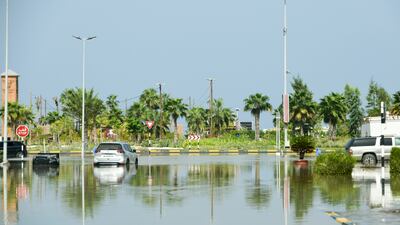
Vehicles trapped by the floods in Fujairah. Khushnum Bhandari / The National -
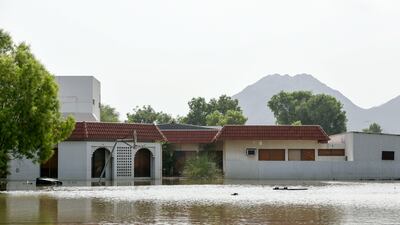
The flooded streets of Fujairah. Khushnum Bhandari / The National -
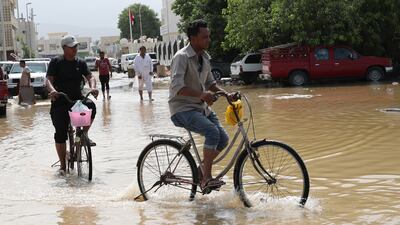
People make their way through Fujairah's floodwaters. EPA -
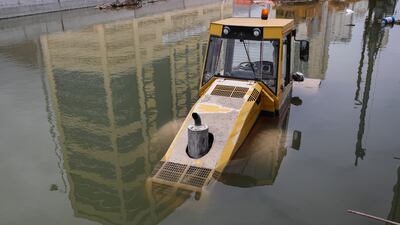
A construction vehicle in a flooded tunnel in Fujairah. EPA



