

Abu Dhabi's mission to eliminate single-use plastic bags is offering a safer passage to turtles navigating the emirate's waters.
The capital introduced its single-use plastic ban on June 1, 2022, as part of a major push to protect the environment and reduce plastic pollution in the sea.
The campaign has generated significant dividends, with an estimated 360 million plastic bags taken out of circulation by the end of 2024.
As World Environment Day is observed on Thursday, the impact of the initiative is being felt far and wide – not least by joyous children seeing nature up close off Abu Dhabi's mangrove-lined coast.
Tackling environmental scourge
A group of children recently watched 20 turtles – 10 juveniles and 10 adults, including a rescued loggerhead – slip into the turquoise water off Saadiyat Island.
“These are endangered species,” said Lewis Cocks, curator at The National Aquarium in Abu Dhabi. “Without anyone rescuing them they would probably perish.”
The 10 adult turtles had been rehabilitated at a sanctuary area at Louvre Abu Dhabi. Mr Cocks and his team retrieved them from the turtle lagoon at 5am on the day of their release. The enclosure is the last stop on the rehabilitation journey for many turtles, where they experience Arabian Gulf water, sunlight and seasonal changes.
-
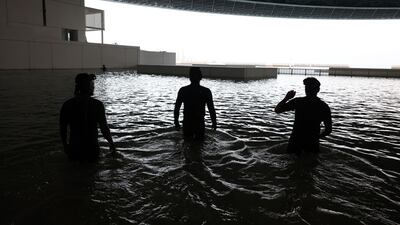
The National Aquarium team enter the waters of the Louvre Abu Dhabi's turtle sanctuary at 5am to retrieve rehabilitated animals to prepare them for release back to the sea. Chris Whiteoak / The National -
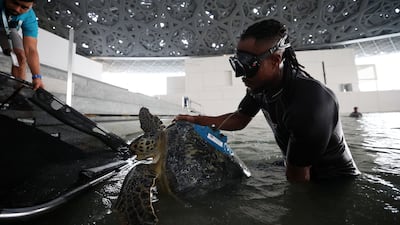
Turtles at the Louvre Abu Dhabi are prepared to be transported to the sea for release. Chris Whiteoak / The National -
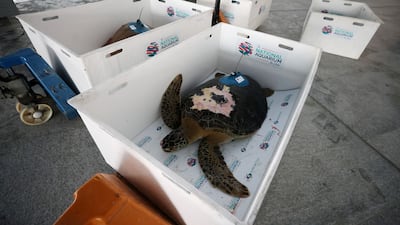
Turtles are carefully loaded into boxes to be transported to Saadiyat beach for release. Chris Whiteoak / The National -
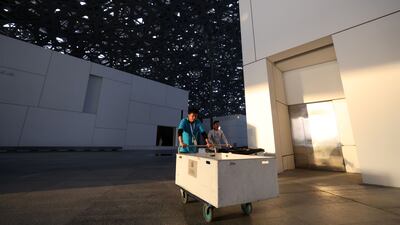
The turtles are moved to the lorry. Turtles being transported from the Louvre and to the sea. Turtle release. Louvre, Abu Dhabi. Chris Whiteoak / The National -
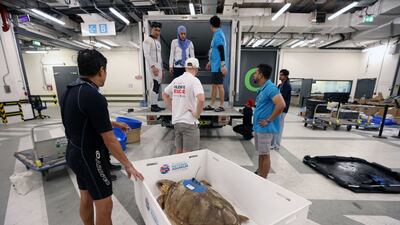
The turtles are moved to the lorry. Turtles being transported from the Louvre and to the sea. Turtle release. Louvre, Abu Dhabi. Chris Whiteoak / The National -

The turtles are released. Turtles being transported from the Louvre and to the sea. Turtle release. Jumeirah Saadiyat Island Beach, Abu Dhabi. Chris Whiteoak / The National -
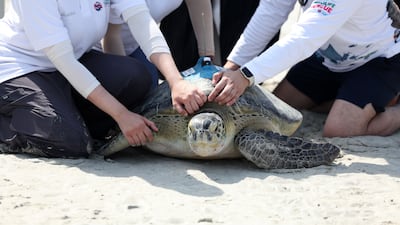
The turtles are released. Turtles being transported from the Louvre and to the sea. Turtle release. Jumeirah Saadiyat Island Beach, Abu Dhabi. Chris Whiteoak / The National -
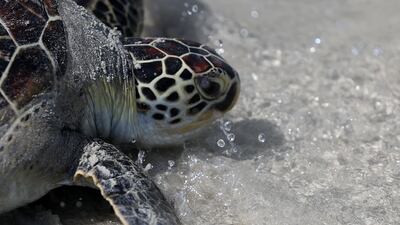
The turtles are released. Turtles being transported from the Louvre and to the sea. Turtle release. Jumeirah Saadiyat Island Beach, Abu Dhabi. Chris Whiteoak / The National -
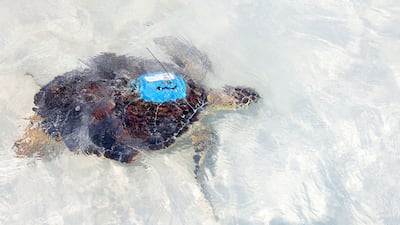
The turtles are released. Turtles being transported from the Louvre and to the sea. Turtle release. Jumeirah Saadiyat Island Beach, Abu Dhabi. Chris Whiteoak / The National -
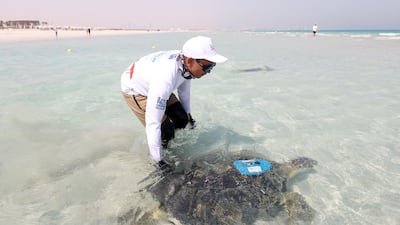
Turtles being released at Jumeirah Saadiyat Island Beach, Abu Dhabi. Chris Whiteoak / The National -
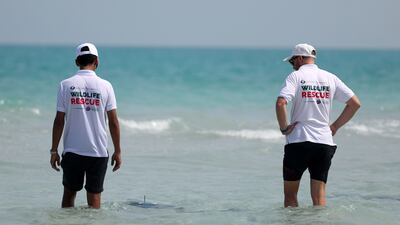
The turtles are released. Turtles being transported from the Louvre and to the sea. Turtle release. Jumeirah Saadiyat Island Beach, Abu Dhabi. Chris Whiteoak / The National


Most of the juvenile turtles at the aquarium and the sanctuary are being rehabilitated for cold stunning, a condition that affects young turtles adapting to seasonal temperature changes.
However, Mr Cocks says the stories of the 10 older turtles being released are linked with World Environment Day and its theme of #BeatPlasticPollution.
“Turtles – they think with their stomach, and they don't really have good eyesight so they will happily eat plastic, thinking its jellyfish,” said Mr Cocks.
Read more: President Sheikh Mohamed sets out UAE's green vision
The event was more than symbolic. As Abu Dhabi marks the third anniversary of its single-use plastic bag ban, the turtles return to the sea served as a stark reminder of what is at stake – and what is still to be done.
Plastic ingestion is a recurring cause of distress in marine life, Mr Cocks explained. “We see a lot of plastic. We find it inside turtles and washed up on beaches. It shows how widespread the issue is.”
The National Aquarium typically releases up to 200 rehabilitated turtles each year, part of wider conservation efforts that aim to not only rescue individual animals, but to educate the public about the threats to ocean life. “It's about instilling awareness, especially in children,” said Mr Cocks. “We're all responsible for reducing waste, cleaning up after ourselves, and changing our behaviour.”

Beyond the ban
While public turtle releases grab headlines, the real work of tackling single-use plastic pollution is happening behind the scenes – and across government departments.
Mr Cocks told The National that since measures have been introduced he has noticed reduction in plastic waste.
Sheikha Al Mazrouei, executive director of the Environment Agency Abu Dhabi's Integrated Environment Policy and Planning Sector, spoke of the importance of winning hearts and minds.
“We launched the Abu Dhabi single-use plastic policy in 2020,” she said. “It covers both the public and private sectors. The idea is not just to ban, but to change behaviour.”
“We want people to understand: we're not against plastic. Plastic has benefits – its lightweight, durable, it can reduce emissions during transport. But the issues is single-use plastic. These items are used for less than 10 minutes and then discarded. They stay in the environment for hundreds of years.”
Beyond the plastic bag ban, the UAE's strategy extends to phasing out single-use styrofoam products – with a full ban on certain items implemented in June 2024, alongside significantly expanding its recycling systems. This includes the 2023 roll-out of more than 170 reverse vending machines across Abu Dhabi, which have collected more than 130 million plastic bottles for recycling systems.
Federal regulation will take the effort further in 2026, banning an expanded list of single-use plastics.
Culture shift, not crackdown
The policy's success is striking not just for its scope, but for its reception. “We haven't had to issue a single penalty,” said Ms Al Mazrouei. “People said it would be hard – that businesses would complain, that shoppers would resist. But we took a collaborative approach: workshops, school programmes, social media campaigns. It worked.”
Instead of fines, the agency relied on outreach and education, helping companies retrofit production lines and encouraging individuals to adopt reusable habits.
“When I go to the market, I take my own bag,” Ms Al Mazrouei told The National. “It even helps me buy less.”
Still, confusion remains. “People ask, 'if there is a plastic ban, why can I still get a plastic bag at the checkout?'” she said. “The answer is those are reusable bags. You can use them many times.”

Why it matters
Globally, the numbers are daunting. The UN Environment Programme (UNEP) estimates that humans have produced 9.2 billion tonnes of plastic since the 1950s, with 7 billion tonnes now waste. By 2060, the Organisation for Economic Co-operation and Development forecasts that plastic waste will nearly triple to one billion tonnes annually if current trends continue.
“Plastic pollution is one of the gravest environmental threats facing Earth,” said Elisa Tonda, the environment programme's chief of resources and markets. “But it's a problem we can solve.”
This year's World Environment Day is focused on preventing plastic waste from entering the environment – through bans, redesign and better waste systems.
In the UAE, the urgency is more than theoretical. “We eat seafood … That plastic enters our food chain, and it stays in our bodies. It's toxic. This isn't just about the environment – it's about public health,” said Ms Al Mazrouei.
Looking ahead
As the campaign matures, technology is becoming part of the solution. Abu Dhabi is working with the private sector to integrate artificial intelligence into its circular economy systems that encourage healthier, more sustainable habits.
“We want people to live eco-friendly but also healthy and convenient lifestyles,” Ms Al Mazrouei said. “The environment shouldn't be seen as a sacrifice. With the right solutions, it can be a benefit.”
For Mr Cocks, each turtle release is a small reminder of what the future might look like. “They're indicators,” he said. “If we protect their world, we're protecting our own.”

