Polar bear on a wide surface of ice in the russian arctic close to Franz Josef Land. Getty Images

World 'teetering on planetary tightrope' as global warming set to hit 3.1°C this century, UN warns


Soraya Ebrahimi
  • English
  • Arabic

The UN has called for massive efforts to cut the emissions that drive climate change after a warning that the world is on track for a “catastrophic” 3.1°C of global warming by the end of this century.

Its annual report highlights the gap between cuts to emissions needed to limit global warming to 1.5°C above pre-industrial levels and what countries are doing and have pledged to do, with the UN Environment Programme (Unep) saying the goal would “soon be dead” without a global mobilisation on a scale and at a pace not seen before.

Depending on the progress made in current climate action pledges, the UN warned the world was currently on track for temperature rises of between 2.6°C and 3.1°C before the next century.

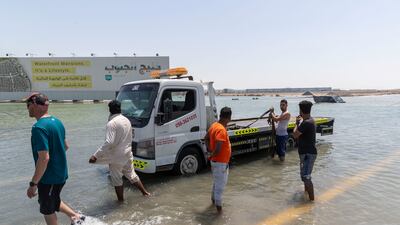
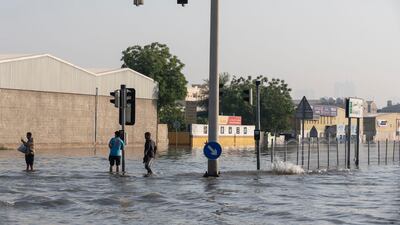
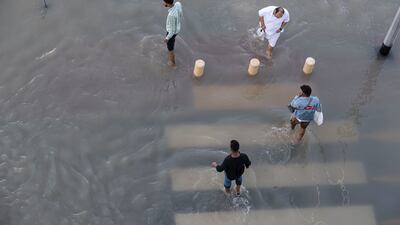
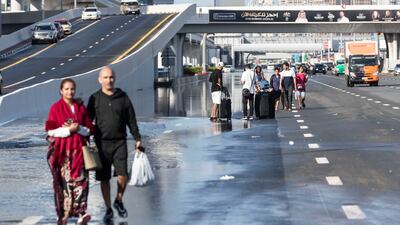
The effects of climate change on the Middle East region - in pictures

  • Flooding in the Al Barsha area of Dubai. Chris Whiteoak / The National
    Flooding in the Al Barsha area of Dubai. Chris Whiteoak / The National
  • Vehicles being recovered near Al Maktoum airport in Dubai. Antonie Robertson / The National
    Vehicles being recovered near Al Maktoum airport in Dubai. Antonie Robertson / The National
  • Flooding in the Al Barsha area of Dubai. Chris Whiteoak / The National
    Flooding in the Al Barsha area of Dubai. Chris Whiteoak / The National
  • Flooding along Sheikh Zayed Road in Dubai. Antonie Robertson / The National
    Flooding along Sheikh Zayed Road in Dubai. Antonie Robertson / The National
  • Flooding along Sheikh Zayed Road in Dubai. Antonie Robertson / The National
    Flooding along Sheikh Zayed Road in Dubai. Antonie Robertson / The National
  • Cars move through floodwater in Al Qudra, Dubai. Chris Whiteoak / The National
    Cars move through floodwater in Al Qudra, Dubai. Chris Whiteoak / The National
  • Flooding on Dubai's Al Khail Road. Chris Whiteoak / The National
    Flooding on Dubai's Al Khail Road. Chris Whiteoak / The National
  • People abandon their cars on Sheikh Zayed Road due to heavy rain. Antonie Robertson/The National
    People abandon their cars on Sheikh Zayed Road due to heavy rain. Antonie Robertson/The National
  • Flooding on Al Khail Road. Chris Whiteoak / The National
    Flooding on Al Khail Road. Chris Whiteoak / The National
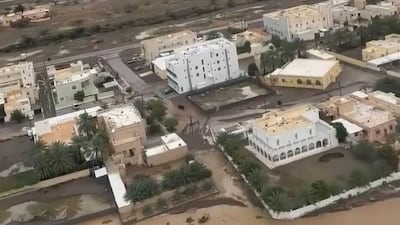
  • Flooding in Oman. Photo: Royal Oman Police
    Flooding in Oman. Photo: Royal Oman Police
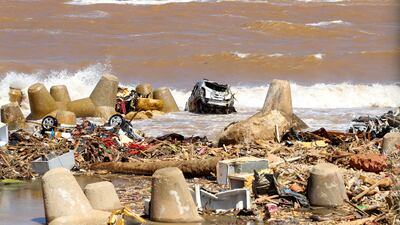
  • A damaged car in Derna, Libya. Reuters
    A damaged car in Derna, Libya. Reuters
  • A destroyed vehicle in Derna. AFP
    A destroyed vehicle in Derna. AFP
  • Abdul Salam Ibrahim Al-Qadi walks on rubble in front of his house, searching for his missing father and brother, in Derna. Reuters
    Abdul Salam Ibrahim Al-Qadi walks on rubble in front of his house, searching for his missing father and brother, in Derna. Reuters
  • An aerial view of the destruction in Derna. Reuters
    An aerial view of the destruction in Derna. Reuters
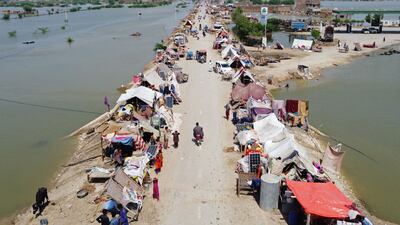
  • Flood-affected people taking refuge in a makeshift camp after heavy monsoon rains in Jaffarabad district of Balochistan province. AFP
    Flood-affected people taking refuge in a makeshift camp after heavy monsoon rains in Jaffarabad district of Balochistan province. AFP
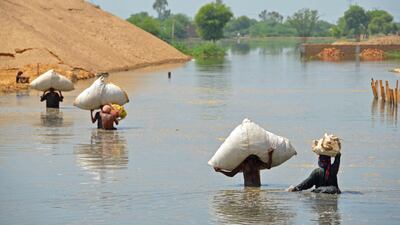
  • Internally displaced flood-affected people shift husk for their animals in a flood-hit area following heavy rains in Dera Allah Yar in Balochistan. AFP
    Internally displaced flood-affected people shift husk for their animals in a flood-hit area following heavy rains in Dera Allah Yar in Balochistan. AFP
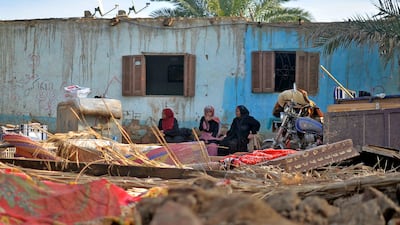
  • The aftermath of flooding in Egypt's southern city of Aswan, 920 kilometres south of the capital. AFP
    The aftermath of flooding in Egypt's southern city of Aswan, 920 kilometres south of the capital. AFP
  • The Nile River from the top of Famine Stela, or Rock of Starvation, Egypt. Reuters
    The Nile River from the top of Famine Stela, or Rock of Starvation, Egypt. Reuters
  • Volunteers search for people in need following heavy rainfall in east Mosul, Iraq, in March 2020. Reuters
    Volunteers search for people in need following heavy rainfall in east Mosul, Iraq, in March 2020. Reuters
  • People clean up after floods in Duhok, Iraq, on March 19. Reuters
    People clean up after floods in Duhok, Iraq, on March 19. Reuters

The warning comes ahead of next month’s UN Cop29 talks in Baku, the capital of fossil fuel-rich Azerbaijan, where nations are facing calls to agree on bolder action to scale up finance for developing countries to tackle climate change, and to close the emissions gap.

At the Paris climate talks in 2015, countries agreed to limit temperature rises to “well below” 2°C and pursue efforts to curb them to 1.5°C above pre-industrial levels.

Scientists have warned there is no safe amount of climate change but 1.5°C has come to be seen as a threshold beyond which the worst effects of heatwaves, drought, flooding, the collapse of natural systems and rising sea levels will be felt.

Nations have set out country-level action plans, known as nationally determined contributions (NDCs), for meeting the Paris target, through cutting emissions from activities such as burning fossil fuels and creating or restoring habitats such as forests to capture carbon, up to 2030.

But as countries prepare to submit the next set of plans for action up to 2035 in the next few months, Unep is warning the goal of preventing dangerous warming is slipping out of reach.

The report said global greenhouse gases are still rising and were up 1.3 per cent in 2023 on the previous year's levels – a faster increase than the average of the past decade – with the G20 group of leading economies accounting for more than three quarters (77 per cent) of emissions.

Under current policies the world is facing long-term global warming of 3.1°C and even if countries deliver on their climate plans up to 2030, it will lead to temperature rises of 2.6°C to 2.8°C, it added. But countries are off-track even for those plans.

Responding to the report, UN Secretary General Antonio Guterres said the world was “teetering on a planetary tightrope”.

“Either leaders bridge the emissions gap, or we plunge headlong into climate disaster – with the poorest and most vulnerable suffering the most,” he said.

He said people were already suffering from monster hurricanes, biblical floods and record heat, which was turning forests into tinder boxes and cities into saunas, and warned “current policies are taking us towards a catastrophic 3.1°C temperature rise by the end of the century”.

He said governments must drive down all greenhouse gas emissions – weaning the world off fossil fuels, accelerating the introduction of renewables, and halting and reversing deforestation – and agree to a new finance goal at Cop29 to unlock the huge sums of money developing countries need to tackle climate change.

Inger Andersen, executive director of Unep, said: “Climate crunch time is here. We need global mobilisation on a scale and pace never seen before – starting right now, before the next round of climate pledges – or the 1.5°C goal will soon be dead and well below 2°C will take its place in the intensive care unit."

She urged nations meeting for Cop29 to increase action now, set the stage for stronger national plans, then “go all-out to get on a 1.5°C pathway”.

“Even if the world overshoots 1.5°C – and the chances of this happening are increasing every day – we must keep striving for a net-zero, sustainable and prosperous world," she added. “Every fraction of a degree avoided counts in terms of lives saved, economies protected, damages avoided, biodiversity conserved and the ability to rapidly bring down any temperature overshoot.”

Nations must collectively commit to cut 42 per cent of annual greenhouse gas emissions by 2030 and 57 per cent by 2035 in the next round of NDCs to achieve the 1.5°C goal, Unep warned.

It is technically feasible to deliver such a cut, by tripling renewable energy capacity by 2030, stepping up energy efficiency improvements, shifting away from fossil fuel use, and protecting and restoring natural habitats such as forests and mangroves.

But there must be a massive globalisation effort to cut the global greenhouse gases driving rising temperatures, starting today and led by the G20, Unep said.


Mercer, the investment consulting arm of US services company Marsh & McLennan, expects its wealth division to at least double its assets under management (AUM) in the Middle East as wealth in the region continues to grow despite economic headwinds, a company official said.

Mercer Wealth, which globally has $160 billion in AUM, plans to boost its AUM in the region to $2-$3bn in the next 2-3 years from the present $1bn, said Yasir AbuShaban, a Dubai-based principal with Mercer Wealth.

Within the next two to three years, we are looking at reaching $2 to $3 billion as a conservative estimate and we do see an opportunity to do so,” said Mr AbuShaban.

Mercer does not directly make investments, but allocates clients’ money they have discretion to, to professional asset managers. They also provide advice to clients.

“We have buying power. We can negotiate on their (client’s) behalf with asset managers to provide them lower fees than they otherwise would have to get on their own,” he added.

Mercer Wealth’s clients include sovereign wealth funds, family offices, and insurance companies among others.

From its office in Dubai, Mercer also looks after Africa, India and Turkey, where they also see opportunity for growth.

Wealth creation in Middle East and Africa (MEA) grew 8.5 per cent to $8.1 trillion last year from $7.5tn in 2015, higher than last year’s global average of 6 per cent and the second-highest growth in a region after Asia-Pacific which grew 9.9 per cent, according to consultancy Boston Consulting Group (BCG). In the region, where wealth grew just 1.9 per cent in 2015 compared with 2014, a pickup in oil prices has helped in wealth generation.

BCG is forecasting MEA wealth will rise to $12tn by 2021, growing at an annual average of 8 per cent.

Drivers of wealth generation in the region will be split evenly between new wealth creation and growth of performance of existing assets, according to BCG.

Another general trend in the region is clients’ looking for a comprehensive approach to investing, according to Mr AbuShaban.

“Institutional investors or some of the families are seeing a slowdown in the available capital they have to invest and in that sense they are looking at optimizing the way they manage their portfolios and making sure they are not investing haphazardly and different parts of their investment are working together,” said Mr AbuShaban.

Some clients also have a higher appetite for risk, given the low interest-rate environment that does not provide enough yield for some institutional investors. These clients are keen to invest in illiquid assets, such as private equity and infrastructure.

“What we have seen is a desire for higher returns in what has been a low-return environment specifically in various fixed income or bonds,” he said.

“In this environment, we have seen a de facto increase in the risk that clients are taking in things like illiquid investments, private equity investments, infrastructure and private debt, those kind of investments were higher illiquidity results in incrementally higher returns.”

The Abu Dhabi Investment Authority, one of the largest sovereign wealth funds, said in its 2016 report that has gradually increased its exposure in direct private equity and private credit transactions, mainly in Asian markets and especially in China and India. The authority’s private equity department focused on structured equities owing to “their defensive characteristics.”

Diriyah%20project%20at%20a%20glance
%3Cp%3E-%20Diriyah%E2%80%99s%201.9km%20King%20Salman%20Boulevard%2C%20a%20Parisian%20Champs-Elysees-inspired%20avenue%2C%20is%20scheduled%20for%20completion%20in%202028%3Cbr%3E-%20The%20Royal%20Diriyah%20Opera%20House%20is%20expected%20to%20be%20completed%20in%20four%20years%3Cbr%3E-%20Diriyah%E2%80%99s%20first%20of%2042%20hotels%2C%20the%20Bab%20Samhan%20hotel%2C%20will%20open%20in%20the%20first%20quarter%20of%202024%3Cbr%3E-%20On%20completion%20in%202030%2C%20the%20Diriyah%20project%20is%20forecast%20to%20accommodate%20more%20than%20100%2C000%20people%3Cbr%3E-%20The%20%2463.2%20billion%20Diriyah%20project%20will%20contribute%20%247.2%20billion%20to%20the%20kingdom%E2%80%99s%20GDP%3Cbr%3E-%20It%20will%20create%20more%20than%20178%2C000%20jobs%20and%20aims%20to%20attract%20more%20than%2050%20million%20visits%20a%20year%3Cbr%3E-%20About%202%2C000%20people%20work%20for%20the%20Diriyah%20Company%2C%20with%20more%20than%2086%20per%20cent%20being%20Saudi%20citizens%3Cbr%3E%3C%2Fp%3E%0A
Tamkeen's offering
  • Option 1: 70% in year 1, 50% in year 2, 30% in year 3
  • Option 2: 50% across three years
  • Option 3: 30% across five years 
TEACHERS' PAY - WHAT YOU NEED TO KNOW

Pay varies significantly depending on the school, its rating and the curriculum. Here's a rough guide as of January 2021:

- top end schools tend to pay Dh16,000-17,000 a month - plus a monthly housing allowance of up to Dh6,000. These tend to be British curriculum schools rated 'outstanding' or 'very good', followed by American schools

- average salary across curriculums and skill levels is about Dh10,000, recruiters say

- it is becoming more common for schools to provide accommodation, sometimes in an apartment block with other teachers, rather than hand teachers a cash housing allowance

- some strong performing schools have cut back on salaries since the pandemic began, sometimes offering Dh16,000 including the housing allowance, which reflects the slump in rental costs, and sheer demand for jobs

- maths and science teachers are most in demand and some schools will pay up to Dh3,000 more than other teachers in recognition of their technical skills

- at the other end of the market, teachers in some Indian schools, where fees are lower and competition among applicants is intense, can be paid as low as Dh3,000 per month

- in Indian schools, it has also become common for teachers to share residential accommodation, living in a block with colleagues

In numbers

Number of Chinese tourists coming to UAE in 2017 was... 1.3m

Alibaba’s new ‘Tech Town’  in Dubai is worth... $600m

China’s investment in the MIddle East in 2016 was... $29.5bn

The world’s most valuable start-up in 2018, TikTok, is valued at... $75bn

Boost to the UAE economy of 5G connectivity will be... $269bn 

VEZEETA PROFILE

Date started: 2012

Founder: Amir Barsoum

Based: Dubai, UAE

Sector: HealthTech / MedTech

Size: 300 employees

Funding: $22.6 million (as of September 2018)

Investors: Technology Development Fund, Silicon Badia, Beco Capital, Vostok New Ventures, Endeavour Catalyst, Crescent Enterprises’ CE-Ventures, Saudi Technology Ventures and IFC

Teri%20Baaton%20Mein%20Aisa%20Uljha%20Jiya
%3Cp%3E%3Cstrong%3EDirectors%3A%3C%2Fstrong%3E%20Amit%20Joshi%20and%20Aradhana%20Sah%3C%2Fp%3E%0A%3Cp%3E%3Cstrong%3ECast%3A%3C%2Fstrong%3E%20Shahid%20Kapoor%2C%20Kriti%20Sanon%2C%20Dharmendra%2C%20Dimple%20Kapadia%2C%20Rakesh%20Bedi%3C%2Fp%3E%0A%3Cp%3E%3Cstrong%3ERating%3A%3C%2Fstrong%3E%204%2F5%3C%2Fp%3E%0A
The specs

Price: From Dh529,000

Engine: 5-litre V8

Transmission: Eight-speed auto

Power: 520hp

Torque: 625Nm

Fuel economy, combined: 12.8L/100km

Auron Mein Kahan Dum Tha

Starring: Ajay Devgn, Tabu, Shantanu Maheshwari, Jimmy Shergill, Saiee Manjrekar

Director: Neeraj Pandey

Rating: 2.5/5

First Person
Richard Flanagan
Chatto & Windus 

Updated: October 24, 2024, 5:33 PM