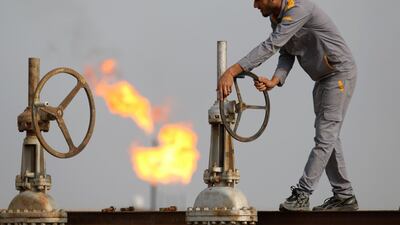
As crude prices plunge, prodcuers who get their oil to th emarket first are at an advantage. Afp

Why the logistics of oil supply matter


Robin Mills
  • English
  • Arabic

“Amateurs talk about strategy but professionals study logistics,” as an old military saying has it. The current collapse in oil demand places more stress on logistics than ever before. Where will supply be cut, how can it stay profitable, and where can it be stored and sold?

There are three ways production can be reduced. Producing wells and fields can be shut-in because the sales price for oil and gas does not cover their operating costs, or because they physically have no available access to export or storage. Supply can decline naturally and more gradually because of a halt in investment (new drilling and processing facilities). Or Opec countries and others can voluntarily reduce output, either unilaterally or more likely, through coordination.

The calculation of economic survival has become extremely complex in this matter of wafer-thin margins. It depends on operating costs, transport costs to market, the costs of stopping or restarting production, taxes, and oil quality. Goldman Sachs estimates that 1 million bpd of uneconomic production is already shut-in worldwide.

Companies may keep producing at a loss for a while, because they have contractual commitments to customers or pipelines, or because they fear the wells will not be viable to restart once shut down. But smaller firms will quickly run out of money. Bankruptcy may expunge their obligations, and new owners of the assets will continue operating only the profitable ones.

The current collapse in demand has affected gasoline (petrol) and jet fuel more than diesel for trucks and fuel oil for ships. So light crudes, like those from American shale oil, north and west Africa, have lost value relative to medium-grades typical of the Middle East and Russia.

Many government fiscal schemes impose a fixed tax on oil production regardless of profitability – either a limit on how much costs can be set against tax each year, or a royalty levied on gross revenues. As prices fall, governments face a difficult choice: waive these rules temporarily and give up badly-needed revenue, or keep them and risk production shutting down entirely.

Disadvantaged producers include the landlocked ones – facing high transport costs to destinations where demand may be in freefall. Those who have long sea voyages to remaining markets confront rising tanker costs as the ships have been snapped up to carry expanded exports from Saudi Arabia, or to act as floating storage. Heavy crudes, such as those from Canada and Venezuela, face the double whammy of higher production costs and lower sales prices than benchmark grades.

At the start of this price war, there was an idea Russian companies were immune because of their low production costs. But their problem is market access. Though the Espo pipeline from East Siberia reaches China and East Asia directly, exports through the Druzhba pipeline, rail and barge to European destinations are likely to be choked back as the continent’s refiners cut their throughput. Crude exports from the Baltic face a long journey to Asia. That partly explains why Saudi Arabia cut its official selling prices, particularly for Europe, after the Opec+ deal broke down a month ago.

When the price for Russia’s benchmark Urals grade fall below $15 per barrel, companies stop paying mineral extraction and export taxes. So Russian government oil revenues will approach zero faster than the drop in prices.

Global production will also decline steadily as investment in new wells and fields dries up. Shale oil will take the brunt of this initially. Many conventional non-Opec projects have already been canned, but given their long lead-time, this will only have a major impact on production from 2022 onwards.

Finally, the leading Opec countries and Russia, the only producers large and flexible enough to balance the market, could return to a renewed pact to limit output. But despite Donald Trump’s hopeful tweets, it’s practically unlikely the US will join in, and without that, a deal remains out of reach for now.

In this environment, the target market becomes key. East Asia, where the response to the virus has been better, and where China is increasing purchases for its strategic crude reserve, is now an even more important buyer than before the crisis.

Storage has emerged as a key strategic asset. Saudi Aramco has storage at the Egyptian Mediterranean terminal of Sidi Kerir, the Dutch port of Rotterdam and the Japanese island of Okinawa, as well as at home. Adnoc has agreements to store crude in India’s strategic reserves and is building a 42-million-barrel underground facility at Fujairah. Private Abu Dhabi firm Brooge is also expanding its storage in the east coast emirate.

Equity partners in fields in places such as Oman, Abu Dhabi and Iraq can be required to lift their share of oil, shifting the responsibility for selling it. National oil company access to joint-venture refineries or long-term sales contracts can also help place barrels.

In the 1985-6 price bust, Saudi Aramco began offering “netback” contracts which guaranteed refiners a profit based on the sales price of their products. But such arrangements may not work now that the products are not even wanted. Some Indian refiners have already declared force majeure, a legal manoeuvre to avoid taking unwanted deliveries.

The leading Gulf producers have to pull out all the stops. As the market shrinks and prices plunge, they have to ensure it is their oil that gets to market first. That is the fastest way to drive out the high-cost producers, or set the stage for a deal, a brutal but necessary process.

Robin M. Mills is CEO of Qamar Energy, and author of The Myth of the Oil Crisis

Central%20Bank's%20push%20for%20a%20robust%20financial%20infrastructure
%3Cul%3E%0A%3Cli%3ECBDC%20real-value%20pilot%20held%20with%20three%20partner%20institutions%26nbsp%3B%3C%2Fli%3E%0A%3Cli%3EPreparing%20buy%20now%2C%20pay%20later%20regulations%26nbsp%3B%3C%2Fli%3E%0A%3Cli%3EPreparing%20for%20the%202023%20launch%20of%20the%20domestic%20card%20initiative%26nbsp%3B%3C%2Fli%3E%0A%3Cli%3EPhase%20one%20of%20the%20Financial%20Infrastructure%20Transformation%20(FiT)%20completed%3C%2Fli%3E%0A%3C%2Ful%3E%0A
Herc's Adventures

Developer: Big Ape Productions
Publisher: LucasArts
Console: PlayStation 1 & 5, Sega Saturn
Rating: 4/5

The Birkin bag is made by Hermès. 
It is named after actress and singer Jane Birkin
Noone from Hermès will go on record to say how much a new Birkin costs, how long one would have to wait to get one, and how many bags are actually made each year.

Jawan
%3Cp%3E%3Cstrong%3EDirector%3A%20%3C%2Fstrong%3EAtlee%3C%2Fp%3E%0A%3Cp%3E%3Cstrong%3EStars%3A%3C%2Fstrong%3E%20Shah%20Rukh%20Khan%2C%20Nayanthara%2C%20Vijay%20Sethupathi%26nbsp%3B%3C%2Fp%3E%0A%3Cp%3E%3Cstrong%3ERating%3A%20%3C%2Fstrong%3E4%2F5%3C%2Fp%3E%0A
Company%20Profile
%3Cp%3E%3Cstrong%3ECompany%20name%3A%3C%2Fstrong%3E%20myZoi%3Cbr%3E%3Cstrong%3EStarted%3A%3C%2Fstrong%3E%202021%3Cbr%3E%3Cstrong%3EFounders%3A%3C%2Fstrong%3E%20Syed%20Ali%2C%20Christian%20Buchholz%2C%20Shanawaz%20Rouf%2C%20Arsalan%20Siddiqui%2C%20Nabid%20Hassan%3Cbr%3E%3Cstrong%3EBased%3A%3C%2Fstrong%3E%20UAE%3Cbr%3E%3Cstrong%3ENumber%20of%20staff%3A%3C%2Fstrong%3E%2037%3Cbr%3E%3Cstrong%3EInvestment%3A%3C%2Fstrong%3E%20Initial%20undisclosed%20funding%20from%20SC%20Ventures%3B%20second%20round%20of%20funding%20totalling%20%2414%20million%20from%20a%20consortium%20of%20SBI%2C%20a%20Japanese%20VC%20firm%2C%20and%20SC%20Venture%3C%2Fp%3E%0A
Generation Start-up: Awok company profile

Started: 2013

Founder: Ulugbek Yuldashev

Sector: e-commerce

Size: 600 plus

Stage: still in talks with VCs

Principal Investors: self-financed by founder

Company Profile

Name: Thndr
Started: 2019
Co-founders: Ahmad Hammouda and Seif Amr
Sector: FinTech
Headquarters: Egypt
UAE base: Hub71, Abu Dhabi
Current number of staff: More than 150
Funds raised: $22 million

Dust and sand storms compared

Sand storm

  • Particle size: Larger, heavier sand grains
  • Visibility: Often dramatic with thick "walls" of sand
  • Duration: Short-lived, typically localised
  • Travel distance: Limited 
  • Source: Open desert areas with strong winds

Dust storm

  • Particle size: Much finer, lightweight particles
  • Visibility: Hazy skies but less intense
  • Duration: Can linger for days
  • Travel distance: Long-range, up to thousands of kilometres
  • Source: Can be carried from distant regions
Essentials

The flights
Emirates, Etihad and Malaysia Airlines all fly direct from the UAE to Kuala Lumpur and on to Penang from about Dh2,300 return, including taxes. 
 

Where to stay
In Kuala Lumpur, Element is a recently opened, futuristic hotel high up in a Norman Foster-designed skyscraper. Rooms cost from Dh400 per night, including taxes. Hotel Stripes, also in KL, is a great value design hotel, with an infinity rooftop pool. Rooms cost from Dh310, including taxes. 


In Penang, Ren i Tang is a boutique b&b in what was once an ancient Chinese Medicine Hall in the centre of Little India. Rooms cost from Dh220, including taxes.
23 Love Lane in Penang is a luxury boutique heritage hotel in a converted mansion, with private tropical gardens. Rooms cost from Dh400, including taxes. 
In Langkawi, Temple Tree is a unique architectural villa hotel consisting of antique houses from all across Malaysia. Rooms cost from Dh350, including taxes.

UAE currency: the story behind the money in your pockets
The smuggler

Eldarir had arrived at JFK in January 2020 with three suitcases, containing goods he valued at $300, when he was directed to a search area.
Officers found 41 gold artefacts among the bags, including amulets from a funerary set which prepared the deceased for the afterlife.
Also found was a cartouche of a Ptolemaic king on a relief that was originally part of a royal building or temple. 
The largest single group of items found in Eldarir’s cases were 400 shabtis, or figurines.

Khouli conviction

Khouli smuggled items into the US by making false declarations to customs about the country of origin and value of the items.
According to Immigration and Customs Enforcement, he provided “false provenances which stated that [two] Egyptian antiquities were part of a collection assembled by Khouli's father in Israel in the 1960s” when in fact “Khouli acquired the Egyptian antiquities from other dealers”.
He was sentenced to one year of probation, six months of home confinement and 200 hours of community service in 2012 after admitting buying and smuggling Egyptian antiquities, including coffins, funerary boats and limestone figures.

For sale

A number of other items said to come from the collection of Ezeldeen Taha Eldarir are currently or recently for sale.
Their provenance is described in near identical terms as the British Museum shabti: bought from Salahaddin Sirmali, "authenticated and appraised" by Hossen Rashed, then imported to the US in 1948.

- An Egyptian Mummy mask dating from 700BC-30BC, is on offer for £11,807 ($15,275) online by a seller in Mexico

- A coffin lid dating back to 664BC-332BC was offered for sale by a Colorado-based art dealer, with a starting price of $65,000

- A shabti that was on sale through a Chicago-based coin dealer, dating from 1567BC-1085BC, is up for $1,950

Our family matters legal consultant

Name: Hassan Mohsen Elhais

Position: legal consultant with Al Rowaad Advocates and Legal Consultants.

The burning issue

The internal combustion engine is facing a watershed moment – major manufacturer Volvo is to stop producing petroleum-powered vehicles by 2021 and countries in Europe, including the UK, have vowed to ban their sale before 2040. The National takes a look at the story of one of the most successful technologies of the last 100 years and how it has impacted life in the UAE.

Read part three: the age of the electric vehicle begins

Read part two: how climate change drove the race for an alternative 

Read part one: how cars came to the UAE

Islamophobia definition

A widely accepted definition was made by the All Party Parliamentary Group on British Muslims in 2019: “Islamophobia is rooted in racism and is a type of racism that targets expressions of Muslimness or perceived Muslimness.” It further defines it as “inciting hatred or violence against Muslims”.

Engine: 5.6-litre V8

Transmission: seven-speed automatic

Power: 400hp

Torque: 560Nm

Price: Dh234,000 - Dh329,000

On sale: now

Dubai Bling season three

Cast: Loujain Adada, Zeina Khoury, Farhana Bodi, Ebraheem Al Samadi, Mona Kattan, and couples Safa & Fahad Siddiqui and DJ Bliss & Danya Mohammed 

Rating: 1/5

How to apply for a drone permit
  • Individuals must register on UAE Drone app or website using their UAE Pass
  • Add all their personal details, including name, nationality, passport number, Emiratis ID, email and phone number
  • Upload the training certificate from a centre accredited by the GCAA
  • Submit their request
What are the regulations?
  • Fly it within visual line of sight
  • Never over populated areas
  • Ensure maximum flying height of 400 feet (122 metres) above ground level is not crossed
  • Users must avoid flying over restricted areas listed on the UAE Drone app
  • Only fly the drone during the day, and never at night
  • Should have a live feed of the drone flight
  • Drones must weigh 5 kg or less
