


Apple could lead smartphone industry shipments for the first time this year, at a time when overall shipments are set to drop to their lowest in a decade, a report has found.
Global smartphone shipments are expected to drop 6.5 per cent annually to 1.15 billion units in 2023, Counterpoint Research said in its latest report. In 2014, smartphone shipments stood at 1.32 billion.
Shipments indicate expected demand and they are not equal to actual sales. They represent the number of units that vendors ship to retailers.
Overall, the smartphone industry is projected to decline as macroeconomic challenges and weak consumer demand weigh on the sector. Regional macro risks are extending smartphone replacement cycles to record levels in 2023, Hong Kong-based Counterpoint said.
Apple, meanwhile, is expected to launch its latest iPhone 15 series next month. The new phones could help the company attract new buyers as well as prompt existing customers to upgrade to newer premium devices, Counterpoint analysts said.
Good sales in the fourth quarter could help Apple become number one globally in terms of annual shipments for the first time ever, they said.
The iPhone maker has previously hit the number one spot in quarterly sales.

“We are watching [the] fourth quarter with interest because the iPhone 15 launch is a window for carriers to steal high-value customers … leaving Apple in a good spot,” said Jeff Fieldhack, Counterpoint’s research director for North America.
“It’s the closest Apple’s been to the top spot. We are talking about a spread that’s literally a few days worth of sales … assuming Apple does not run into production problems like it did last year.”
Apple's share of profitability and revenue in the global smartphone market hit record levels in the second quarter of 2023, amid another low three-month period for the industry.
The company was the single-largest contributor to profitability in the smartphone sector at 85 per cent, up from 81 per cent a year ago and from 84 per cent in the first quarter, Counterpoint said.
The share of revenue from the California-based company grew to 45 per cent, up by about 3 per cent from the second quarter of 2023, it said.
Both measures gave Apple a big lead over Samsung Electronics, the world's biggest mobile phone manufacturer, which had profit and revenue shares of 12 per cent and 17 per cent, respectively.
Replacement cycles, or the average time consumers take before buying new smartphones, in 2022 were more than 40 months, the highest level ever, the Counterpoint report said.
Asia is one of the “major hurdles to positive growth”, as headwinds halt the economic turnaround expected for China at the start of the year, and the broader region experiences “intensifying declines” across emerging markets, it added

Smartphone sales in China fell 4 per cent yearly in the June quarter, reaching the lowest second-quarter sales figure since 2014, the report found.
China’s economy, which rebounded after the lifting of Covid-19 restrictions at the start of the year, lost momentum in May, posting weaker retail sales and manufacturing output.
North American market also continues to be a major drag on global recovery, with a disappointing first half setting it up for double-digit full year declines in smartphone sales. Despite strength in the jobs market and inflation falling, consumers are hesitant to upgrade their devices, pushing replacement rates for the US and globally to record highs, Counterpoint said.
“There’s been a decoupling between what’s happening in the economy and consumers buying phones. So far this year, it’s been record low upgrades across all carriers,” Mr Fieldhack said.
-
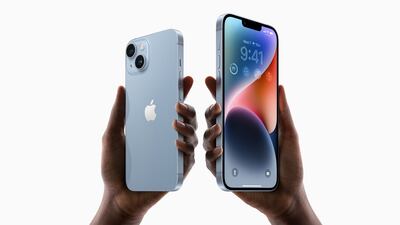
Available in a 6.1-inch display and a new, larger 6.7-inch size, the iPhone 14 and iPhone 14 Plus feature impressive camera upgrades and groundbreaking new safety capabilities. Photo: Apple -

The iPhone 14 and iPhone 14 Plus will be available in five colours: midnight, blue, starlight, purple, and (PRODUCT)RED. Photo: Apple -

Apple chief executive Tim Cook speaks at an Apple event on the campus of Apple's headquarters in Cupertino, California. AP -
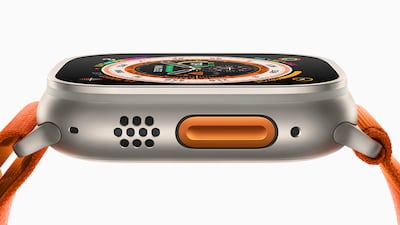
Apple Watch Ultra features a new, customisable action button in high-contrast international orange that gives users quick physical control over a range of functions. Photo: Apple -
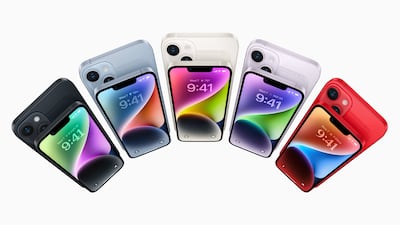
The iPhone 14 and iPhone 14 Plus offer industry-leading durability and amazing battery life, including the best battery life ever in an iPhone with iPhone 14 Plus. Photo: Apple -

Mr Cook arrives to speak at an Apple event in Cupertino. AP -

Visitors arrive at the Steve Jobs Theatre before the Far Out Apple event. Bloomberg -

Visitors arrive at Steve Jobs Theatre on the Apple campus. Bloomberg -

Members of the media await the arrival of Mr Cook in Cupertino. EPA -

Mr Cook presents the new iPhone 14 at the event. Reuters -

The new extra-small ear tip on the Apple AirPods Pro delivers a better fit to more customers. Photo: Apple -
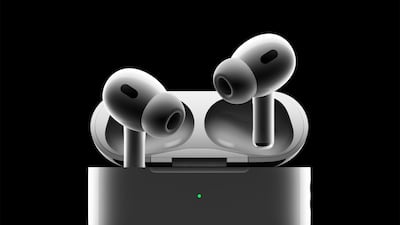
The new AirPods Pro bring major upgrades to Transparency mode, Spatial Audio and convenience features while cancelling up to twice as much noise. Photo: Apple -
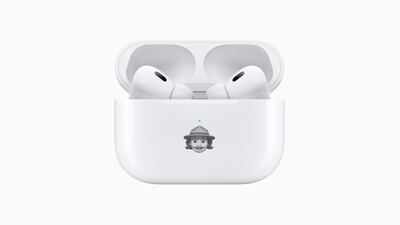
You can personalise the charging case with Memoji, Animoji and a curated list of stickers. Photo: Apple -

The new AirPods Pro. Photo: Apple -

Apple Watch Ultra, the most rugged and capable Apple Watch. Photo: Apple -
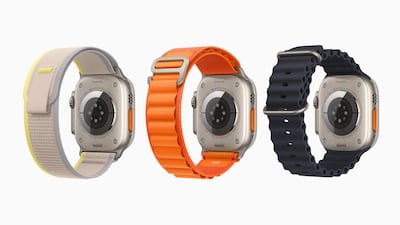
Three new bands — Trail Loop, Alpine Loop and Ocean Band — offer unique design features that provide a secure and comfortable fit. Photo: Apple -

The reimagined Lock Screen in iOS 16 offers a multilayered effect that sets subjects of photos in front of the time, along with newly designed widgets. Photo: Apple -

The Ultra Wide camera offers a new perspective for photos and video, and receives benefits from Photonic Engine — an enhanced image pipeline. Photo: Apple -
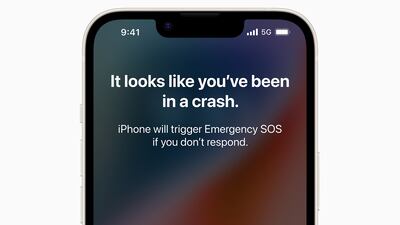
Crash Detection uses specialised components paired with Apple-designed algorithms to detect a severe car crash and automatically dial emergency services when a user is unconscious or unable to reach their iPhone. Photo: Apple -
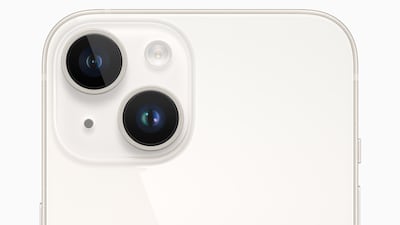
The iPhone 14 and iPhone 14 Plus contain a new 12MP Main camera, a new front TrueDepth camera and the Ultra Wide camera. Photo: Apple -
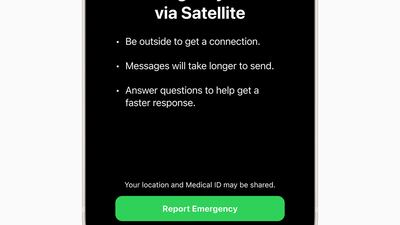
The iPhone 14 line-up includes Emergency SOS via satellite, enabling the user to contact emergency services when outside of cellular or Wi-Fi coverage. Photo: Apple



