


Dubai is considering plans to implement a new economic output metric to measure the contribution of the metaverse to its economy, according to the Minister of State for Artificial Intelligence, Digital Economy and Remote Work Applications.
The new metric, set to be called "gross metaverse product", will showcase how the emerging technology is poised to be a significant contributor to the future economy, Omar Al Olama said at the Dubai Metaverse Assembly on Wednesday.
"Gross metaverse product will be able to create billions of dollars in returns from Dubai without people being physically in the emirate but experiencing it in the metaverse," said Mr Al Olama, who is also chairman of the Dubai Chamber of Digital Economy.
The sectors that the metric will be applied to include tourism, education, retail, real estate and the government, he said.
The minister did not reveal any further details or when it is likely to be launched.
The metaverse, an emerging space where people can interact in virtual worlds, presents an economic opportunity worth between $8 trillion and $13tn, although it is heavily dependent on how much companies are willing to invest in the emerging innovation, according to consultancy PricewaterhouseCoopers.
The UAE has taken a number of steps to promote the adoption of the metaverse.
In July, officials unveiled the Dubai Metaverse Strategy, which aims to create 40,000 jobs and add $4 billion to the emirate's economy over the next five years.
Mr Al Olama stressed that Dubai is building the metaverse with a pragmatic view, ensuring that its development is not based on hype or unproven mechanics, but rather, on a strategy with tangible outcomes.
"We have a goal of making Dubai one of the leaders in the metaverse globally," he said.
A major benefit that the metaverse provides for the workforce is that it helps protect workers and also has the potential to pay higher salaries, said Sultan bin Sulayem, chairman and chief executive of Dubai-based ports operator DP World.
"The metaverse is a technology that we need, as it allows us to interact better and has so much potential in our business," he said at the assembly.
"The impact for the people will be better because you will move people from a job that is dangerous and doesn’t pay much to one that is safer and pays more."
-
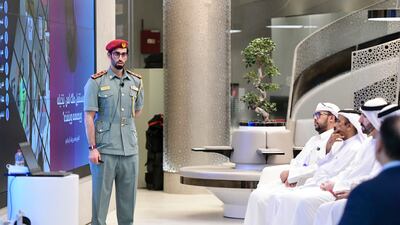
Presentations regarding different facets of Metaverse at the Dubai Metaverse Assembly at Museum of the Future. All photos: Khushnum Bhandari / The National -
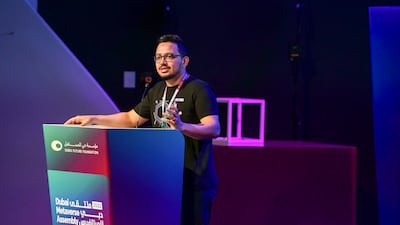
Sandeep Nailwal, co-founder of Polygon, speaks about The Building Blocks for WEB 3.0 and the Metaverse. -

From left, Alex Gubbay, Head of Digital at 'The National', moderator Amin Al Zarouni, of Bedu, Abdelrahman Mohamed, of MetaCon Global, Abdulla Mohamed Al Dhaheri, of Chaintech Lab, and Haya Al Gussain, of Evolve Network Club take part in the UAE Metaverse Contributors' panel discussion. -
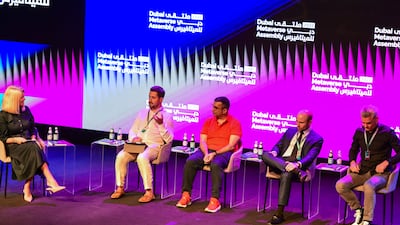
From left, Jane Witherspoon of Euronews moderates a panel discussion on 'Which sectors is the Metaverse already impacting' with Yusuf Bahadir, of GoArt, Vishal Gondal, founder and CEO of GOQii, David Clark-Joseph, of Pixelynx and Bradford Bird, of The Fabricant. -

Tom Urquhart from Arabian Radio Network speaks about gaming with Ahmed Tehemar, of Gamefi. -
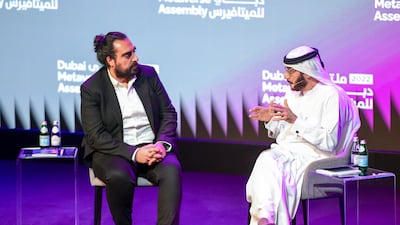
From left, Mustafa Alrawi of 'The National' speaks to Adel Al Redha, CEO of Emirates about 'Opportunities in Aviation'. -
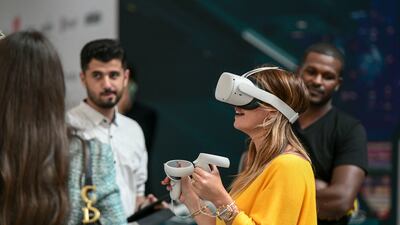
A visitor tests a virtual reality headset at the Dubai Metaverse Assembly at Museum of Future. -
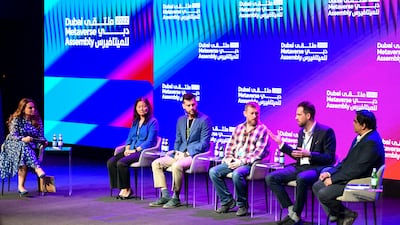
From left, moderator Mina Al-Oraibi, Editor-in-Chief at 'The National', HSBC's Catherine Zhou, Alexander Chehade from Binance, Keith Jordan from Mastercard, DIFC Authority's Christian Kunz and Vinit Shah from the Virtual Assets Regulatory Authority discuss the role of governments in virtual worlds. -
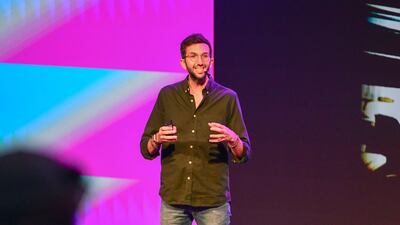
Ziad Traboulsi from Meta addresses the assembly. -
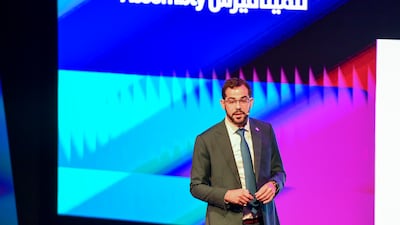
Gabriel Abed, ambassador of Barbados to the UAE, speaks about the future of nations in the Metaverse. -
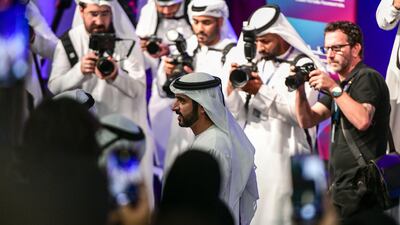
Sheikh Hamdan bin Mohammed, Crown Prince of Dubai, attends the event at Museum of the Future. -
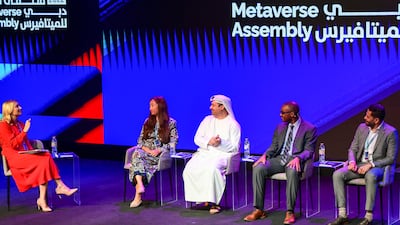
From left, Euronews moderator Laura Buckwell, Cathy Li of the World Economic Forum, Digital Dubai's Marwan Al Zarouni, Meta's James Hairston and Balsam Danhach of FTX discuss 'Maximizing the Potential of Ecosystems on the Metaverse'. -

Brandy Scott of the Arabian Radio Network, left, and Sultan Ahmed Bin Sulayem, Group Chairman and CEO of DP World discuss 'How the Metaverse will Enable People and Operations'. -
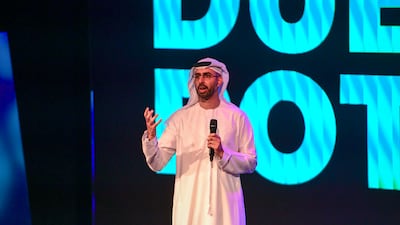
Omar Al Olama, Minister of State for Digital Economy, AI and Remote Working System, speaks about 'Unlocking Dubai's Potential'. -
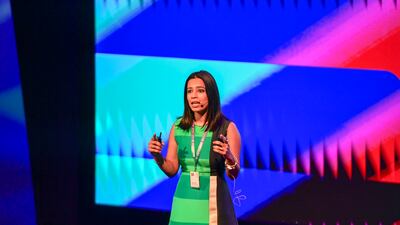
Asma Shabab of Accenture leads the 'Building the Responsible Metaverse' discussion with virtual speaker Anne Groeppelin, also from Accenture. -
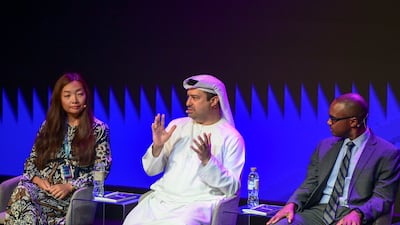
Ms Li, left, and Mr Hairston, right, listen as Mr Al Zarouni makes a point. -
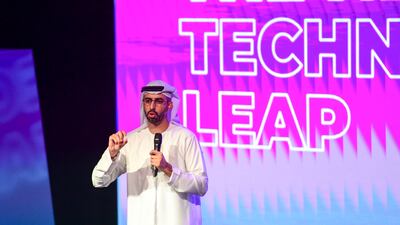
Mr Al Olama, who is also Chairman of Dubai Chamber of Digital Economy and Vice Chairman of the Higher Committee for Future Technology and Digital Economy in Dubai. -
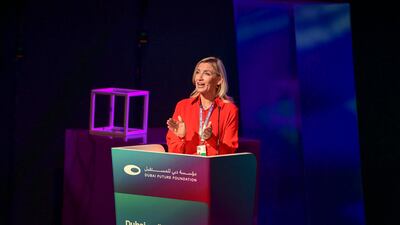
Moderator Ms Buckwell leads the panel discussion on 'Maximizing the Potential of Ecosystems on the Metaverse'. -

From left, The National's Sarah Forster moderates a discussion with Samuel Hamilton of the Decentraland Foundation, Majid Al Futtaim's Joe Abi Akl, Damac Properties' Ali Sajwani and Guy Parsonage from PwC on 'Opportunities in Virtual Real Estate'. -
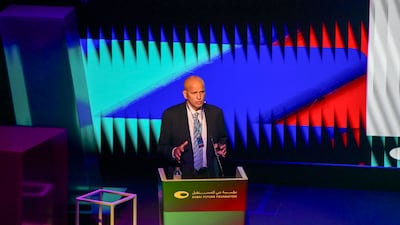
Ihab Foudeh from Microsoft speaks on the topic of 'Unravelling the Metaverse and its Future'. -
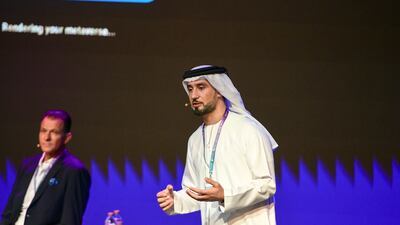
Khalifa Al Jaziri Al Shehhi gives a presentation on 'Metaverse and the Economy'. -
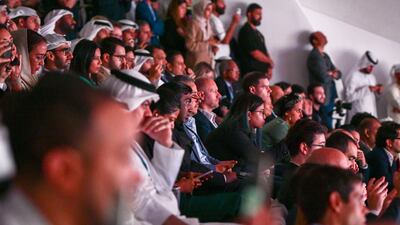
Some of the audience at the Dubai Metaverse Assembly. -
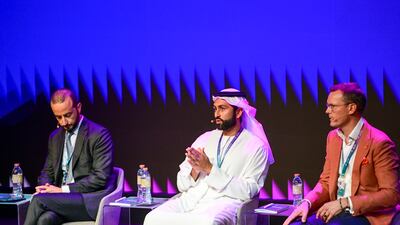
From left, Mr Abi Akl, Mr Sajwani and Mr Parsonage continue their discussion. -

The audience takes in the discussion. -
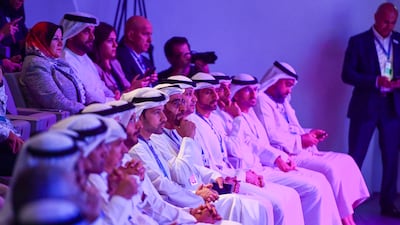
Front-row seats for the Dubai Metaverse Assembly. -

Minister of Economy Abdulla bin Touq, second from left, joins a discussion on 'Metaverse and the Economy' moderated by Karl Tlais, left, founder and strategic advisor of iAdvisory, Accenture managing director Bashar Kilani, second from right, and BCG Digital Ventures managing director and partner Mark Zaleski. -

Khalfan Belhoul, CEO of the Dubai Future Foundation gives the opening address.


DP World in May said it was tapping into the metaverse with a new platform to solve supply-chain challenges.
The platform, called DPMetaWorld, is expected to be released by the end of 2022 and will use digital solutions and accelerate their adoption through the untapped capabilities of the metaverse, “helping drive efficiency and transparency”, the company said at that time.
Mr bin Sulayem said that the digitisation of jobs allows companies, such as DP World, to delegate employees to other essential tasks to make operations more robust, which in turn would result in higher revenue.
Citing an example, he said that instead of staff operating machines, which is a repetitive job and can be automated, they can be reassigned to other areas such as mobilising cargo and negotiating prices with clients, which would add value to the company's overall operations.
"People would be in the office doing their best ... that is better for me and the business," he added.

