Founded by banker turned entrepreneur Karl Naim, Wissam Ghorra and Jean-Marie Khoueir in 2021, the trio are well on their way to disrupting the country’s remittance sector by focusing on financial inclusion, lower fees and allowing beneficiaries to withdraw money from ATMs owned by its banking partner Banque Libano-Francaise.
“I was based [in] Paris until October of 2021,” says Mr Naim.
“Every time I would travel to Lebanon, I had friends in Paris who were asking me to take money with me to give to their families. Obviously, the maximum you can take is €10,000 [$9,979], so people will give me thousands of euros and say, 'Please, once you get to Beirut, distribute them to my uncle, my parents and my cousins'.
“Eventually, I was [asking myself], why is it so hard to send money to Lebanon?”
Lebanon remittances — in pictures
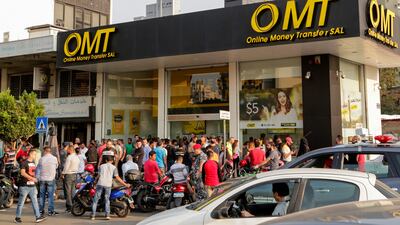
People gather at a shop that provides money transfer services in the Lebanese capital Beirut. AFP
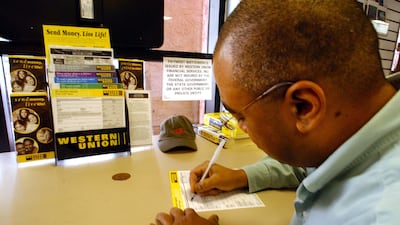
A man fills out a form to wire money at a Western Union outlet in San Diego, California. Getty Images
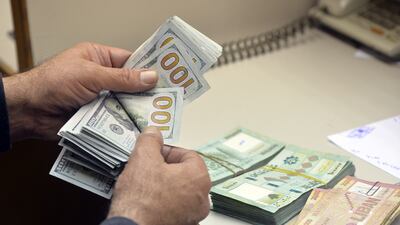
An exchange dealer counts money at a currency exchange office as the value of the Lebanese lira continues to drop. Getty Images
A pedestrian walks past a Western Union and check cashing store in the Brooklyn borough of New York City. Getty Images
For two decades, the Lebanese pound has been pegged to the US dollar, but banks have been reducing access to dollars following fears of a shortage in central bank reserves. AFP
People no longer trust banks “because they're worried that [if] you send it to their bank account, they're not able to cash it out”, Mr Naim says.
By sending money home with a trusted friend, people were also trying to avoid the high fees charged by a few money transfer companies, which enjoy a near-monopoly status through a large network of branches, he adds.
“So that's how we came up with the idea of building an aggregator, where we are the technology piece that integrates with new digital remittance players to open the corridor to Lebanon, which will eventually bring fees lower for the sender, and at the same time bring an app that permits the beneficiary to cash out in a much more seamless and efficient way.
Lebanon is facing its worst economic crisis since the country's independence in 1943. Its economy contracted about 58 per cent between 2019 and 2021, with gross domestic product plummeting to $21.8 billion in 2021 from about $52bn in 2019, according to the World Bank. That is the largest contraction on a list of 193 countries.
Lebanon's economy collapsed after it defaulted on about $31bn of Eurobonds in March 2020, with its currency sinking more than 90 per cent against the dollar on the black market and inflation rising to triple digits.
Banks have imposed informal capital controls, barring depositors from accessing their savings, which created huge difficulties for people to withdraw money from their accounts.
Last month, a local man gained the admiration of many in Lebanon when he held up a bank branch in Beirut, demanding access to his blocked savings, so he could pay for his father’s medical treatment.
__________________
Watch: Beirut bank hostage situation comes to end
The company's mission is to “democratise remittances, cross-border transfer flows and enable financial inclusion in a country where 80 per cent of the population is unbanked. It's very important to promote financial inclusion”, Mr Naim says.
“So we've built a technology that allows us to use ATMs of banks, that are supposedly only used by banked people or people that have a card, by unbanked people. With our prepaid app, you can even cash out from an ATM without having an account or a card.”
Remittances are important for Lebanon’s economy and account for 54 per cent of the country’s GDP, which is the highest among the Mena countries, according to the World Bank.
Lebanon received $6.6bn in remittances in 2021 and is the third highest remittance receiver in the Mena region after Egypt and Morocco, the World Bank data shows.
“Today, our users are people residing in Lebanon. For now, we are focusing on the inward remittances. Once we get a digital wallet licence, which we expect very soon, we will be able to also focus on the outward remittances allowing foreign workers in Lebanon to send money home.”
Purpl office in Lebanon. Photo: Purpl
The digital wallet licence will also allow “users to store value on their app, and spend digitally at merchants instead of just cashing out that money all the time”, he says.
The company, which is part of the Hub71 ecosystem in Abu Dhabi, has plans to expand to other countries including Iraq, Syria, Jordan and Egypt as part of its future growth plans.
It has already signed an agreement with a partner in Iraq to replicate the same model of cardless ATM withdrawals for remittances, Mr Naim says.
Purpl has raised $2 million in funding so far from international investors, venture capital funds and family offices and is looking at doing another funding round at the end of 2023 to expand its operations across the region.
Being part of the Hub71 ecosystem in Abu Dhabi will help the company to secure more funding as well as build partnerships with remittance companies, Mr Naim adds.
“Today, for example, we are in talks with a few remittance companies in the UAE, thanks to help from Hub71.”
Q&A with Karl Naim, co-founder and chief executive of Purpl
What successful start-up do you wish you had started?
For me, a start-up success is a measure of disruption, empowerment and community building. In 2014 I launched my first start-up in FoodTech, called ChefXchange, a marketplace for private chefs. I was then inspired by Deliveroo. A second start-up I wish I had started would be Revolut, which reinvented banking in Europe.
What is your vision for the company?
We started Purpl to provide a new alternative to a banking sector that collapsed in Lebanon and lost the trust of the Lebanese population. Our vision is to connect, empower and enable financial access to all in Lebanon and eventually in the Mena region.
What new skills have you learnt in the process of launching your start-up?
Life in a start-up is all about continuous learning. When launching my first start-up in 2014, I learnt all about resilience and perseverance, but, most importantly, I learnt the hard way to never fall in love with your original idea and accept change. Being agile and accepting to pivot based on what your market and customers tell you is the key to success.
If you could start all over again, what would you do differently?
I wouldn't change anything. Everything that I did shaped me into who I am today and it came with its fair share of failures, successes and, most importantly, learning. I cherish and am thankful for everything I went through and the people who shared these adventures with me.
Who is your role model?
Every entrepreneur I meet and every person I get a chance to work with are role models one way or another. If I were to pick people who inspired me to start my entrepreneurial journey, it would be the founders I invested in as an angel investor.
Where do you see yourself after 10 years?
Hopefully, in a position of giving back, mentoring and investing in ambitious and disruptive founders. I do not believe, 10 years from now, that I would still have the energy required to start new ventures myself.
How would you describe the current state of Lebanon’s economy?
A state that is hard to comprehend. So much value destruction in so little time. In numbers, a currency that lost 94 per cent of its value, 75 per cent of the population living under the poverty line, 80 per cent of the population that is unbanked, triple-digit month-on-month inflation, and a GDP cut by more than 50 per cent in three years. That being said, adversity breeds opportunity and it is our duty to not stand idle and to try to make a difference. This is the mission we set ourselves at Purpl.

Ten tax points to be aware of in 2026
1. Domestic VAT refund amendments: request your refund within five years
If a business does not apply for the refund on time, they lose their credit.
2. E-invoicing in the UAE
Businesses should continue preparing for the implementation of e-invoicing in the UAE, with 2026 a preparation and transition period ahead of phased mandatory adoption.
3. More tax audits
Tax authorities are increasingly using data already available across multiple filings to identify audit risks.
4. More beneficial VAT and excise tax penalty regime
Tax disputes are expected to become more frequent and more structured, with clearer administrative objection and appeal processes. The UAE has adopted a new penalty regime for VAT and excise disputes, which now mirrors the penalty regime for corporate tax.
5. Greater emphasis on statutory audit
There is a greater need for the accuracy of financial statements. The International Financial Reporting Standards standards need to be strictly adhered to and, as a result, the quality of the audits will need to increase.
6. Further transfer pricing enforcement
Transfer pricing enforcement, which refers to the practice of establishing prices for internal transactions between related entities, is expected to broaden in scope. The UAE will shortly open the possibility to negotiate advance pricing agreements, or essentially rulings for transfer pricing purposes.
7. Limited time periods for audits
Recent amendments also introduce a default five-year limitation period for tax audits and assessments, subject to specific statutory exceptions. While the standard audit and assessment period is five years, this may be extended to up to 15 years in cases involving fraud or tax evasion.
8. Pillar 2 implementation
Many multinational groups will begin to feel the practical effect of the Domestic Minimum Top-Up Tax (DMTT), the UAE's implementation of the OECD’s global minimum tax under Pillar 2. While the rules apply for financial years starting on or after January 1, 2025, it is 2026 that marks the transition to an operational phase.
9. Reduced compliance obligations for imported goods and services
Businesses that apply the reverse-charge mechanism for VAT purposes in the UAE may benefit from reduced compliance obligations.
10. Substance and CbC reporting focus
Tax authorities are expected to continue strengthening the enforcement of economic substance and Country-by-Country (CbC) reporting frameworks. In the UAE, these regimes are increasingly being used as risk-assessment tools, providing tax authorities with a comprehensive view of multinational groups’ global footprints and enabling them to assess whether profits are aligned with real economic activity.
Contributed by Thomas Vanhee and Hend Rashwan, Aurifer
Tips for job-seekers
Do not submit your application through the Easy Apply button on LinkedIn. Employers receive between 600 and 800 replies for each job advert on the platform. If you are the right fit for a job, connect to a relevant person in the company on LinkedIn and send them a direct message.
Make sure you are an exact fit for the job advertised. If you are an HR manager with five years’ experience in retail and the job requires a similar candidate with five years’ experience in consumer, you should apply. But if you have no experience in HR, do not apply for the job.
David Mackenzie, founder of recruitment agency Mackenzie Jones Middle East
Desert Warrior
Starring: Anthony Mackie, Aiysha Hart, Ben Kingsley
Company name/date started: Abwaab Technologies / September 2019
Founders: Hamdi Tabbaa, co-founder and CEO. Hussein Alsarabi, co-founder and CTO
Based: Amman, Jordan
Sector: Education Technology
Size (employees/revenue): Total team size: 65. Full-time employees: 25. Revenue undisclosed
Stage: early-stage startup
Investors: Adam Tech Ventures, Endure Capital, Equitrust, the World Bank-backed Innovative Startups SMEs Fund, a London investment fund, a number of former and current executives from Uber and Netflix, among others.
Itcan profile
Founders: Mansour Althani and Abdullah Althani
Based: Business Bay, with offices in Saudi Arabia, Egypt and India
Sector: Technology, digital marketing and e-commerce
Size: 70 employees
Revenue: On track to make Dh100 million in revenue this year since its 2015 launch
Founded over 50 years ago, the National Archives collects valuable historical material relating to the UAE, and is the oldest and richest archive relating to the Arabian Gulf.
Much of the material can be viewed on line at the Arabian Gulf Digital Archive - https://www.agda.ae/en
3pm: 49kg female: Mayssa Bastos (BRA) v Thamires Aquino (BRA)
3.07pm: 56kg male: Hiago George (BRA) v Carlos Alberto da Silva (BRA)
3.14pm: 55kg female: Amal Amjahid (BEL) v Bianca Basilio (BRA)
3.21pm: 62kg male: Gabriel de Sousa (BRA) v Joao Miyao (BRA)
3.28pm: 62kg female: Beatriz Mesquita (BRA) v Ffion Davies (GBR)
3.35pm: 69kg male: Isaac Doederlein (BRA) v Paulo Miyao (BRA)
3.42pm: 70kg female: Thamara Silva (BRA) v Alessandra Moss (AUS)
3.49pm: 77kg male: Oliver Lovell (GBR) v Tommy Langarkar (NOR)
3.56pm: 85kg male: Faisal Al Ketbi (UAE) v Rudson Mateus Teles (BRA)
4.03pm: 90kg female: Claire-France Thevenon (FRA) v Gabreili Passanha (BRA)
4.10pm: 94kg male: Adam Wardzinski (POL) v Kaynan Duarte (BRA)
4.17pm: 110kg male: Yahia Mansoor Al Hammadi (UAE) v Joao Rocha (BRA
COMPANY PROFILE
● Company: Bidzi
● Started: 2024
● Founders: Akshay Dosaj and Asif Rashid
● Based: Dubai, UAE
● Industry: M&A
● Funding size: Bootstrapped
● No of employees: Nine
World record transfers
1. Kylian Mbappe - to Real Madrid in 2017/18 - €180 million (Dh770.4m - if a deal goes through)
2. Paul Pogba - to Manchester United in 2016/17 - €105m
3. Gareth Bale - to Real Madrid in 2013/14 - €101m
4. Cristiano Ronaldo - to Real Madrid in 2009/10 - €94m
5. Gonzalo Higuain - to Juventus in 2016/17 - €90m
6. Neymar - to Barcelona in 2013/14 - €88.2m
7. Romelu Lukaku - to Manchester United in 2017/18 - €84.7m
8. Luis Suarez - to Barcelona in 2014/15 - €81.72m
9. Angel di Maria - to Manchester United in 2014/15 - €75m
10. James Rodriguez - to Real Madrid in 2014/15 - €75m
Company name: baraka
Started: July 2020
Founders: Feras Jalbout and Kunal Taneja
Based: Dubai and Bahrain
Sector: FinTech
Initial investment: $150,000
Current staff: 12
Stage: Pre-seed capital raising of $1 million
Investors: Class 5 Global, FJ Labs, IMO Ventures, The Community Fund, VentureSouq, Fox Ventures, Dr Abdulla Elyas (private investment)
A Bad Moms Christmas
Dir: John Lucas and Scott Moore
Starring: Mila Kunis, Kathryn Hahn, Kristen Bell, Susan Sarandon, Christine Baranski, Cheryl Hines
Two stars
Profile
Name: Carzaty
Founders: Marwan Chaar and Hassan Jaffar
Launched: 2017
Employees: 22
Based: Dubai and Muscat
Sector: Automobile retail
Funding to date: $5.5 million
FIXTURES
Thu Mar 15 – West Indies v Afghanistan, UAE v Scotland
Fri Mar 16 – Ireland v Zimbabwe
Sun Mar 18 – Ireland v Scotland
Mon Mar 19 – West Indies v Zimbabwe
Tue Mar 20 – UAE v Afghanistan
Wed Mar 21 – West Indies v Scotland
Thu Mar 22 – UAE v Zimbabwe
Fri Mar 23 – Ireland v Afghanistan
The top two teams qualify for the World Cup
Classification matches
The top-placed side out of Papua New Guinea, Hong Kong or Nepal will be granted one-day international status. UAE and Scotland have already won ODI status, having qualified for the Super Six.
Thu Mar 15 – Netherlands v Hong Kong, PNG v Nepal
Sat Mar 17 – 7th-8th place playoff, 9th-10th place play-off
The specs
Engine: 3.6 V6
Transmission: 8-speed auto
Power: 295bhp
Torque: 353Nm
Price: Dh155,000
On sale: now
Key facilities
Olympic-size swimming pool with a split bulkhead for multi-use configurations, including water polo and 50m/25m training lanes
Premier League-standard football pitch
400m Olympic running track
NBA-spec basketball court with auditorium
600-seat auditorium
Spaces for historical and cultural exploration
An elevated football field that doubles as a helipad
Specialist robotics and science laboratories
AR and VR-enabled learning centres
Disruption Lab and Research Centre for developing entrepreneurial skills
Nigel Farage told Reform's annual conference that the party will proscribe the Muslim Brotherhood if he becomes Prime Minister. "We will stop dangerous organisations with links to terrorism operating in our country," he said. "Quite why we've been so gutless about this – both Labour and Conservative – I don't know. “All across the Middle East, countries have banned and proscribed the Muslim Brotherhood as a dangerous organisation. We will do the very same.” It is 10 years since a ground-breaking report into the Muslim Brotherhood by Sir John Jenkins. Among the former diplomat's findings was an assessment that “the use of extreme violence in the pursuit of the perfect Islamic society” has “never been institutionally disowned” by the movement. The prime minister at the time, David Cameron, who commissioned the report, said membership or association with the Muslim Brotherhood was a "possible indicator of extremism" but it would not be banned.