

The UAE's demographic trends significantly shape its real estate market dynamics, reflecting an interplay between population characteristics and property demand.
It is a known fact that expatriates account for the majority of the country's 12.5 million population – about 88 per cent or 11.06 million as of July.
Breaking down the numbers, the largest age bracket in the UAE’s population, at 68 per cent, is between 25 and 54 years. In terms of nationality, 4.75 million people in the country, or about 43 per cent of the residents, are Indians.
The intersection of people aged between 25 and 54 years and Indian by nationality in the UAE is about three million. For perspective, that's close to the entire population of Dubai, which stands at 3.7 million.
Impact on rents
Now we can infer that a large portion of this young Indian demographic might prefer renting over buying due to the transient nature of expatriate life.
Areas with established Indian communities, such as Bur Dubai and Karama, continue to attract new residents due to cultural familiarity and community support.
Also, since all expats require visa permits to reside in the country, it can be assumed that a majority of the 11 million in the country are employed.
Young professionals often prioritise career growth and frequently change jobs or relocate for better opportunities. Renting offers the flexibility to move without the long-term commitment of home ownership, making it an attractive option.
Also, with the sharp rise in house prices in Dubai (up 20 per cent annually in May, as per property consultancy JLL's estimates), driven by high demand from ultra-high-net-worth individuals, reforms attracting long-term buyers as well as limited supply, renting becomes a more attractive option for young residents.
Renting allows them to avoid the high costs of home ownership and benefit from more affordable living options.
For example, the average cost of renting an apartment in Dubai varies by location but is generally more affordable than the combined costs of a mortgage, property maintenance, and other ownership-related expenses. Additionally, many rental properties in Dubai come with amenities such as pools, gyms, and maintenance services, which would be expensive to maintain in a privately owned property for the young demographic.
There is also a notable shift in cultural attitudes towards home ownership among younger generations.
Unlike previous generations, young people today often do not view home ownership as a necessary step towards adulthood or financial stability. Instead, they tend to prioritise spending on experiences such as travel and leisure activities rather than overcommitting to a mortgage.
Renting provides the financial freedom to pursue these interests, offering greater flexibility and fewer long-term financial commitments.
Young professionals also often seek residences close to work, entertainment and amenities, driving up demand for apartments in urban areas, leading to high occupancy rates in central locations like Downtown Dubai, Business Bay and the Dubai International Financial Centre.
All of this creates sustained demand for rental apartments and villas, which in turn pushes up the rates.
For example, in May, the average residential rent in Dubai rose by 21 per cent annually, according to JLL.
Moreover, the supply and demand dynamics indicate that residential rents are expected to continue rising.
In the first half, 6,600 units were delivered in Dubai, as per JLL estimates. And during the same period, the city's population increased by approximately 50,000 people, official data shows.
With the rapidly growing population, the resulting imbalance between demand and supply will maintain Dubai’s residential market trajectory upwards.
Filling up offices and malls
Dubai's young workforce, booming with the influx of small businesses, as well as the growth of the financial services sector, has in turn supported the commercial property sector.
Office occupancy rates rose to 91.3 per cent in the first quarter, up from 90.1 per cent during the same period last year.
This high occupancy, despite limited new supply, highlights the demand for modern, flexible office spaces.
Beyond the residential and commercial sectors, Dubai's retail and hospitality markets are also heavily influenced by the country's diverse demographic profile.
The city's major malls, like Dubai Mall and Mall of the Emirates, report high footfall and strong sales performance, reflecting the purchasing power of residents and tourists.
For perspective, Dubai Mall claimed to be the most visited mall globally last year, welcoming a record 103 million visitors, as Dubai continues to thrive as a retail hub driven by its large tourism industry.
Dubai Mall celebrates 15 years – in pictures
-

Dubai Mall shortly after it opened in 2008. AFP -
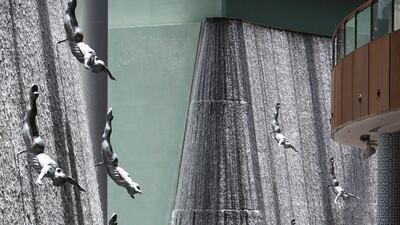
The fountain with sculpture divers at Dubai Mall is a popular site in the shopping centre. AFP -

The new Chinatown section of the mall. Chris Whiteoak / The National -

The section is filled with artworks and designs alluding to Asian cultures. Chris Whiteoak / The National -

Chinatown is one of the most recent additions to Dubai Mall. Chris Whiteoak / The National -

Chinatown is one of many Instagram favourites at Dubai Mall. Chris Whiteoak / The National -
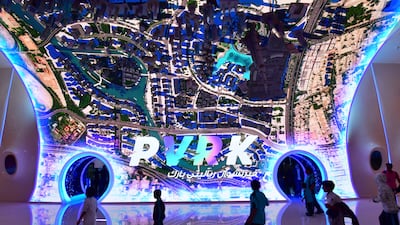
The virtual reality park at Dubai Mall. AFP -

Apple employees cheer as the doors of the Dubai Mall Apple Store open in September 2017 for customers to buy the new iPhone 8. AFP -

A passageway covered with umbrellas. AFP -

The mall houses an original skeleton of a dinosaur, which scientists named Amphicoelias. The 155-million-year-old dinosaur was discovered in 2008 in the Dana Quarry in Wyoming, USA. Reuters -

The mall often stages art exhibitions, including once by American artist Andy Warhol, which was held in 2010. AFP -
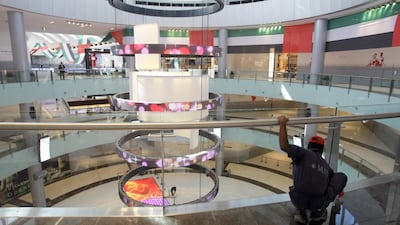
A worker puts in a final few finishing touched at the new Dubai Mall shopping centre, hours before its official opening on November 4, 2008. AFP -

Sharks swim past divers and visitors in Dubai Aquarium and Underwater Zoo. AFP -

Dubai Mall welcomes about 100 million visitors a year. Chris Whiteoak / The National -

The exterior of Dubai Mall. Chris Whiteoak / The National -

After 15 years, the mall has retained its title as the world's largest mall based on total area. Chris Whiteoak / The National -

A worker at a construction site near Dubai Mall in October 2008, days before the shopping centre's official opening. Reuters


Additionally, the UAE this year has a gross domestic product per capita of around $96,850, emphasising the necessity for top-tier retail spaces.
A big part of the hospitality sector's growth is led by the tourism boom in Dubai and the UAE: in the first half of this year, Dubai alone welcomed an astounding 9.31 million international visitors.
However, a high proportion of expatriate residents in the country also tend to attract family and friends, which, in turn, significantly supports the demand for hotels and short-term rentals.
Changing dynamics
Going forward, the UAE government's reforms such as the issuance of golden visas for expatriates are likely to tilt the residential market towards sales as more residents might favour buying over renting.
This anticipated shift towards home ownership will positively support the growth of the future residential real estate market.
A higher rate of home ownership among expatriates will also lead to an expansion of the mortgage market.
Vijay Valecha is the chief investment officer at Century Financial

