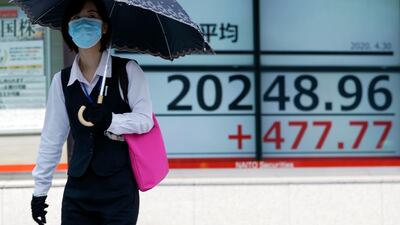
Credit agency Moody’s said some ETFs may prove “illiquid" in a bear market, meaning investors could struggle to get their money in a crash. Associated Press

How have ETFs weathered the market crash?


  • English
  • Arabic

ETFs explained

Exhchange traded funds are bought and sold like shares, but operate as index-tracking funds, passively following their chosen indices, such as the S&P 500, FTSE 100 and the FTSE All World, plus a vast range of smaller exchanges and commodities, such as gold, silver, copper sugar, coffee and oil.

ETFs have zero upfront fees and annual charges as low as 0.07 per cent a year, which means you get to keep more of your returns, as actively managed funds can charge as much as 1.5 per cent a year.

There are thousands to choose from, with the five biggest providers BlackRock’s iShares range, Vanguard, State Street Global Advisors SPDR ETFs, Deutsche Bank AWM X-trackers and Invesco PowerShares.

Exchange traded funds have been the big investment success story of the last 25 years, attracting huge sums from private investors. But there has always been a question mark hanging over the sector: how would it perform in a market crash?

Last year, Wall Street guru Michael Burry said the flood of money going into index-tracking ETFs will reverse at some point and when that happens, “it will be ugly”.

“Like most bubbles, the longer it goes on, the worse the crash will be," he said.

The ETF market has been stable during the pandemic. No big stock or bond fund has collapsed and some even saw their most active trading days.

Many heeded Mr Burry's warning because this is the man who made $1 billion (Dh3.67bn) by accurately predicting the 2008 market collapse, and was famous enough to be played by Christian Bale in the Hollywood film The Big Short.

Credit agency Moody’s also warned some ETFs may prove “illiquid" in a bear market, meaning investors could struggle to get their money in a crash, if nobody wants to buy the underlying assets.

The big test finally came in March, when markets crashed due to Covid-19, and several ETFs investing in oil and corporate bonds hit liquidity problems. So is it still safe to hold them?

Between the launch of the first ETF in 1993 and the end of last year, an incredible $6.35 trillion was invested in the sector, according to figures from ETFGI.com. Then came this year's crash.

Inevitably, any investor who holds ETFs will be hurting right now. As passive tracking funds, all they can do when stock markets crash is passively follow share prices downward.

Stuart Ritchie, director of wealth advice at AES International and an advocate of ETFs, says investors had an easy run after 2008, as low interest rates and central bank stimulus packages drove asset prices higher and higher, and ETFs passively followed as they are designed to do.

The big worry was that when the crash came, investors would panic and sell everything at the same time, accelerating the downturn and leaving investors in a liquidity trap, unable to withdraw their funds.

With one or two notable exceptions, this hasn't happened, Mr Ritchie says. “The ETF market has been stable during the pandemic. No big stock or bond fund has collapsed and some even saw their most active trading days.”

He says they continue to prove their worth over actively managed funds, which once again have fallen short.

Fund managers argued that while ETFs may do well in a bull market, active funds offer far more protection against a crash, as managers could take evasive action by shifting into safer assets. Mr Ritchie says this didn’t happen in practice.

“More than two thirds of actively managed funds fell in line with their benchmarks, or worse. No active manager can guarantee to outperform the market,” he says.

ETFs have not emerged totally unscathed, though. The unprecedented scale of the oil price crash hit the United States Oil Fund, the largest oil-focused ETF, which attempts to track daily price movements by purchasing oil futures contracts. However, its performance diverged sharply, falling 7 per cent last week even as US crude futures climbed 11 per cent, Reuters reports.

Barclays is now shutting down a similar fund, the iPath Series B S&P GSCI Crude Oil Total Return Index ETN.

Peter Garnry, head of equity strategy at Saxo Bank, says liquidity problems created a large "deviance" between the quoted fund price and the value of the underlying assets.

"The United States Oil Fund exposed private investors to market dynamics they didn't understand, and investors need to be aware of the danger before the next crisis comes.”

In March, ETFs investing in company bonds suffered similar pricing problems, with the iShares iBoxx Investment Grade Corporate Bond ETF closing 4.5 per cent below its fair value at one point. The Pimco Investment Grade Corporate Bond Index ETF (LQD) traded at a similar discount.

The Vanguard Total Bond Market Index fund and Fidelity US Bond Index also fell sharply. The sector was ultimately saved by the US Federal Reserve’s pledge on March 23 to buy investment-grade credit and certain ETFs. This provided the liquidity needed to rescue bonds that had been floundering in a market with no buyers.

Matt Brennan, head of passive portfolios at UK-based investment platform AJ Bell, says despite these isolated issues, the vast majority of ETFs have proved their worth and the long feared sell-off has not happened.

"Latest data from asset manager DWS shows net outflows totalling €4.5bn (Dh18.3bn), which is less than 1 per cent of the market," he says.

Mr Bell says investors should watch for ETF variants such as traded commodities and exchange traded notes , which do not hold the underlying asset but use derivatives or other securities to replicate performance.

For added security, look for ETFs that are compliant with the European Union’s investment fund rules, known as UCITS funds, typically domiciled in tax-neutral jurisdictions such as Ireland or Luxembourg.

Most private investors use ETFs to track mainstream stock markets such as the US S&P 500, FTSE 100, euro Stoxx 50 and MSCI global indices, and Mr Garnry says these funds have had no liquidity issues. “The ETF market has for the most part weathered the crisis well, with just a few hiccups,” he says.

Vijay Valecha, chief investment officer at Century Financial in Dubai, says fears that ETFs would hinder "price discovery", the process by which investors work out how much assets are worth, have proved unfounded.

“When China closed its financial markets during January's lunar holiday as protection against the pandemic, the US-listed ETF that tracks Chinese securities declined 9.6 per cent in the week to January 31," he says. "When the CSI 300 Index opened for trading, it had fallen by roughly the same amount.”

Investors still have to accept that if they are holding, say, an ETF investing in the S&P 500, it will fall alongside the market.

As we saw in March, those falls can be severe. However, that is exactly what ETFs are supposed to do: track what is happening in the wider market.

You can reduce investment risk through the old-fashioned method of investing in a diversified spread of ETFs, Mr Valecha says.

He suggests starting with a spread of good quality larger company funds, such as Pro Shares S&P 500 Dividend Aristocrats ETF (NOBL), Van Eck Gold Miners ETF (GDX) and Utilities Select Sector SPDR Fund (XLU).

Then spread your wings by investing in alternative ETFs and Mr Valecha tips Fidelity MSCI Health Care Index (FHLC) right now.

“This gives investors a simple way to invest in pharmaceuticals, biotechnology, medical device makers and other companies that could benefit from the pandemic threat, notably Pfizer, Merck and Johnson & Johnson," he says.

Mr Valecha also highlights the Consumer Discretionary Select Sector SPDR (XLY).

“Consumer spending makes up 70 per cent of gross domestic product in the US and will be a main driver of economic growth once the recovery starts.”

Finally, he tips Vanguard Small Cap ETF (VB), for those happy with the higher risk of investing in smaller companies, which fall faster in a bear market and rise faster when shares recover.

"The current US stimulus package could give the fragile sector a much-needed boost," he says.

Dr Ryan Lemand, senior executive officer of ADS Investment Solutions, says ETFs remain “brilliant products” for individual investors because they are cheap and easy to access.

Fears that investors would run to their smartphones and start selling ETFs when markets crashed, worsening any sell-off, have not been realised. “That would have triggered a failure of market-makers, typically large investment banks that intervene when buy and sell orders are unbalanced. Thankfully, this did not happen, and ETFs did not cause any market disruptions or market breakdown.”

Despite this, Mr Lemand says some investors may return to active fund managers if current volatility continues. “This could help them weather the choppy period with limited losses, or potentially even some gains,” he says.

Others may prefer sophisticated “quantitative” ETFs, that can rapidly switch from aggressive to defensive strategies, based on high-frequency market data. “These are more expensive, but offer good protection during volatile markets,” Mr Lemand says.

The Covid-19 stock market crash was ugly and a handful of oil and corporate bond ETFs have struggled, but Mr Ritchie says investors are standing by passive funds, which have come through their test in good shape. He remains an advocate.

“It is onwards and upward for ETFs,” he says.

Asia Cup Qualifier

Final
UAE v Hong Kong

Live on OSN Cricket HD. Coverage starts at 5.30am

%3Cp%3EMATA%0D%3Cbr%3EArtist%3A%20M.I.A%0D%3Cbr%3ELabel%3A%20Island%0D%3Cbr%3ERating%3A%203.5%2F5%3C%2Fp%3E%0A
The specs

Engine: 2.0-litre 4cyl turbo

Power: 261hp at 5,500rpm

Torque: 405Nm at 1,750-3,500rpm

Transmission: 9-speed auto

Fuel consumption: 6.9L/100km

On sale: Now

Price: From Dh117,059

Guide to intelligent investing
Investing success often hinges on discipline and perspective. As markets fluctuate, remember these guiding principles:
  • Stay invested: Time in the market, not timing the market, is critical to long-term gains.
  • Rational thinking: Breathe and avoid emotional decision-making; let logic and planning guide your actions.
  • Strategic patience: Understand why you’re investing and allow time for your strategies to unfold.


Henrik Stenson's finishes at Abu Dhabi HSBC Championship:

2006 - 2
2007 - 8
2008 - 2
2009 - MC
2010 - 21
2011 - 42
2012 - MC
2013 - 23
2014 - MC
2015 - MC
2016 - 3
2017 - 8

Tree of Hell

Starring: Raed Zeno, Hadi Awada, Dr Mohammad Abdalla

Director: Raed Zeno

Rating: 4/5

UAE currency: the story behind the money in your pockets
What can victims do?

Always use only regulated platforms

Stop all transactions and communication on suspicion

Save all evidence (screenshots, chat logs, transaction IDs)

Report to local authorities

Warn others to prevent further harm

Courtesy: Crystal Intelligence

MATCH INFO

Manchester United 1 (Greenwood 77')

Everton 1 (Lindelof 36' og)

Islamophobia definition

A widely accepted definition was made by the All Party Parliamentary Group on British Muslims in 2019: “Islamophobia is rooted in racism and is a type of racism that targets expressions of Muslimness or perceived Muslimness.” It further defines it as “inciting hatred or violence against Muslims”.

Sole survivors
  • Cecelia Crocker was on board Northwest Airlines Flight 255 in 1987 when it crashed in Detroit, killing 154 people, including her parents and brother. The plane had hit a light pole on take off
  • George Lamson Jr, from Minnesota, was on a Galaxy Airlines flight that crashed in Reno in 1985, killing 68 people. His entire seat was launched out of the plane
  • Bahia Bakari, then 12, survived when a Yemenia Airways flight crashed near the Comoros in 2009, killing 152. She was found clinging to wreckage after floating in the ocean for 13 hours.
  • Jim Polehinke was the co-pilot and sole survivor of a 2006 Comair flight that crashed in Lexington, Kentucky, killing 49.

Directed by: Craig Gillespie

Starring: Emma Stone, Emma Thompson, Joel Fry

4/5

Who's who in Yemen conflict

Houthis: Iran-backed rebels who occupy Sanaa and run unrecognised government

Yemeni government: Exiled government in Aden led by eight-member Presidential Leadership Council

Southern Transitional Council: Faction in Yemeni government that seeks autonomy for the south

Habrish 'rebels': Tribal-backed forces feuding with STC over control of oil in government territory

Pharaoh's curse

British aristocrat Lord Carnarvon, who funded the expedition to find the Tutankhamun tomb, died in a Cairo hotel four months after the crypt was opened.
He had been in poor health for many years after a car crash, and a mosquito bite made worse by a shaving cut led to blood poisoning and pneumonia.
Reports at the time said Lord Carnarvon suffered from “pain as the inflammation affected the nasal passages and eyes”.
Decades later, scientists contended he had died of aspergillosis after inhaling spores of the fungus aspergillus in the tomb, which can lie dormant for months. The fact several others who entered were also found dead withiin a short time led to the myth of the curse.

Abandon
Sangeeta Bandyopadhyay
Translated by Arunava Sinha
Tilted Axis Press 

All or Nothing

Amazon Prime

Four stars

Specs

Engine: Dual-motor all-wheel-drive electric

Range: Up to 610km

Power: 905hp

Torque: 985Nm

Price: From Dh439,000

Available: Now

COMPANY%20PROFILE
%3Cp%3E%3Cstrong%3ECompany%20name%3A%3C%2Fstrong%3E%20Alaan%3Cbr%3E%3Cstrong%3EStarted%3A%3C%2Fstrong%3E%202021%3Cbr%3E%3Cstrong%3EBased%3A%3C%2Fstrong%3E%20Dubai%3Cbr%3E%3Cstrong%3EFounders%3A%3C%2Fstrong%3E%20Parthi%20Duraisamy%20and%20Karun%20Kurien%3Cbr%3E%3Cstrong%3ESector%3A%3C%2Fstrong%3E%20FinTech%3Cbr%3E%3Cstrong%3EInvestment%20stage%3A%3C%2Fstrong%3E%20%247%20million%20raised%20in%20total%20%E2%80%94%20%242.5%20million%20in%20a%20seed%20round%20and%20%244.5%20million%20in%20a%20pre-series%20A%20round%3Cbr%3E%3Cbr%3E%3C%2Fp%3E%0A
SPEC%20SHEET%3A%20SAMSUNG%20GALAXY%20Z%20FOLD%204
%3Cp%3E%3Cstrong%3EMain%20display%3A%3C%2Fstrong%3E%207.6%22%20QXGA%2B%20Dynamic%20Amoled%202X%2C%202176%20x%201812%2C%2021.6%3A18%2C%20374ppi%2C%20HDR10%2B%2C%20up%20to%20120Hz%3C%2Fp%3E%0A%3Cp%3E%3Cstrong%3ECover%20display%3A%3C%2Fstrong%3E%206.2%22%20HD%2B%20Dynamic%20Amoled%202X%2C%202316%20x%20904%2C%2023.1%3A9%2C%20402ppi%2C%20up%20to%20120Hz%3C%2Fp%3E%0A%3Cp%3E%3Cstrong%3EProcessor%3A%3C%2Fstrong%3E%20Qualcomm%20Snapdragon%208%2B%20Gen%201%2C%204nm%2C%20octa-core%3B%20Adreno%20730%20GPU%3C%2Fp%3E%0A%3Cp%3E%3Cstrong%3EMemory%3A%3C%2Fstrong%3E%2012GB%3C%2Fp%3E%0A%3Cp%3E%3Cstrong%3ECapacity%3A%3C%2Fstrong%3E%C2%A0256%2F512GB%20%2F%201TB%3C%2Fp%3E%0A%3Cp%3E%3Cstrong%3EPlatform%3A%3C%2Fstrong%3E%20Android%2012%2C%20One%20UI%204.1.1%3C%2Fp%3E%0A%3Cp%3E%3Cstrong%3EMain%20camera%3A%3C%2Fstrong%3E%20Triple%2012MP%20ultra-wide%20(f%2F2.2)%20%2B%2050MP%20wide%20(f%2F1.8)%20%2B%2010MP%20telephoto%20(f%2F2.4)%2C%20dual%20OIS%2C%203x%20optical%20zoom%2C%2030x%20Space%20Zoom%2C%20portrait%2C%20super%20slo-mo%3C%2Fp%3E%0A%3Cp%3E%3Cstrong%3EVideo%3A%3C%2Fstrong%3E%208K%4024fps%2C%204K%4030%2F60fps%2C%20full-HD%4030%2F60fps%2C%20HD%4030fps%3B%20slo-mo%4060%2F240%2F960fps%3B%20HDR10%2B%3C%2Fp%3E%0A%3Cp%3E%3Cstrong%3ECover%20camera%3A%3C%2Fstrong%3E%2010MP%20(f%2F2.2)%3C%2Fp%3E%0A%3Cp%3E%3Cstrong%3EInner%20front%20camera%3A%3C%2Fstrong%3E%20Under-display%204MP%20(f%2F1.8)%3C%2Fp%3E%0A%3Cp%3E%3Cstrong%3EBattery%3A%3C%2Fstrong%3E%204400mAh%2C%2025W%20fast%20charging%2C%2015W%20wireless%20charging%2C%20reverse%20wireless%20charging%2C%20'all-day'%20life%3C%2Fp%3E%0A%3Cp%3E%3Cstrong%3EConnectivity%3A%3C%2Fstrong%3E%205G%3B%20Wi-Fi%2C%20Bluetooth%205.2%2C%20NFC%20(Samsung%20Pay)%3C%2Fp%3E%0A%3Cp%3E%3Cstrong%3EI%2FO%3A%3C%2Fstrong%3E%20USB-C%3C%2Fp%3E%0A%3Cp%3E%3Cstrong%3ECards%3A%3C%2Fstrong%3E%20Nano-SIM%20%2B%20eSIM%3B%202%20nano-SIMs%20%2B%20eSIM%3B%202%20nano-SIMs%3C%2Fp%3E%0A%3Cp%3E%3Cstrong%3EColours%3A%3C%2Fstrong%3E%20Graygreen%2C%20phantom%20black%2C%20beige%2C%20burgundy%20(online%20exclusive)%3C%2Fp%3E%0A%3Cp%3E%3Cstrong%3EIn%20the%20box%3A%3C%2Fstrong%3E%20Fold%204%2C%20USB-C-to-USB-C%20cable%3C%2Fp%3E%0A%3Cp%3E%3Cstrong%3EPrice%3A%3C%2Fstrong%3E%20Dh6%2C799%20%2F%20Dh7%2C249%20%2F%20Dh8%2C149%3C%2Fp%3E%0A
Australia tour of Pakistan

March 4-8: First Test, Rawalpindi  

March 12-16: Second Test, Karachi 

March 21-25: Third Test, Lahore

March 29: First ODI, Rawalpindi

March 31: Second ODI, Rawalpindi

April 2: Third ODI, Rawalpindi

April 5: T20I, Rawalpindi

UAE currency: the story behind the money in your pockets
How the bonus system works

The two riders are among several riders in the UAE to receive the top payment of £10,000 under the Thank You Fund of £16 million (Dh80m), which was announced in conjunction with Deliveroo's £8 billion (Dh40bn) stock market listing earlier this year.

The £10,000 (Dh50,000) payment is made to those riders who have completed the highest number of orders in each market.

There are also riders who will receive payments of £1,000 (Dh5,000) and £500 (Dh2,500).

All riders who have worked with Deliveroo for at least one year and completed 2,000 orders will receive £200 (Dh1,000), the company said when it announced the scheme.

WOMAN AND CHILD

Director: Saeed Roustaee

Starring: Parinaz Izadyar, Payman Maadi

Rating: 4/5

The five pillars of Islam

1. Fasting 

2. Prayer 

3. Hajj 

4. Shahada 

5. Zakat 

Famous left-handers

- Marie Curie

- Jimi Hendrix

- Leonardo Di Vinci

- David Bowie

- Paul McCartney

- Albert Einstein

- Jack the Ripper

- Barack Obama

- Helen Keller

- Joan of Arc

Profile of Hala Insurance

Date Started: September 2018

Founders: Walid and Karim Dib

Based: Abu Dhabi

Employees: Nine

Amount raised: $1.2 million

Funders: Oman Technology Fund, AB Accelerator, 500 Startups, private backers


Ruwais timeline

1971 Abu Dhabi National Oil Company established

1980 Ruwais Housing Complex built, located 10 kilometres away from industrial plants

1982 120,000 bpd capacity Ruwais refinery complex officially inaugurated by the founder of the UAE Sheikh Zayed

1984 Second phase of Ruwais Housing Complex built. Today the 7,000-unit complex houses some 24,000 people.  

1985 The refinery is expanded with the commissioning of a 27,000 b/d hydro cracker complex

2009 Plans announced to build $1.2 billion fertilizer plant in Ruwais, producing urea

2010 Adnoc awards $10bn contracts for expansion of Ruwais refinery, to double capacity from 415,000 bpd

2014 Ruwais 261-outlet shopping mall opens

2014 Production starts at newly expanded Ruwais refinery, providing jet fuel and diesel and allowing the UAE to be self-sufficient for petrol supplies

2014 Etihad Rail begins transportation of sulphur from Shah and Habshan to Ruwais for export

2017 Aldar Academies to operate Adnoc’s schools including in Ruwais from September. Eight schools operate in total within the housing complex.

2018 Adnoc announces plans to invest $3.1 billion on upgrading its Ruwais refinery 

2018 NMC Healthcare selected to manage operations of Ruwais Hospital

2018 Adnoc announces new downstream strategy at event in Abu Dhabi on May 13

Source: The National


The Library: A Catalogue of Wonders
Stuart Kells, Counterpoint Press

The Abu Dhabi Awards explained:

What are the awards? They honour anyone who has made a contribution to life in Abu Dhabi.

Are they open to only Emiratis? The awards are open to anyone, regardless of age or nationality, living anywhere in the world.

When do nominations close? The process concludes on December 31.

How do I nominate someone? Through the website.

When is the ceremony? The awards event will take place early next year.

ETFs explained

Exhchange traded funds are bought and sold like shares, but operate as index-tracking funds, passively following their chosen indices, such as the S&P 500, FTSE 100 and the FTSE All World, plus a vast range of smaller exchanges and commodities, such as gold, silver, copper sugar, coffee and oil.

ETFs have zero upfront fees and annual charges as low as 0.07 per cent a year, which means you get to keep more of your returns, as actively managed funds can charge as much as 1.5 per cent a year.

There are thousands to choose from, with the five biggest providers BlackRock’s iShares range, Vanguard, State Street Global Advisors SPDR ETFs, Deutsche Bank AWM X-trackers and Invesco PowerShares.
