


Republican candidate Donald Trump’s potential return as US president will probably raise concerns about conflicts of interest that may pile pressure on him to distance himself from overseas business dealings, analysts have said.
During his term as president from 2017 to 2021, Mr Trump had said his business interests would be held in a trust run by his sons Don and Eric. He also said that there would be no new foreign deals during his presidency.
However, Mr Trump made at least $9.6 million from countries in the Middle East during his presidency, according to an analysis of his tax returns last year by non-profit watchdog organisation Citizens for Responsibility and Ethics in Washington (Crew).
That means Mr Trump pulled in at least six times his official presidential salary in side income from the Middle East alone during his time in office, the study showed.
The total could be much higher but public reporting only sheds light on the most high-profile instances of profiteering, Crew’s analysis found.
“After Trump was elected president, he made the unprecedented decision not to divest from his business interests, and remained very much involved in the Trump Organisation, creating an endless number of conflict of interests by blurring the lines between the government and his businesses,” the report said.
He refused to follow the 50-year presidential tradition of building a wall between his business interests and his presidential duties.
“In theory, I can be president of the United States and run my business 100 per cent,” he told the New York Times in 2016.
According to the 1978 Ethics in Government Act, all high-ranking federal officials are required to disclose their financial holdings and recuse themselves from any government business in which they, their families or close associates have a financial interest.
All federal officials except the president, the vice president, members of Congress and federal judges.
“The profiteering paid off and Trump raked in tens of millions from international business interests during his time in office,” the Crew report said.
Under what is known as the Foreign Emoluments Clause in the US, presidents are barred from benefitting from foreign governments or affiliated entities without the consent of Congress, says Kate Belinski, a government ethics lawyer at Ballard Spahr in Washington.
“It is clear that Trump’s continued involvement in his business interests violated the Foreign Emoluments Clause, but the problem is enforcement,” she says.
“The US Supreme Court had the opportunity to weigh in, but wouldn’t even take the case.”
Policy impact
Generally, Mr Trump’s overseas investments served as more of a political problem for him at home, where his opponents accused him of doing favours for countries such as Russia, Turkey and Saudi Arabia as a result of his connections there, says Ryan Bohl, senior Mena analyst at risk intelligence platform Rane Network.
While that certainly affected the way he would at times talk about these countries – often praising them and their leadership – on a policy level, they still have to face entrenched strategic interests, he explains.
“Russia, for example, was able to secure a Trump meeting but could not get the US to end arms support for Ukraine; Saudi Arabia got high-profile meetings with Trump but, nevertheless, received substantial criticism over its Qatari and Yemeni policies; and Turkey, despite Trump business interests there, had a brief currency crisis because Trump threatened to tariff them in August 2018 over the arrest of an American pastor,” Mr Bohl says.
Mr Trump will use his “bully pulpit” to praise his investment destinations, but he struggles from a policy standpoint to do more than that, he adds.
Gulf ties
James Swanston, Mena economist at Capital Economics, reckons that if Mr Trump is to be re-elected, his previous term could allude to a turn towards warming relations with the Gulf economies, regardless of his personal investments.
Ties between the US and the Gulf, particularly Saudi Arabia, were at their best during his presidency, he says.
Mr Trump made a pledge during his campaign to pull the US out of the nuclear agreement struck between world powers and Iran in 2016, and he successfully did that in 2018 and then reimposed sanctions, he says.
“At the same time, until recently, Iran and the Gulf had a strong regional rivalry that had seen conflict played out in proxy wars such as that in Yemen. Even before that, protests in the Arab Spring in Bahrain were blamed on Iranian influence. On top of this in 2019, the Iranian-backed Houthis attacked Saudi Arabia's Abqaiq oil facility,” Mr Swanston says.
In short, there was a shared opposition to Iran by the US and the Gulf that brought the relationship together.
“That said, the influence that president Trump could have in relations may be more diffused than previously, given the growing ties economically and politically between the Gulf states and China, which has been highlighted [in] Saudi Arabia and the UAE being invited into the Brics group, and Saudi Arabia also [being] invited to join the Shanghai Co-operation Organisation,” Mr Swanston adds.
However, Mr Trump contends that his involvement in global real estate predates his political career.
Vijay Valecha, chief investment officer of Dubai-based Century Financial, says this is demonstrated by the following examples.
Following financial setbacks in the 1990s, Mr Trump shifted his approach to property, favouring licensing deals over direct investment.
Under these agreements, developers fund projects while the Trump Organisation provides branding and oversight, serving as the property manager, Mr Valecha says.
Forbes estimated Trump's net worth at $6.4 billion, with undisclosed holdings in the Middle East.
This includes social media platform Truth Social's parent company, Trump Media & Technology Group, which is worth $4.6 billion, his real estate portfolio valued at $1.1 billion, clubs and resorts worth $810 million, cash and liquid assets estimated at $410 million, as well as other assets worth $100 million, Forbes reported.
“Licensing deals in Oman and the UAE brought in millions in fees, totalling $6.9 million. Though small when compared to Trump’s net worth, it meant a lot to his licensing business, which comprises a small slice of his fortune,” Mr Valecha says, citing data from Forbes.
Mr Trump has numerous business interests in the GCC, the Middle East, Asia, Europe, Africa, South America and North America.
The National explores his investments in the region ahead of the elections to examine how his financial interests could influence foreign policy if were he to return to the White House.

UAE
Mr Trump first attempted to pursue business opportunities in the UAE in 2005, when the Trump Organisation signed a joint venture with developer Nakheel for a hotel and tower on the Palm Jumeirah that was never built.
The Trump Organisation and developer Damac are partners in two golf-related developments in Dubai's Damac Hills community, formerly known as Akoya by Damac.
Damac announced its first deal with the Trump Organisation in May 2013, when Mr Trump and his daughter Ivanka attended a launch event in Dubai to announce a Trump International Golf Club to be built at the community.
In 2017, during his term as president, Mr Trump said he had turned down a $2 billion deal from Hussain Sajwani, the billionaire founder of Damac, to extend the developer’s working relationship with the Trump Organisation.
The developer has paid Mr Trump’s private company as much as $10 million for branding rights since the beginning of 2015, the Washington Post reported in 2017, citing his financial disclosure filings.
Villa designs for Trump International Golf Club Oman – in pictures
-
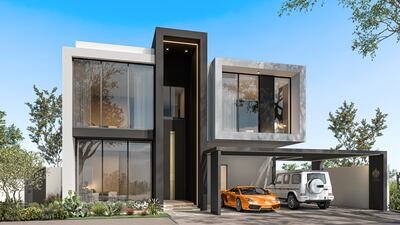
The Trump Signature Villas are in an enclave of properties within Trump International Golf Club Oman, in Aida, Muscat. All photos: Dar Global -

The villas come in three to seven bedrooms. -

The properties offer sea views. -

The villas also come with elite membership of the golf club. -
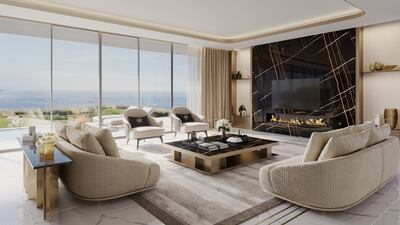
Phase one of the Trump Villas project is expected to be completed this year. -
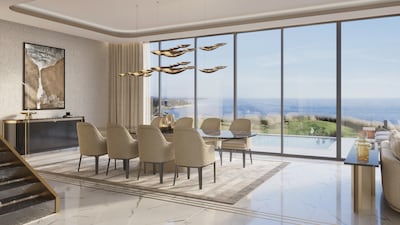
The development is expected to be finished by 2026.


Oman
Saudi property developer Dar Al Arkan teamed up with the Trump Organisation for the development of a resort that will include residential villas, a hotel and a golf course in Muscat.
The Trump Resort will be located at Aida, a 100-metre-high hilltop development situated directly by the sea, Dar Al Arkan said.
Dar Al Arkan and the Oman Tourism Development Company, better known as Omran, are developing the $4 billion mixed-use Aida project in the capital of the sultanate.
The Trump Signature Villas, an enclave of properties within Trump International Golf Club Oman, come with “elite membership” of the golf club and a Trump-branded golf cart, Dar Global, Dar Al Arkan’s global arm said last month.
Riyadh-based Dar Al Arkan is the largest developer in Saudi Arabia.
Interviews and an examination by The New York Times last year of hundreds of pages of financial documents associated with the Oman project show that the Trump Organisation has already received at least $5 million from the deal.
senior Mena analyst at Rane Network
Under its terms, the Trump Organisation will not put up any money for the development but will help to design a Trump-branded hotel, golf course and golf club and will be paid to manage them for up to 30 years, among other revenue, the report revealed.
Eric Trump, the former president’s son who is overseeing the project for the Trump Organisation, described the project as “the Hamptons of the Middle East” during a visit to Oman last year.
In previous international deals, the Trump family has traditionally taken a fee in exchange for the use of its name, a separate fee to manage the hotel and golf properties and a percentage of the profits on the sale of Trump-branded villas, if the prices hit a goal, the NYT reported.
Ziad El Chaar, Dar Global’s chief executive, had worked with the Trump family in Dubai as chief executive of Damac Properties.

Saudi Arabia
Saudi Arabia was Mr Trump’s first foreign trip when he took office in 2017.
The Republican presidential candidate recently spoke with Saudi Crown Prince Mohammed bin Salman, the NYT reported on April 3.
Mr Trump’s family business is expected to benefit from last year’s agreement by PGA Tour, European Tour and Saudi-backed LIV Golf circuit to merge and form a commercial entity to unify golf.
It could have benefits for the family by increasing the prospect of major tournaments continuing to be played at Trump-owned courses in the US and abroad, the New York Times reported.
The former president’s golf courses in Florida, New Jersey and Virginia hosted three tournaments last year for the breakaway league that Saudi Arabia’s sovereign wealth fund is backing.
The Trump National Doral course in Miami again hosted the LIV Golf tournament earlier this month.
The US also sealed a $110 billion arms deal with Saudi Arabia during his presidency in 2017.
Separately, Mr Trump’s son-in-law and former senior White House adviser Jared Kushner’s private equity firm received a $2 billion investment from the kingdom’s wealth fund in 2022.
Mr Kushner had worked closely with Saudi Arabia on many issues during the Trump administration.
However, he denied that the investment represented a conflict of interest.
The Saudi investment into Mr Kushner's firm, Affinity Partners, took place after he left the White House.
Qatar
Canada's Brookfield Asset Management, a global property investor in which the Qatari government has a stake, struck a deal in 2018 that rescued the Kushner Companies' 666 Fifth Avenue tower in Manhattan.
The Qatar Investment Authority said it had no involvement in the 666 Fifth Avenue development.
Mr Kushner's private equity fund, Affinity Partners, also received about $200 million in investments from Qatar as his father-in-law seeks the presidency again, the New York Times reported last year.
Separately, in a hint of the kind of Middle East policy that could be pursued in the event that Mr Trump returns to the White House, Mr Kushner praised the “very valuable” potential of Gaza’s “waterfront property” and suggested Israel should remove civilians while it “cleans up” the strip during a February interview at Harvard University.
“It’s a little bit of an unfortunate situation there but, from Israel’s perspective, I would do my best to move the people out and then clean it up,” he said.
Mr Kushner added that he thinks Israel should move civilians from Gaza to the Negev desert in southern Israel.

Turkey
The Trump family has extensive business ties in Turkey, and Mr Trump in a 2015 interview with Breitbart News suggested there could be a conflict of interest.
“I have a little conflict of interest because I have a major, major building in Istanbul,” Mr Trump said at the time.
“It’s a tremendously successful job. It’s called Trump Towers – two towers, instead of one, not the usual one, it’s two.”
Trump Towers Istanbul continues to generate revenue for Mr Trump as part of the Trump Organisation.
The high-rises pay the Trump Organisation a licensing fee – between $5 million to $10 million a year in the first years after it opened, and down to $100,000 to $1 million a year in more recent years – according to Mr Trump’s financial disclosure forms, the New York Times reported in 2019.
Turkish businessman Aydin Dogan owns the building. The Trumps also have a close relationship with Mehmet Ali Yalcindag, Mr Dogan’s son-in-law.
Turkish officials visited Mr Trump’s properties 14 times, more than officials from any other country, according to a Crew analysis performed for NBC News in 2020.
Does it matter?
Despite all these potential conflict of interest concerns, it seems unlikely that Americans' votes will be influenced by Mr Trump's global business interests. This will probably only be a political talking point among his opponents.
With the election still more than six months away, a new Pew Research Centre survey found that the presidential race is virtually tied: 49 per cent of registered voters favour Mr Trump or lean toward voting for him, while 48 per cent support or lean toward Joe Biden.
However, Mr Trump is currently facing criminal charges in a case focused on an alleged hush money payment to an adult film star during his 2016 presidential campaign.
He is the first former or sitting president of the US to be charged in a criminal case, racking up 91 felony counts in four cases, and the New York case was the first time a president has appeared in court as part of a trial.

