

Gautam Adani
As shares of Gautam Adani’s conglomerate recover from an epic rout, the big question looming over the Indian tycoon is whether he can convince investors and lenders to back his capital-hungry businesses.
Few parts of Adani’s empire underscore the urgency of that funding for the billionaire better than Adani Transmission.
India’s largest private utility is a key player in Mr Modi’s pledge to provide power to every Indian home, with the company touting itself as capable of “distributing electricity to every corner of the country”.
Yet, it faces a funding gap which may force it to infuse as much as $700 million by March 2026 to fulfil existing project commitments, according to the Indian unit of Fitch Ratings.
The funding needs of infrastructure builders, like Adani Transmission, are a major factor behind the conglomerate’s race to return to business as usual after months of damage control and denying US short-seller Hindenburg Research’s allegations of widespread corporate malfeasance.
Adani Transmission, which went from being a fledgling to India’s largest private utility in seven years, has grown its asset portfolio 3.6 times to 19,779 circuit kilometres across 33 projects.
Of these, 13 projects are currently under way, but many face delays or cost overruns. Others have been beset by adverse weather, pandemic-era disruptions or legal wrangles.
With India planning to add more than 27,000 ckm of transmission lines by 2025, the company’s continued expansion will be crucial for the national goal.
The utility company last month announced plans to raise $1 billion – one of two Adani companies looking to issue new shares for the first time since the short-seller crisis.
Capital infusion required by March 2026 from the company in its continuing projects has surged 60 per cent to 57.95 billion rupees ($700 million) compared with what was envisaged before, India Ratings and Research, the local unit of Fitch Rating’s, said in a March 30 statement.
This is due to cost overruns or the borrowings not being enough to support the projects, forcing further investment.
World’s richest people aged 30 and under – in pictures
-
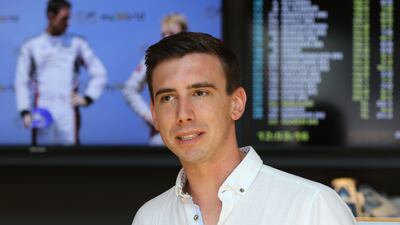
Mark Mateschitz. Getty Images -
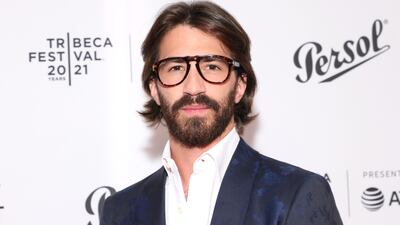
Leonardo Maria Del Vecchio. AFP -

Michal Strnad, chairman and owner of Czechoslovak Group. Reuters -

Gustav Magnar Witzoe. Getty Images -
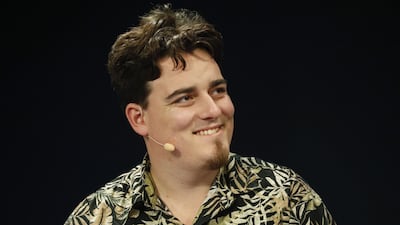
Palmer Luckey, co-founder of Oculus VR. Bloomberg -

Katharina G. Andresen. Photo: Dag Knudsen -

Alexandra G. Andresen Photo: Dag Knudsen -

Gymshark's Ben Francis. Photo: Wikimedia Commons -
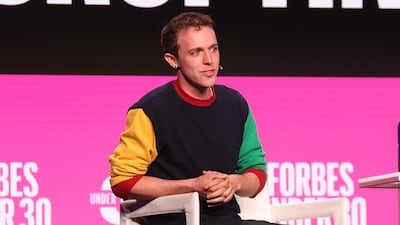
Ryan Breslow. Getty Images


India Ratings revised its outlook on Adani Transmission to “negative” to reflect this uncertainty around debt funding secured for the under-construction transmission lines.
Any shortfall will require the company to invest more “to meet project completion deadlines, potentially creating cash flow mismatches over FY24“, it said.
An Adani Group spokesperson said that the conglomerate does “not comment on routine business matters”.
“All public disclosures on business matters are disclosed when appropriate,” the spokesperson said in response to queries on how Adani Transmission plans to plug the funding gap.

Anil Agarwal
India’s government is poised to deny crucial funding for billionaire Anil Agarwal’s chip venture, a setback for a $19 billion push to make semiconductors in the country.
The government is set to tell the venture between Mr Agarwal’s Vedanta Resources and Taiwan’s Hon Hai Precision Industry that it won’t get incentives to make 28-nanometer chips, sources said.
The venture has applied for such assistance, potentially worth billions of dollars, but hasn’t met the criteria set by the government.
While Vedanta and Hon Hai can apply again, a rejection would mean delays for Mr Agarwal’s ambition to establish India’s first major chip-making operation, even as his metals and mining conglomerate struggles to reduce a heavy debt load.
Nine months after Mr Agarwal announced the chip partnership to build India’s “own Silicon Valley”, the project is yet to find a technology partner or license manufacturing-grade technology for the 28-nanometre chips it was seeking to build, sources said.
At least one of those steps is required for the venture to get government assistance.
Vedanta and Hon Hai, the assembler of a bulk of the world’s iPhones, have no previous significant experience in chip making.
Their difficulty in finding production-ready technology underscores how hard it is to set up new semiconductor plants, with the massive complexes, that cost billions to build, requiring specialised expertise to run.
A representative for Vedanta said the company was awaiting the outcome of its application.
Indian Prime Minister Narendra Modi has pledged $10 billion to woo chip makers to India, promising his administration will bear half the cost of setting up all semiconductor sites.
Vedanta previously said its partner Hon Hai had secured “production-grade, high-volume” 40-nanometre technology and “development-grade” technology for relatively more sophisticated 28-nanometre chips.
That’s likely not enough for the government to award the funding, as the venture had applied to actually produce 28-nanometre chips, the sources said.
The federal government may soon ask Vedanta to submit a new application for financial support to make 40-nanometre chips, and provide a revised capital expenditure estimate.
Such a bid could be considered after New Delhi reopens the application process for incentives.
Vedanta had previously submitted a capital expenditure estimate of $10 billion to India. Financial help from the state is crucial for Mr Agarwal, whose Vedanta is working to reduce gross borrowings of $6.8 billion as of April.
Vedanta has been in talks with STMicroelectronics to license chip fabrication technology, Bloomberg News reported previously.

Robin Li
Billionaire Robin Li’s Baidu has set aside 1 billion yuan ($140 million) to fund Chinese start-ups that explore generative AI, joining a global investment wave keen on riding a frenzy around ChatGPT-like services.
China’s internet search leader will use the pool to establish projects built on top of its AI model, in deployments as high as 10 million yuan apiece.
Venture investors, including IDG Capital, will listen to pitches from founders, who then build demo products before receiving a verdict on whether they have been granted seed funding, Baidu said.
Baidu delivered the country’s first major riposte to ChatGPT, called Ernie Bot, igniting a race by rivals from Alibaba Group Holding to Tencent Holdings and SenseTime Group to unveil rival platforms.
Baidu and its VC partners will examine pitches from prospective founders who’ll use Ernie to build out their own services.
“Large-language models will give birth to AI-native applications,” Mr Li said.
“Baidu will become the first company to rework all of its products. It’s not about integrating or accessing AI. It’s about rework and restructuring.”
China’s top internet regulator said it will require security reviews of generative AI tools before they can be put into action.
US sanctions have deprived Chinese tech companies of the best chips to train their AI models, which could widen gaps between services like Ernie Bot and their Western counterparts.
In March, Mr Li introduced Ernie Bot using a pre-recorded demo, underwhelming investors and analysts who were hoping for a livelier interaction.
The Chinese chatbot subsequently scored positive reviews among selected testers, but its shares are still down roughly 20 per cent from a February high.

Carlos Slim
Billionaire Carlos Slim is making one of his biggest oil investments after agreeing to purchase a minority stake in a producer that allows his conglomerate, Grupo Carso, to enter the Zama field, one of Mexico’s most promising energy projects.
Grupo Carso is purchasing a 49.9 per cent minority stake in the local unit of Houston-based Talos Energy for $125 million.
The deal gives Carso a 17.4 per cent stake in Zama, with the price implying a minimum valuation of about $250 million for the oilfield stake.
Talos will retain control of the local unit through a 50.1 per cent stake. The transaction is pending approval from the local regulator.
Mr Slim, Latin America’s wealthiest person with a fortune estimated at $90 billion, is expanding his energy bets in Mexico at a time when President Andres Obrador has rolled back some of the previous administration’s opening of the industry as he insists that the government maintain control of key assets through Petroleos Mexicanos and utility CFE.
Mr Slim’s vast empire was built on telecommunications company America Movil, while Grupo Carso also has retail, construction, manufacturing and real estate interests.
The group has exploration, oil drilling and services operations through Carso Energy in Mexico and Colombia, and exploration contracts in Mexico.
The company also operates many natural gas pipelines in northern Mexico and Texas.
The expectation is for Zama to start producing oil by 2025 and for it to produce 150,000 to 180,000 barrels a day by 2029, the president said.

