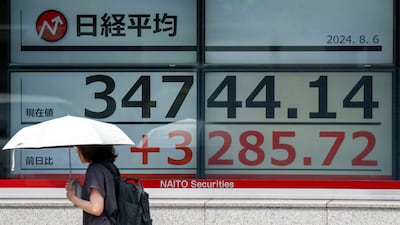
Global stocks largely rebounded on Tuesday, with Europe following rallies in Japan and on Wall Street after fears of a US recession and war in the Middle East drove regional equity gauges to their heaviest single-day losses since 2008.
Japan’s Nikkei closed 10.23 per cent higher, regaining some of its losses after plunging 12.4 per cent on Monday in what was its steepest sell-off since the 1987 Black Monday crash.
Hong Kong’s Hang Seng closed 0.31 per cent lower while India’s BSE Sensex Index was down 0.21 per cent.
The MSCI Asia Pacific Index surged by as much as 3.9 per cent, heading for its best day since November 2022 after it fell by more than 6 per cent on Monday, according to Bloomberg data.
Technology-heavy South Korean and Taiwanese stock gauges also traded in the green on Tuesday.
“The market reaction was a bit extreme yesterday and hence we see this sharp rebound today,” Bloomberg quoted Rupal Agarwal, Asia quantitative strategist at Sanford C Bernstein, as saying.
“I would expect markets to remain volatile and hence would stick to looking for late-cycle defensive exposure through quality or dividend-yielding names.”
Major indexes in Europe were mixed, with London’s FTSE 100 closing 0.29 per cent higher, while the CAC-40 in Paris finished in the red, dropping 0.27 per cent.
Germany’s DAX was almost unchanged, closing 0.088 per cent higher.

The equities rout on Monday was sparked by two employment reports last week, and a Labour Department report that showed the economy added a weaker-than-expected 114,000 jobs last month, a steep decline from 179,000 in June.
Meanwhile, the unemployment rate unexpectedly rose to 4.3 per cent, its highest since October 2021.
The latest figures crossed the Sahm Rule threshold, which typically indicates a coming recession if the three-month average unemployment rate increases by half a percentage point from its low point in the past 12 months.
With worries of a looming slowdown in the world's largest economy, European stocks followed the slide in Asian equities and Wall Street replicated the negative trend on Monday.
The Dow fell by 1,033.99 points – or 2.6 per cent – at the close of trading on Monday in the US while the Nasdaq dropped 3.43 per cent. Both equities indexes suffered their largest losses in nearly two years.
The S&P 500 fell 3 per cent, as Wall Street's fear gauge, the CBOE Volatility Index, rose to its highest level since March 2020.
Wall Street rallies
But a rally on US equities gained traction on Tuesday after Wall Street suffered its worst day since 2022.
“Smart money will take it as an opportunity to buy,” said Naeem Aslam, chief investment officer at London-based Zaye Capital Markets.
The Dow Jones was up 293.39 points – or 0.46 per cent higher – when trading closed in New York. The S&P 500 and Nasdaq ended the day up by 1.04 per cent and 1.03 per cent.
The volatility index dropped nearly 28 per cent.
Khatija Haque, chief economist and head of research at Emirates NBD, said the release of the ISM manufacturing index, a gauge of the US sector's health, was also supporting the market recovery.
“The better-than-expected US ISM services index helped to reassure markets that the world’s largest economy is probably not on the brink of recession,” she said on Tuesday in a note to investors.
“The ISM index rose to 51.4 in July … with both business activity and new orders rebounding from the weak June figures … however, firms [surveyed] indicated that higher interest rates were dampening demand.”
Federal Reserve officials on Monday tried to ease concerns about the economy.
San Francisco Fed president Mary Daly said recent softening in the labour market indicated the US central bank should begin cutting rates in the coming quarters.
"Underneath the hood of the labour market report, there's a little more for confidence – confidence that we're slowing but not falling off a cliff," she said of last week's jobs report.
"This is what we would expect: slowing but not falling off a cliff."
Chicago Fed president Austan Goolsbee echoed the sentiment, saying the Federal Reserve would fix the economy if it crumbles.
“If the conditions collectively start coming in like that on the through line, there’s deterioration on any of those parts, we’re going to fix it,” Mr Goolsbee told CNBC's Squawk Box.
A September interest rate cut has been all but locked in by traders after the Fed left its target rate unchanged at 5.25 per cent to 5.50 per cent last week.
As of Tuesday, investors price in a 76.5 per cent probability the Fed will cut rates by 50 basis points at the end of its September 17-18 meeting, according to the CME FedWatch tool.
GCC markets rise
Benchmark indexes in the UAE, which fell sharply on Monday, also recovered some of the losses.
The Dubai Financial Market's main index rose by 2.26 per cent on Tuesday, after plunging 4.5 per cent in the previous trading session.
The Abu Dhabi Securities Market equities gauge climbed 1.21 per cent, rebounding from a 3.4 per cent loss on Monday.
Saudi Arabia's Tadawul, the biggest Arab bourse by market capitalisation, rose 1.52 per cent. It lost 2 per cent in the previous trading session.
Investors in the GCC are dealing with the added challenges of rising geopolitical risk.
The Israel-Gaza war threatens to become a full-scale regional military conflict involving Iran and Hezbollah in Lebanon.
Iran, its proxies in the Middle East and Hezbollah are expected to launch attacks on Israel imminently after last week's killings of Hamas leader Ismail Haniyeh in Tehran and Hezbollah commander Fouad Shukr in Beirut.
The US is making last-ditch efforts to avert a broader military conflict.
Secretary of State Antony Blinken said on Monday that the US was working round the clock to prevent escalation in the Middle East, and urged Israel and Hamas to “break this cycle” of violence through a ceasefire.
Iran's retaliatory strike against Israel would “only lead to more conflict, more violence, more insecurity”, he said.
“We are engaged in intense diplomacy, pretty much around the clock, with a very simple message – all parties must refrain from escalation,” Mr Blinken said as he met Australian Foreign Minister Penny Wong.
European bounce-back
European shares also closed higher on Tuesday, following positive momentum from Wall Street.
In London, shares opened slightly higher after losing 2 per cent on Monday.
Some of the shares that took a severe battering on Monday – such as Melrose Industries, Pershing Square and Scottish Mortgage – closed higher.
In addition, solid profit numbers from InterContinental Hotels went some way in improving sentiment.
Nonetheless, analysts and traders said the bounce in share prices should in no way indicate that the rollercoaster ride was over.
“Investors shouldn’t assume this relative calm means markets are back to behaving rationally again,” said Matt Britzman, senior equity analyst at Hargreaves Lansdown.
"The volatility index is still at elevated levels, suggesting more turbulence to come.
Richard Hunter, head of markets at Interactive Investor, said that even though share prices were having a better time on Tuesday, compared with the slumps of the previous day, “the end to the volatile state of global markets cannot be called just yet”.

