

It was a week of good, bad and ambiguous news for Iraq’s natural gas industry. What stood out is the fact that solving its gas problem is the single most feasible and effective thing the government could do for its economy, environment and quality of life. But meddlesome forces stand in the way.
On the good side, Iraq signed an agreement with US oil services giant SLB (formerly Schlumberger) to develop the Akkas field on the Syrian border, a large but geologically challenging resource. Iraqi prime minister Mohammed Shia Al Sudani inaugurated two new gas processing plants in the Basra province, including one at the Faihaa field, in which Dubai-based Dragon Oil is a partner. And US-based HKN agreed to expand oil and gas output from the Hamrin field in the Salahaddin province.
In May, HKN had been awarded a contract to develop the Miran gasfield, while compatriot Western Zagros signed terms for Topkhana. These are two of the largest undeveloped gas accumulations in the Kurdistan region and, indeed, the whole of Iraq. And Sharjah-based Crescent Petroleum is moving ahead with work on Chemchemal, another large gasfield in Kurdistan, while it completes work to expand its long-standing Khor Mor field.
Agreement signalled that a logjam between the two main Kurdish political parties had been broken – the Kurdistan Democratic Party, which controls the capital Erbil, the oil sector and most of the government, and the smaller Patriotic Union of Kurdistan, which holds the gasfields themselves and territory through which pipelines have to run.
On the bad side, drones launched by unidentified assailants struck several oilfields in the semi-autonomous Kurdistan region. Fortunately, and probably by design, no one was killed or injured, and the damage to facilities seems to be limited. But most of the region’s oil output has now been closed down as a precautionary measure.
One of the two initial targets was the Sarsang field, operated by HKN. The company has been one of the most vocal in pressing its rights in Baghdad, and bringing US political pressure to bear.
These bombings are the most widespread and clearly targeted assault on the Kurdish petroleum sector so far. Earlier attacks were sporadic, and mostly consisted of unguided rockets aimed at Khor Mor. One strike killed four workers at the field in April last year, the only deadly incident known of this campaign.
Iran-aligned armed groups are well-understood to be the culprits, which used Iranian-model drones, though they denied responsibility. Their aims seem to be to attack American interests, deter alleged ties of the Kurdistan region with Israel, prevent competition to Iranian gas supplies to Iraq, and keep up pressure on Mr Al Sudani’s government as it seeks a workable arrangement with Erbil and as federal elections in November loom.
In the ambiguous category is Turkey’s decision to exit the treaty governing the Iraq-Turkey oil pipeline when it expires next July. The pipeline has been shut anyway since March 2023 when an arbitral judgment went against Turkey.
But the main sticking point since then has been the need for an accord between the Kurdistan region and the federal authorities in Baghdad over the rules for oil export, the responsibility for sales, the distribution of revenue, and the contractual position of the oil companies operating in Kurdistan.
Ankara seems to favour replacement of the treaty with a more expansive agreement covering gas and electricity as well as oil. That could be good news for facilitating Kurdish gas exports finally, after a decade of discussion.
But Turkey is playing a complicated game, including balancing tensions within Iraq, its interests in Syria, which include gas supply and electricity investments, and its gas trade with Russia, Iran and European neighbours.
Iraq has struggled to provide adequate electricity to its people since the 1990-91 Gulf War and particularly following the botched US occupation after 2003. This creates discontent as people swelter through ever-hotter summers without adequate air-conditioning. It holds back the development of an economy beyond oil.
-
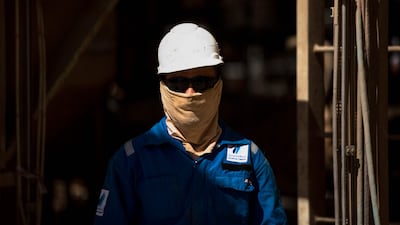
A worker at the Basra Gas company, at Khor Al Zubair in Iraq's southern Basra governorate. Despite being the number two producer in Opec, the country is experiencing an acute energy crisis and chronic blackouts that fuel social discontent. All photos: AFP -
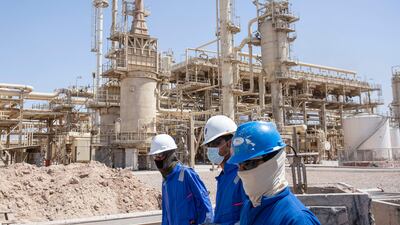
Workers at the Basra Gas company in Iraq's Basra governorate, one of many plants affected by decades of conflict, poor maintenance and rampant corruption. -
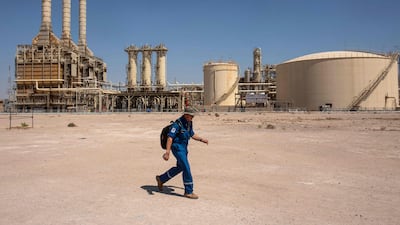
The Basra Gas company site at Khor al-Zubair in Basra governorate, Iraq. -
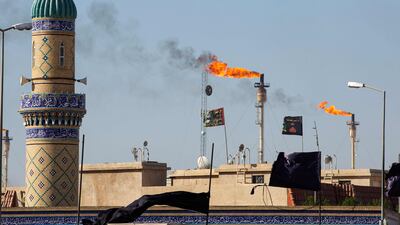
Flare stacks burning off excess gas dominate the skyline at Khor Al Zubair city. -

Workers in a Basra Gas company installation in southern Iraq. -

Much of the social unrest in Iraq in recent years has been fuelled by the energy sector's failure to manage the energy crisis, leading to ongoing blackouts. -
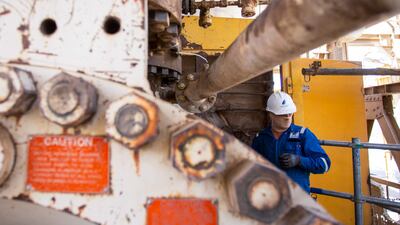
A worker goes about his tasks at the Basrah Gas company, at Khor al-Zubair in Iraq's southern Basra governorate. Decades of conflict, poor maintenance and rampant corruption have battered Iraq's energy sector. Despite being the number two producer in the Organization of the Petroleum Exporting Countries, Iraq is experiencing an acute energy crisis and chronic blackouts that fuel social discontent.


In turn, a large part of the electricity problem stems from the failure to supply enough gas. Iraq is the world’s third worst flarer of unused gas from oil production, behind only Russia and Iran. This causes local pollution and massive greenhouse gas releases.
Yet it burns more than 300,000 barrels per day of extra oil for power generation in the summer, causing further pollution and wasting fuel that could be exported.
Gas capture has increased in the past few years, but oil production has also grown, so the flaring problem has hardly diminished. Iraq’s fast-rising population means the gas and electricity deficits do not narrow either. Supplies of Iranian gas and electricity, vital to help fill the gap, have become increasingly unreliable because of US sanctions and Iran’s own worsening shortages.
The US has devoted significant diplomatic effort to solving this mess, with mixed motives including the noble – promoting Iraqi stability, well-being and the environment – and the more self-interested, including its campaign against Iran, and boosting the prospects of American companies.
The optimal development of gas in Kurdistan and the rest of Iraq is the key that would unlock several other doors. It could foster a more constructive relationship between Baghdad and Erbil. It would improve Iraq’s economy and help it move on from over-reliance on oil exports, by providing reliable energy for industry.
It is plausible that it would not even harm Iran. Tehran cannot meet its supply commitments to Iraq anyway, because of its own shortfall and because of US sanctions. Its exports to Turkey too are coming under increasing strain. If Iran overcame these problems, Iraq would be ready to continue buying its gas: domestic Iraqi, including Kurdish, supplies will not be enough for years to come, so great is the deficit and the pent-up demand.
Turkey would gain from a greater pool of gas which it can combine with its own burgeoning supplies, to on-sell to Europe. Europe too would be aided in its attempts to eliminate its remaining fraction of Russian gas imports.
Brussels’ lack of realpolitik and its allergy to hydrocarbons unfortunately prevent it from playing the active role it should. Gulf, European, Turkish and American companies may be able to tread a path between Baghdad, Erbil and Ankara. But first, the shadowy figures behind the drone swarm need to be stopped.

