


Half a century ago, a North Sea oil boom transformed Aberdeen’s skyline and the fortunes of the north-east of Scotland.
A medieval harbour once known for herring and whaling became dotted with white storage cylinders and brightly coloured supply vessels, ferrying cargo to North Sea oil rigs. Shell built a modernist five-storey HQ as wealth and people flowed into the city. An Aberdeen team managed by Sir Alex Ferguson even beat Real Madrid to win football's European Cup Winners’ Cup in their 1980s heyday.
A local joke was that oil and gas workers recruited from abroad "used to complain about being sent to far north Aberdeen, the Granite City, and then they moaned even more when they were told they had to leave,” recalls Fergus Mutch, an adviser to local businesses.
Aberdeen through the years – in pictures
-

Aberdeen Town House clock tower in Union Street. For more than 50 years Aberdeen in Scotland has been the UK’s centre for oil. Now, the energy capital is seeking to swap its oil crown for one of renewables. Alamy -

A wind farm in the North Sea off the coast of Aberdeen. Alamy -
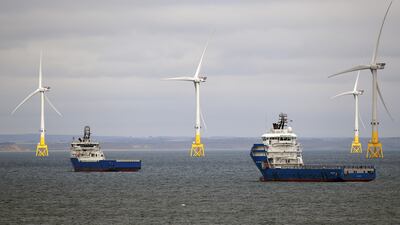
The European Offshore Wind Deployment Centre in Aberdeen Bay in 2018. The site is Scotland's largest offshore wind test and demonstration facility and represents an investment of more than £300 million. Getty Images -
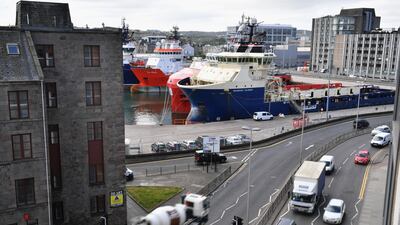
Oil support vessels fill Aberdeen Harbour in 2016. Getty Images -
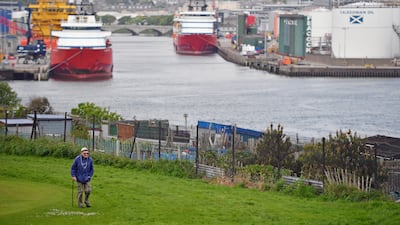
A view over allotments to Aberdeen Harbour. Getty Images -
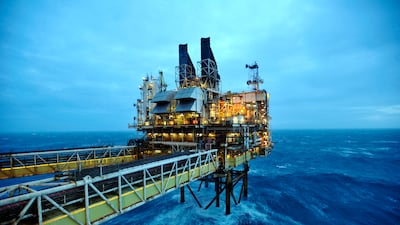
The BP Eastern Trough Area Project oil platform in the North Sea in 2014, about 160 kilometres east of Aberdeen. Getty Images -
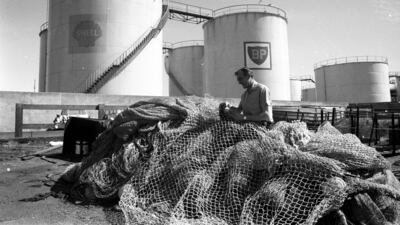
A fisherman attends to his nets beside oil storage containers on the coast at Aberdeen in 1975. Getty Images -
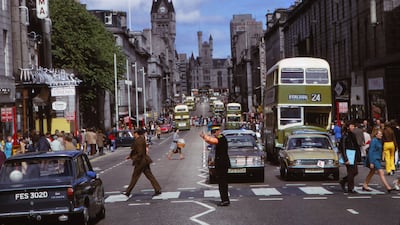
Union Street, built with Aberdeen Granite, in the 1960s. Union Street is a major shopping thoroughfare in Aberdeen, named after the Acts of Union 1800. Getty Images -
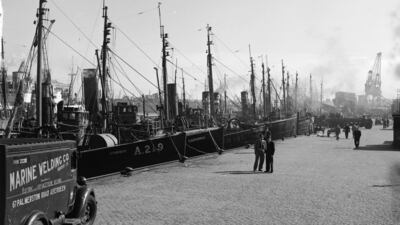
Fishing trawlers in Aberdeen Harbour in 1955. Getty Images -
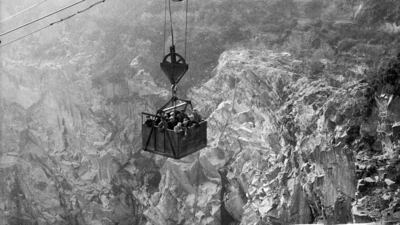
Workers at Rubislaw quarry in Aberdeen in 1955 using a Blondin to reach the work surface of the open quarry, which is about 150 metres deep. The container, named after the French tightrope walker Charles Blondin, can hold five tonnes at a time and is usually used to carry the granite. Getty Images -
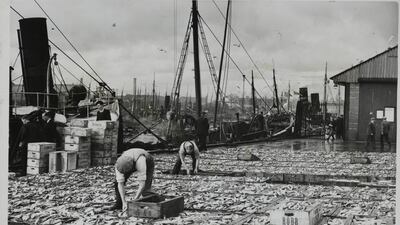
The fish quay at Aberdeen in 1938, with the last of the catches landed at the close of the Scottish herring season. Getty Images -
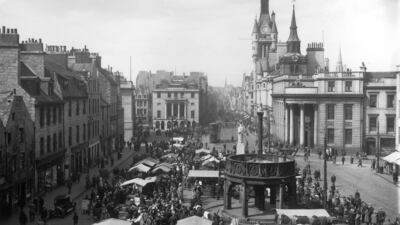
Shoppers in the market at Castlegate, Aberdeen, in 1910. Getty Images -

A view of Union Street towards the municipal buildings, Aberdeen, circa 1895. Getty Images


Not all of Aberdeen felt the boom. The fishing village of Old Torry was demolished in the 1970s to make way for the oil industry. Torry today is a deprived tenement neighbourhood in the shadow of warehouses and storage tanks, where council workers report problems from unsafe roads to tooth decay.
Shell demolished its symbolic Aberdeen HQ in August, abandoning it for nondescript offices on Union Street. The historic shopping thoroughfare is in need of regeneration, with many units lying empty. House prices have been in decline for much of the past decade.
Aberdeen is anxious to change the narrative as North Sea drilling declines and a climate-conscious era takes shape in Britain and the world, making the city a test case for whether workers and communities will be left behind by the global energy transition.
Another change to the skyline hints at better days ahead for the self-described oil capital of Europe. Eleven 191m wind turbines run by the Swedish energy giant Vattenfall spin directly off Aberdeen’s coast, visible from the promenade where waves crash into the beach – a landscape that could also make the area suitable for tidal power.
If oil and gas can be combined with wind, tidal, carbon capture and hydrogen, there is “actually more energy potential in the North Sea in future than we had in the past,” says Paul de Leeuw, a former Shell and BP employee turned professor at an Energy Transition Institute at Aberdeen’s Robert Gordon University.
The fear is that oil and gas will disappear too fast, before the greener alternatives are ready. “If you do it just right, in the Goldilocks zone, you can take the supply chain, the workforce, all the capabilities from one industry and actually accelerate the other industry,” said Prof de Leeuw. “The alternative is accelerated decline, where you basically stop everything and you live with the consequences.”

Budget watch
That made it an anxious wait for Aberdeen to see whether Britain's new Labour government would put its foot on the accelerator in Wednesday's Budget, in which Chancellor Rachel Reeves raised taxes by £40 billion ($51.9 billion).
Aberdeen's chamber of commerce said business confidence is lower than during the financial crash of 2008 or the height of Covid-19. Mr Mutch, who advises on policy at the chamber, had warned that any tax rise would be "simply too much to bear" for some operators.
The contents of Ms Reeves's red box were mixed for Aberdeen. A profits levy was raised to 38 per cent, as expected. An end date of 2030 was offered along with a consultation next year on how windfall taxes will work in future, addressing concerns about a never-ending tax.

An allowance for investment in the tax rules was partially extended in a "signal that the government was listening", said the chamber's chief executive Russell Borthwick. But he said there was "no justification for a super tax on ‘windfall profits’ which no longer exist".
Although Labour’s plan for a new state-owned clean power investor, GB Energy, to have its headquarters in Aberdeen has gone down well locally, there is uncertainty about what it will do, said Mr Mutch. About one in five workers in the north-east of Scotland have jobs linked to the offshore industry. “There’s a decline in the number of oil and gas jobs required in the North Sea. There is an uptick, but not at anything like the same rate in employment in renewables,” he said.
Green initiatives
There are plenty of plans to make the green switch happen in Aberdeen. A floating Aberdeenshire wind farm called Green Volt, billed as the world’s largest, was given the go-ahead in April. The new GB Energy comes armed with £8.3 billion ($10.78 billion) to invest in clean power. In July the energy giant BP committed to a new hydrogen hub in Aberdeen to produce and store the clean fuel.
Labour is putting billions more into a new National Wealth Fund to spend on ports, green hydrogen and carbon capture. There are sustainable farming efforts in Aberdeenshire, and salmon rivers frequented by King Charles III are being restored to protect local wildlife from climate change. Decommissioning oil rigs is an industry in itself.

David Innes, a retired head teacher and chairman of an organisation called Aberdeen for a Fairer World, said there were some “really excellent examples in the north-east of Scotland” of work being done on sustainable development. “Perhaps we could actually be doing more to bring out more of the good stories, more of the potential and actually be seen to be at the leading edge,” he said.
But there is an awareness among green-minded locals that oil and gas holds a certain sway over politics. North Sea drilling has become part of Aberdeen’s heritage, celebrated at a museum where workers in hard hats tell children about life offshore. “Ensuring a continued supply of hydrocarbons is very important for our economy,” explains an installation manager on the Tern Alpha platform.

Lisa Heinzler, a student who has researched sustainability work in the Aberdeen area, said she struggled to get oil and gas companies to speak about the subject beyond their public releases. “They seem kind of OK with the fact that they are at the starting point of their sustainability journey”, she said.
Britain passed peak oil in 1990 and production has fallen back into steady decline after a brief spike in fossil fuel trading while Europe looked for alternatives to Russian gas. A worldwide race for clean power is on after almost every country agreed at Cop28 in the UAE to treble the world’s renewable energy firepower by 2030.
What Aberdeen has is an industrial supply chain and expertise in sub-sea engineering. Applications opened last week for companies seeking a slice of the offshore wind supply chain to be certified as up to the task. Out of 135 UK companies involved in an earlier round of the scheme, 75 were in the north-east of Scotland. Experts believe 90 per cent of the North Sea workforce has skills that would be transferable to green industries.
Making an energy transition work requires a workforce, a supply chain and an integrated energy ecosystem, all of which "exists plentifully in the north-east of Scotland and Aberdeen," Prof de Leeuw said. "If you want to make an energy transition work, you cannot have a better starting point than we have now."
“If we get it right, this will be an energy powerhouse for decades and decades to come," he said. That is the big opportunity but also the big challenge. Get it wrong and you lose the capacity. People will go and do other jobs.” For Aberdeen, the opportunity to reinvent itself once more is there to be grasped.

