An open cast coal field at Topa coal mine in Jharkhand, India. Reuters

Why Qatar's liquefied natural gas expansion may offer short-term environmental gains


  • English
  • Arabic

Qatar’s decision to increase its liquefied natural gas production capacity may help emerging Asian economies reduce their dependency on coal, resulting in short-term environmental gains, analysts say.

LNG is produced when natural gas is cooled, which shrinks the volume of the gas, making it easier and safer to store and transport over long distances.

The US, Qatar and Australia are the largest exporters of the commodity, considered a low-carbon alternative to crude oil and coal.

Last month, Qatar’s Energy Minister Saad Al Kaabi announced plans to increase capacity by an additional 13 per cent on top of a previously announced expansion. The move aims to raise the nation's LNG output to 142 million tonnes per year by 2030, from its current 77 million tonnes.

“For Asia, Qatar’s announcement is positive for LNG buyers … and helping guarantee a long-term future for LNG in emerging Asia,” intelligence firm Rystad Energy said.

“From a price perspective, Qatari LNG is essentially future-proof with a large low-cost, low-emissions resource base that can prove profitable in any market situation, even under more aggressive energy transition scenarios,” it added.

Price advantage

Qatar's LNG production costs range from $2 to $4 per million metric British thermal units, compared with $3 to $8 per mmbtu in US and $5-$10 per mmbtu in Australia, according to estimates by Rystad, Wood Mackenzie and the Oxford Institute for Energy Studies.

LNG prices in the Asian spot market dipped to their lowest in three years at $8.37 per mmbtu on March 1, down from $8.57 per mmbtu on February 20, according to Rystad Energy.

“There is still some optimisation activity under way in the Asian market with spot LNG prices still slightly above the $8 per mmbtu mark, maintaining at low levels not seen since 2021,” Rystad Energy said.

“LNG players in the market will keep a keen eye on how LNG prices may evolve to optimise spot activity as winter draws to a close.”

Asian spot LNG prices reached a record high of $56 per mmbtu in October 2021, largely due to concerns over winter supply shortages.

Emerging economies in Asia are aiming to increase the share of natural gas to reduce dependency on highly polluting coal amid an expected surge in power demand.

China, the world's biggest coal consumer, is projected to increase the use of natural gas in its primary energy mix to 12 per cent by 2030 from 8.7 per cent in 2020.

India, the second-largest coal consumer, aims to raise the share of natural gas in its total energy mix to 15 per cent by 2030, from about 6 per cent.

An LNG tanker leaves the dock at PetroChina's receiving terminal in Dalian, Liaoning province, China. Reuters

“[Qatar’s] expansion plan is going to help the emerging economies, it's going to keep the prices balanced,” Karthik Sathyamoorthy, chief executive of Atlantic, Gulf and Pacific LNG told The National.

The Singapore-based company, a subsidiary of US investment and development firm Nebula Energy, plans to develop LNG terminals in South and South-east Asia over the next few years.

The company purchased a 49 per cent stake in Vietnam's Cai Mep LNG terminal last week and aims to make a final investment decision on an import compound in Karaikal, a city on India’s eastern coast, this year.

Mr Satyamoorthy expects LNG markets to be oversupplied starting from 2026 or 2027, much sooner than market predictions of a surplus in 2030.

“That's going to keep the prices more attractive for buyers.”

Countries like Vietnam and India, which heavily rely on coal, may increasingly turn to LNG for power generation as it becomes more affordable, Mr Satyamoorthy said.

A pause on new LNG projects in the US made buyers question whether the market would become tight again. However, that concern was somewhat alleviated by the news of Qatar's additional expansion plans, he added.

Bridge fuel

Doha, which exports most of its LNG to Asia, has for years promoted natural gas as a “bridge fuel” towards net zero.

“This climate play is an overlooked and underappreciated aspect of Qatar climate diplomacy, as many emerging countries … are eager to 'divorce' from coal and establish strategic relations with Qatar,” said Andrea Zanon, chief executive of WeEmpower Capital.

“Qatar will go the extra mile to help subsidise the natural gas cost, and thus reduce consumer price, by offering long-term contracts at special discounts,” Mr Zanon told The National.

However, some experts argue that it may hinder the shift towards renewable energy in the longer term by leading to a “lock-in” of infrastructure and investments related to fossil fuels.

China and India are planning to add about 268 million tonnes and 75 million tonnes in annual LNG import capacity over the next few years, according to Statista.

Although natural gas emits less carbon dioxide and fewer air pollutants compared to coal, methane leakage during extraction, processing, and transportation can offset these environmental benefits, Guy Prince, senior analyst at Carbon Tracker, told The National.

“This is bad news for the planet since methane is a far more potent greenhouse gas than carbon dioxide,” Mr Prince said.

  • Coal power plants are a major source of methane emissions. AP
    Coal power plants are a major source of methane emissions. AP
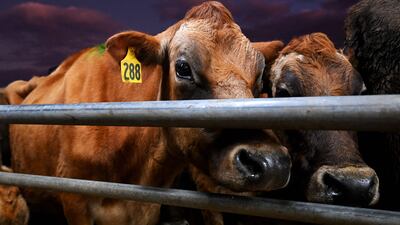
  • Livestock accounts for about one third of methane emissions, the International Methane Emissions Observatory reported. AFP
    Livestock accounts for about one third of methane emissions, the International Methane Emissions Observatory reported. AFP
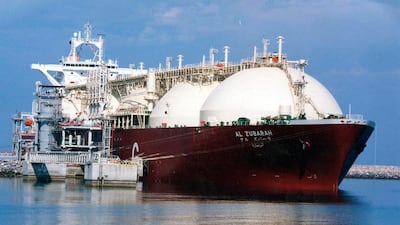
  • A Qatari tanker ship is being loaded up with LNG, made up mainly of methane. The state-owned oil and gas company Qatar Energy said it is joining a new industry-led initiative to reduce nearly all methane emissions from operations by 2030. AP
    A Qatari tanker ship is being loaded up with LNG, made up mainly of methane. The state-owned oil and gas company Qatar Energy said it is joining a new industry-led initiative to reduce nearly all methane emissions from operations by 2030. AP
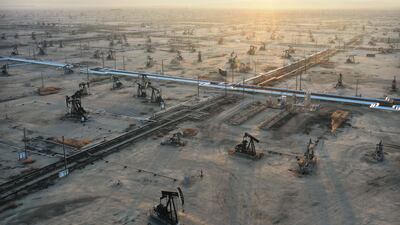
  • An oilfield near McKittrick, California. The state has 35,000 oil and gas wells sitting idle, many of which are unplugged and could leak methane gas. AFP
    An oilfield near McKittrick, California. The state has 35,000 oil and gas wells sitting idle, many of which are unplugged and could leak methane gas. AFP
  • Wind turbines turn on top of a dump next to the BP Refinery Scholven in Gelsenkirchen, Germany. Spiralling energy costs caused by various economic factors and the Ukraine war could be a turning point towards cleaner energy, the International Energy Agency says. AP
    Wind turbines turn on top of a dump next to the BP Refinery Scholven in Gelsenkirchen, Germany. Spiralling energy costs caused by various economic factors and the Ukraine war could be a turning point towards cleaner energy, the International Energy Agency says. AP
  • Waste and landfill sites account for more than 20 per cent of methane emissions. AFP
    Waste and landfill sites account for more than 20 per cent of methane emissions. AFP
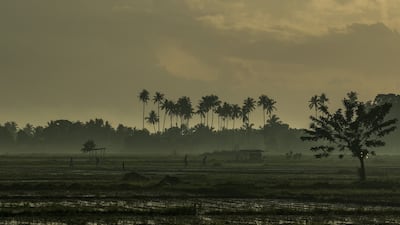
  • Globally, agriculture is the largest source of human-caused methane emissions. Bloomberg
    Globally, agriculture is the largest source of human-caused methane emissions. Bloomberg

Methane emissions are responsible for 30 per cent of greenhouse gas emissions, however, methane has more than 25 times the effect on climate change than carbon dioxide, according to the United Nations Environment Programme (UNEP).

The International Energy Agency has said that oil and gas companies, whose global income surged to almost $4 trillion in 2022, would need to allocate less than 3 per cent of their profits from that year to achieve a 75 per cent reduction in the industry's methane emissions.

Based on its previous aim of reaching 126 mtpa of LNG production by 2027, state-owned QatarEnergy planned to reduce its methane intensity to 0.2 per cent by 2025.

The company's goal is to achieve zero routine flaring by 2030 and have 90 per cent of its resources derived from gas by that year.

“It's hard to see how an oversupply of fossil fuels to the markets and resulting demand destruction will bring much benefit,” Mr Prince said.

Emerging economies seeking to capitalise on lower prices risk infrastructure and investment lock-in, delaying the transition to renewable energy sources like wind and solar, he said.

LNG pivot

Qatar is not the only country betting big on LNG as prices hover at record lows.

Saudi Aramco, the world’s largest oil-exporting company, is in talks with companies in the US to build its LNG capacity, its chief executive said in a post-earnings call on Monday.

The company plans to increase its gas production by more than 60 per cent by 2030 compared with 2021 levels.

Most of the gas produced by Aramco will be used for power generation and industries within the kingdom, with some being utilised as feedstock for blue hydrogen, Mr Amin Nasser said, adding that LNG capacity would be built mainly through outside markets.

Aramco is currently finalising customer offtake agreements to supply blue hydrogen to customers in Japan and South Korea, he added.

Last year, Aramco announced its first international investment in LNG, following the signing of agreements to acquire a minority stake in MidOcean Energy.

Adnoc, which has signed several long-term LNG agreements over the past few months, is building an LNG plant in Al Ruwais Industrial City in Abu Dhabi.


Company%C2%A0profile
%3Cp%3E%3Cstrong%3EName%3A%20%3C%2Fstrong%3EPyppl%3C%2Fp%3E%0A%3Cp%3E%3Cstrong%3EEstablished%3A%20%3C%2Fstrong%3E2017%3C%2Fp%3E%0A%3Cp%3E%3Cstrong%3EFounders%3A%20%3C%2Fstrong%3EAntti%20Arponen%20and%20Phil%20Reynolds%26nbsp%3B%3C%2Fp%3E%0A%3Cp%3E%3Cstrong%3EBased%3A%3C%2Fstrong%3E%20UAE%3C%2Fp%3E%0A%3Cp%3E%3Cstrong%3ESector%3A%3C%2Fstrong%3E%20financial%20services%3C%2Fp%3E%0A%3Cp%3E%3Cstrong%3EInvestment%3A%3C%2Fstrong%3E%20%2418.5%20million%3C%2Fp%3E%0A%3Cp%3E%3Cstrong%3EEmployees%3A%3C%2Fstrong%3E%20150%3C%2Fp%3E%0A%3Cp%3E%3Cstrong%3EFunding%20stage%3A%3C%2Fstrong%3E%20series%20A%2C%20closed%20in%202021%3C%2Fp%3E%0A%3Cp%3E%3Cstrong%3EInvestors%3A%3C%2Fstrong%3E%20venture%20capital%20companies%2C%20international%20funds%2C%20family%20offices%2C%20high-net-worth%20individuals%3C%2Fp%3E%0A
SERIE A FIXTURES

Friday Sassuolo v Torino (Kick-off 10.45pm UAE)

Saturday Atalanta v Sampdoria (5pm),

Genoa v Inter Milan (8pm),

Lazio v Bologna (10.45pm)

Sunday Cagliari v Crotone (3.30pm) 

Benevento v Napoli (6pm) 

Parma v Spezia (6pm)

 Fiorentina v Udinese (9pm)

Juventus v Hellas Verona (11.45pm)

Monday AC Milan v AS Roma (11.45pm)

Scores:

Day 4

England 290 & 346
Sri Lanka 336 & 226-7 (target 301)

Sri Lanka require another 75 runs with three wickets remaining

How to help

Call the hotline on 0502955999 or send "thenational" to the following numbers:

2289 - Dh10

2252 - Dh50

6025 - Dh20

6027 - Dh100

6026 - Dh200

Nick's journey in numbers

Countries so far: 85

Flights: 149

Steps: 3.78 million

Calories: 220,000

Floors climbed: 2,000

Donations: GPB37,300

Prostate checks: 5

Blisters: 15

Bumps on the head: 2

Dog bites: 1

We Weren’t Supposed to Survive But We Did

We weren’t supposed to survive but we did.      
We weren’t supposed to remember but we did.              
We weren’t supposed to write but we did.  
We weren’t supposed to fight but we did.              
We weren’t supposed to organise but we did.
We weren’t supposed to rap but we did.        
We weren’t supposed to find allies but we did.
We weren’t supposed to grow communities but we did.        
We weren’t supposed to return but WE ARE.
Amira Sakalla

Get Out

Director: Jordan Peele

Stars: Daniel Kaluuya, Allison Williams, Catherine Keener, Bradley Whitford

Four stars

Global state-owned investor ranking by size

1.

United States

2.

China

3.

UAE

4.

Japan

5

Norway

6.

Canada

7.

Singapore

8.

Australia

9.

Saudi Arabia

10.

South Korea

AUSTRALIA SQUAD

Aaron Finch, Matt Renshaw, Brendan Doggett, Michael Neser, Usman Khawaja, Shaun Marsh, Mitchell Marsh, Tim Paine (captain), Travis Head, Marnus Labuschagne, Nathan Lyon, Jon Holland, Ashton Agar, Mitchell Starc, Peter Siddle

Ten tax points to be aware of in 2026

1. Domestic VAT refund amendments: request your refund within five years

If a business does not apply for the refund on time, they lose their credit.

2. E-invoicing in the UAE

Businesses should continue preparing for the implementation of e-invoicing in the UAE, with 2026 a preparation and transition period ahead of phased mandatory adoption. 

3. More tax audits

Tax authorities are increasingly using data already available across multiple filings to identify audit risks. 

4. More beneficial VAT and excise tax penalty regime

Tax disputes are expected to become more frequent and more structured, with clearer administrative objection and appeal processes. The UAE has adopted a new penalty regime for VAT and excise disputes, which now mirrors the penalty regime for corporate tax.

5. Greater emphasis on statutory audit

There is a greater need for the accuracy of financial statements. The International Financial Reporting Standards standards need to be strictly adhered to and, as a result, the quality of the audits will need to increase.

6. Further transfer pricing enforcement

Transfer pricing enforcement, which refers to the practice of establishing prices for internal transactions between related entities, is expected to broaden in scope. The UAE will shortly open the possibility to negotiate advance pricing agreements, or essentially rulings for transfer pricing purposes. 

7. Limited time periods for audits

Recent amendments also introduce a default five-year limitation period for tax audits and assessments, subject to specific statutory exceptions. While the standard audit and assessment period is five years, this may be extended to up to 15 years in cases involving fraud or tax evasion. 

8. Pillar 2 implementation 

Many multinational groups will begin to feel the practical effect of the Domestic Minimum Top-Up Tax (DMTT), the UAE's implementation of the OECD’s global minimum tax under Pillar 2. While the rules apply for financial years starting on or after January 1, 2025, it is 2026 that marks the transition to an operational phase.

9. Reduced compliance obligations for imported goods and services

Businesses that apply the reverse-charge mechanism for VAT purposes in the UAE may benefit from reduced compliance obligations. 

10. Substance and CbC reporting focus

Tax authorities are expected to continue strengthening the enforcement of economic substance and Country-by-Country (CbC) reporting frameworks. In the UAE, these regimes are increasingly being used as risk-assessment tools, providing tax authorities with a comprehensive view of multinational groups’ global footprints and enabling them to assess whether profits are aligned with real economic activity. 

Contributed by Thomas Vanhee and Hend Rashwan, Aurifer

Dubai World Cup Carnival card:

6.30pm: Handicap (Turf) | US$175,000 2,410 metres

7.05pm: UAE 1000 Guineas Trial Conditions (Dirt) $100,000 1,400m

7.40pm: Handicap (T) $145,000 1,000m

8.15pm: Dubawi Stakes Group 3 (D) $200,000 1,200m

8.50pm: Singspiel Stakes Group 3 (T) $200,000 1,800m

9.25pm: Handicap (T) | $175,000 1,400m

Who's who in Yemen conflict

Houthis: Iran-backed rebels who occupy Sanaa and run unrecognised government

Yemeni government: Exiled government in Aden led by eight-member Presidential Leadership Council

Southern Transitional Council: Faction in Yemeni government that seeks autonomy for the south

Habrish 'rebels': Tribal-backed forces feuding with STC over control of oil in government territory

ANDROID%20VERSION%20NAMES%2C%20IN%20ORDER
%3Cp%3EAndroid%20Alpha%3C%2Fp%3E%0A%3Cp%3EAndroid%20Beta%3C%2Fp%3E%0A%3Cp%3EAndroid%20Cupcake%3C%2Fp%3E%0A%3Cp%3EAndroid%20Donut%3C%2Fp%3E%0A%3Cp%3EAndroid%20Eclair%3C%2Fp%3E%0A%3Cp%3EAndroid%20Froyo%3C%2Fp%3E%0A%3Cp%3EAndroid%20Gingerbread%3C%2Fp%3E%0A%3Cp%3EAndroid%20Honeycomb%3C%2Fp%3E%0A%3Cp%3EAndroid%20Ice%20Cream%20Sandwich%3C%2Fp%3E%0A%3Cp%3EAndroid%20Jelly%20Bean%3C%2Fp%3E%0A%3Cp%3EAndroid%20KitKat%3C%2Fp%3E%0A%3Cp%3EAndroid%20Lollipop%3C%2Fp%3E%0A%3Cp%3EAndroid%20Marshmallow%3C%2Fp%3E%0A%3Cp%3EAndroid%20Nougat%3C%2Fp%3E%0A%3Cp%3EAndroid%20Oreo%3C%2Fp%3E%0A%3Cp%3EAndroid%20Pie%3C%2Fp%3E%0A%3Cp%3EAndroid%2010%20(Quince%20Tart*)%3C%2Fp%3E%0A%3Cp%3EAndroid%2011%20(Red%20Velvet%20Cake*)%3C%2Fp%3E%0A%3Cp%3EAndroid%2012%20(Snow%20Cone*)%3C%2Fp%3E%0A%3Cp%3EAndroid%2013%20(Tiramisu*)%3C%2Fp%3E%0A%3Cp%3EAndroid%2014%20(Upside%20Down%20Cake*)%3C%2Fp%3E%0A%3Cp%3EAndroid%2015%20(Vanilla%20Ice%20Cream*)%3C%2Fp%3E%0A%3Cp%3E%3Cem%3E*%20internal%20codenames%3C%2Fem%3E%3C%2Fp%3E%0A

Mercer, the investment consulting arm of US services company Marsh & McLennan, expects its wealth division to at least double its assets under management (AUM) in the Middle East as wealth in the region continues to grow despite economic headwinds, a company official said.

Mercer Wealth, which globally has $160 billion in AUM, plans to boost its AUM in the region to $2-$3bn in the next 2-3 years from the present $1bn, said Yasir AbuShaban, a Dubai-based principal with Mercer Wealth.

Within the next two to three years, we are looking at reaching $2 to $3 billion as a conservative estimate and we do see an opportunity to do so,” said Mr AbuShaban.

Mercer does not directly make investments, but allocates clients’ money they have discretion to, to professional asset managers. They also provide advice to clients.

“We have buying power. We can negotiate on their (client’s) behalf with asset managers to provide them lower fees than they otherwise would have to get on their own,” he added.

Mercer Wealth’s clients include sovereign wealth funds, family offices, and insurance companies among others.

From its office in Dubai, Mercer also looks after Africa, India and Turkey, where they also see opportunity for growth.

Wealth creation in Middle East and Africa (MEA) grew 8.5 per cent to $8.1 trillion last year from $7.5tn in 2015, higher than last year’s global average of 6 per cent and the second-highest growth in a region after Asia-Pacific which grew 9.9 per cent, according to consultancy Boston Consulting Group (BCG). In the region, where wealth grew just 1.9 per cent in 2015 compared with 2014, a pickup in oil prices has helped in wealth generation.

BCG is forecasting MEA wealth will rise to $12tn by 2021, growing at an annual average of 8 per cent.

Drivers of wealth generation in the region will be split evenly between new wealth creation and growth of performance of existing assets, according to BCG.

Another general trend in the region is clients’ looking for a comprehensive approach to investing, according to Mr AbuShaban.

“Institutional investors or some of the families are seeing a slowdown in the available capital they have to invest and in that sense they are looking at optimizing the way they manage their portfolios and making sure they are not investing haphazardly and different parts of their investment are working together,” said Mr AbuShaban.

Some clients also have a higher appetite for risk, given the low interest-rate environment that does not provide enough yield for some institutional investors. These clients are keen to invest in illiquid assets, such as private equity and infrastructure.

“What we have seen is a desire for higher returns in what has been a low-return environment specifically in various fixed income or bonds,” he said.

“In this environment, we have seen a de facto increase in the risk that clients are taking in things like illiquid investments, private equity investments, infrastructure and private debt, those kind of investments were higher illiquidity results in incrementally higher returns.”

The Abu Dhabi Investment Authority, one of the largest sovereign wealth funds, said in its 2016 report that has gradually increased its exposure in direct private equity and private credit transactions, mainly in Asian markets and especially in China and India. The authority’s private equity department focused on structured equities owing to “their defensive characteristics.”

Ipaf in numbers

Established: 2008

Prize money:  $50,000 (Dh183,650) for winners and $10,000 for those on the shortlist.

Winning novels: 13

Shortlisted novels: 66

Longlisted novels: 111

Total number of novels submitted: 1,780

Novels translated internationally: 66

The burning issue

The internal combustion engine is facing a watershed moment – major manufacturer Volvo is to stop producing petroleum-powered vehicles by 2021 and countries in Europe, including the UK, have vowed to ban their sale before 2040. The National takes a look at the story of one of the most successful technologies of the last 100 years and how it has impacted life in the UAE.

Part three: an affection for classic cars lives on

Read part two: how climate change drove the race for an alternative 

Read part one: how cars came to the UAE

Company%20profile
%3Cp%3EName%3A%20Tabby%3Cbr%3EFounded%3A%20August%202019%3B%20platform%20went%20live%20in%20February%202020%3Cbr%3EFounder%2FCEO%3A%20Hosam%20Arab%2C%20co-founder%3A%20Daniil%20Barkalov%3Cbr%3EBased%3A%20Dubai%2C%20UAE%3Cbr%3ESector%3A%20Payments%3Cbr%3ESize%3A%2040-50%20employees%3Cbr%3EStage%3A%20Series%20A%3Cbr%3EInvestors%3A%20Arbor%20Ventures%2C%20Mubadala%20Capital%2C%20Wamda%20Capital%2C%20STV%2C%20Raed%20Ventures%2C%20Global%20Founders%20Capital%2C%20JIMCO%2C%20Global%20Ventures%2C%20Venture%20Souq%2C%20Outliers%20VC%2C%20MSA%20Capital%2C%20HOF%20and%20AB%20Accelerator.%3Cbr%3E%3C%2Fp%3E%0A
Updated: March 13, 2024, 3:00 AM