


Qatar, one of the world's largest liquefied natural gas exporters, has paused a number of vessels set to cross through the Bab Al Mandeb off the coast of Yemen where disruptions to Red Sea LNG traffic have heightened after US-led strikes on Houthi targets.
Four Qatari vessels were delayed on the weekend following US and UK attacks against Houthi militants in Yemen targeting the critical trade route, according to ship-tracking data by London-based Independent Commodity Intelligence Services.
Three laden Qatari tankers, the Al Ghariya, Al Huwaila and Al Nuaman, that were signalling a course to the Suez Canal cut their speed on January 14 and started circling off the coast of Oman, east of the strait, Alex Froley, LNG analyst at ICIS, said in a report on Monday.
A fourth vessel, the ballast Qatari tanker Al Rekayyat, which was returning to Qatar, cut its speed on January 13 and is now paused in the middle of the Red Sea, he said.
State-owned QatarEnergy did not immediately respond to The National's request for comment.
“In the last couple of weeks, most LNG tankers have started to avoid the Red Sea and divert around the Cape of Good Hope instead. However, until now Qatari and Russian cargoes had continued to use the route,” Mr Froley said in a LinkedIn post on Monday.
“It could take a Qatari cargo around 27 days to reach north-west European countries like the UK going around South Africa, compared with 18 days going through the Suez Canal.”
The Suez Canal is a major artery for global trade, with significant LNG exports mainly consisting of deliveries from Qatar to Europe and exports from the US and Russia to Asia.
In 2022, Qatar's LNG trade with Europe through the canal stood at 19.84 million tonnes, ahead of the second-largest trade flow from the US, according to Rystad Energy data.
Last year, the Gulf country exported 13.74 million tonnes of LNG to the continent.
Sending Qatari ships to Europe via the Cape of Good Hope, off Southern Africa, would mean extending the travel time by about 17 days, doubling the current duration of the voyage, according to Rystad Energy.
Since the move away from Russian gas supplies by much of Europe, there has been a greater reliance on LNG supplies, including from the Middle East, said Philip Chong, partner in the International Arbitration team at law firm Ashurst.
"These disruptions therefore take place in the context of an already tight market," he said.
"The facilities to store gas is limited in many European countries such as the UK, which means that any supply disruptions cannot be made up wholly of storage gas and accordingly can give rise to significant fluctuations in market prices."
However, European gas prices, which have dropped significantly in recent months on lower demand and higher gas stockpiles, did not immediately react to the report.
Dutch Title Transfer Facility gas futures, the benchmark European contract, were trading 6.46 per cent lower at €29.92 ($32.65) per megawatt hour on Tuesday.
"High gas storage levels and some mild weather this winter means the market is resisting the impact of the latest news," Mr Froley told The National.
"It’s possible Qatari cargoes could start using the Red Sea again after a brief pause, in which case the mood may remain bearish. If the route can’t be used for a long time, this will in the longer-term have a bullish impact pushing prices up.”
-
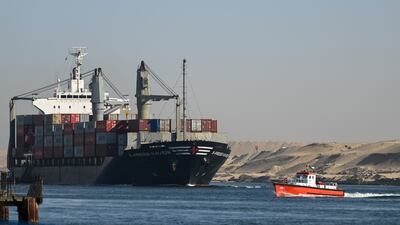
A ship in the Suez Canal heading towards the Red Sea in Ismailia, Egypt. Houthi rebels in Yemen have pledged to disrupt all shipping destined for Israel through the Red Sea and the Suez Canal. Getty Images -
Sailors on the USS Mason during Operation Prosperity Guardian. Photo: US Navy -
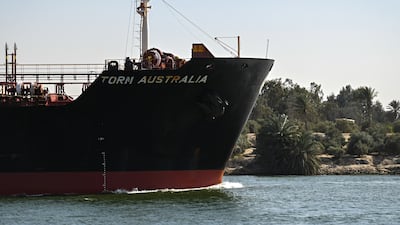
A ship travelling south through the Suez Canal. Getty Images -

The officer of the watch on the bridge of HMS Diamond in the Red Sea. Reuters -

A container ship in the Suez Canal near Ismailia, Egypt. Getty Images -

A televised statement by the Houthis' military spokesman Yahya Sarea in Sanaa, Yemen, after a large-scale missile and drone attack by the group against shipping lanes in the Red Sea. EPA -
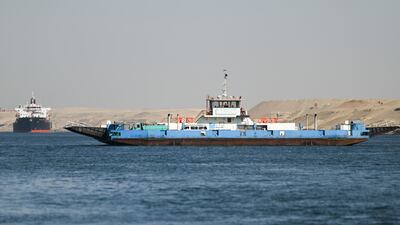
A ship in the Suez Canal heading towards the Red Sea. Getty Images -

On the bridge of HMS Diamond as Sea Viper missiles are fired in the Red Sea to combat a barrage of Houthi drones and missiles. Photo: Ministry of Defence via AP


In the event that LNG shipments cannot be delivered, contractual leeway could be used to find an alternative source of gas, Mr Chong said.
However, this can be difficult in the context of rising prices in a tight market and gives rise to the issue of who bears the loss.
"In terms of legal remedies for cargo owners and shipowners, these centre largely around contractual provisions relating to force majeure and other contractual measures for suspension and/or variation – including hardship doctrine in many civil law systems – but lengthy FM [force majeure] suspensions often lead to a termination right and accordingly have serious price and contractual implications," he said.
Major shipping companies have suspended their operations in the Red Sea after missile attacks by Yemeni Houthi rebels, who say they are acting in solidarity with Palestinians, disrupting global trade as Israel's war in Gaza just surpassed 100 days.
The Red Sea is linked to the Mediterranean by the Suez Canal, making it the shortest shipping route between Europe and Asia.
About 12 per cent of the world's shipping traffic passes through the canal.
-

Israeli and US flags are burned at a rally in Sanaa, Yemen, as Houthi leaders denounced air strikes launched by America and Britain against the rebels. Reuters -

People prepare to burn the Israeli and US flags during the protest in Sanaa. EPA -

An aircraft takes off to join the US-led coalition carrying out air strikes on Houthi militia targets in Yemen. Reuters -

Mohammed Al Houthi, head of the Houthi supreme revolutionary committee, wields a gun as he speaks at a rally to denounce US-UK air strikes, in Sanaa. Reuters -

Yemeni children swim in sea at the Red Sea port of Hodeidah on the morning after US and British forces struck rebel-held targets in Yemen. AFP -

A protest against the US and UK military action, which followed Houthi attacks on Red Sea shipping, in Sanaa. EPA -

A viewer watches a TV statement by Houthi military spokesman Yahya Saree, who said five of the group's fighters were killed and six wounded in 73 air strikes carried out by the US and UK in Yemen. EPA


Global container shipping companies are forced to reroute their vessels, leading to higher shipping costs and scheduling disruptions.
The Asia-Europe corridor will face “the most acute delays” given the scarcity of viable alternatives to the essential Suez Canal and the intricate nature of sea-based logistics, a report by research company BMI said.
Maritime freight rates will stay high in the first quarter of 2024, largely led by the Asia-Europe rates, as the risks in the Red Sea region remain, despite the establishment of a US-led naval protection force and recent counterstrikes, the report on January 12, said.
On January 11, the Drewry’s World Container Index rose by 15 per cent week-on-week to $3,072 per 40-foot container, reflecting a 44 per cent year-on-year increase.
“The Red Sea disruptions will have a domino effect on other shipping routes and key global manufacturing supply chains if the situation is not resolved in the near term,” BMI warned.
“The Red Sea crisis is having a global ripple effect on freight rates with shipping costs between Asia and the US now spiking as well.”
Shipping companies are now proactively dispatching goods well in advance of the Lunar New Year holiday in China – which starts on February 10. This will likely result in capacity constraints and potential bottlenecks during the weeks leading up to the end of January amid equipment and container shortages, BMI said.
There is a “notable rise” in demand for containers in China and South Asia as well as in container trading spot rates ahead of the Chinese New Year, according to a report by Container xChange.
The average rate on China-Europe quoted this week is about $5400, up from $1,500 just the week before, it said.

