

India is stepping up efforts to increase production of biofuels as it pursues sustainable sources of energy to meet growing demand and lower its carbon emissions.
On the sidelines of the G20 Leaders' Summit held in New Delhi this month, India's Prime Minister Narendra Modi unveiled the Global Biofuel Alliance – with India, the UAE, Singapore, Bangladesh, Italy, the US, Brazil, Argentina and Mauritius serving as members.
The group's ambitions include co-operation and technology development to promote the use of biofuels.
India is striving to reduce its dependence on costly imports of crude oil and achieve net-zero carbon emissions by 2070.
“India is highly dependent on imports for meeting fuel needs, which leads to high import bills, fuel price volatility with resultant subsidies and energy security concerns,” says Purva Jain, an energy analyst at the Institute for Energy Economics and Financial Analysis.
“Use of biofuels could help tide over these challenges.”
The launch of the Global Biofuel Alliance “reflects India’s commitment to clean fuels” and it “can serve as a critical knowledge and technology platform”, she says.
“There are needs for technological advancements in the sector and the alliance can bring together capital and scientific resources to work on those.
“It can also help share learning from different countries to ensure higher uptake of biofuels globally.”

With the launch of the alliance, India has taken a “very important step” towards expanding the use of biofuels, which can help to address some of the challenges that the country, and the world, are facing, says Manish Dabkara, chairman and managing director of consultancy EKI Energy Services, which offers climate change and sustainability solutions.
“India, like the rest of the world, is responding to the clarion call of an alarming state of global warming and has been focusing on reducing its dependence on fossil fuels,” he says.
“The focus of the renewable energy world has largely been on solar and wind energy.
“However, in recent years, biofuels have drawn a lot of attention as a potentially fruitful direction in the search for long-term fixes. This shift in emphasis is caused by the realisation that biofuels have the ability to industrially address energy supply and security.”
In recent years, India has focused on boosting the role of biofuel in the country's energy mix.
“As India strives to meet its climate and environmental objectives, expanding biofuel usage becomes a crucial component of its strategy to combat climate change and reduce its carbon footprint,” says Ashvin Patil, founder and director of Biofuels Junction, a Mumbai-based company that manufactures and aggregates solid biofuels.
An added benefit for India is that the production of biofuels creates employment opportunities in rural areas, helping to alleviate poverty and promote economic development, says Mr Dabkara.
The main form of biofuel produced in India is ethanol, which comes from sugar cane and is used for transport as a blend with petrol in cars and other vehicles.
This is something that the government has been promoting, with India achieving its goal of 10 per cent ethanol blending in petrol last year.
The government is now aiming to achieve 20 per cent ethanol blending in petrol by 2026.
Emissions from vehicles is a significant challenge for India, as it has some of the world's most polluted cities.
Biofuels can play an important role in providing a low-carbon solution in transport, including trucking, shipping and aviation, according to the International Energy Agency.
A significant increase in biofuels production is required globally to help bring down carbon emissions, it says.
Biodiesel, which is made from vegetable oil or recycled cooking oil, and biogas are other types of biofuels that India produces.
Last month, Reliance Industries unveiled a plan to set up 100 compressed biogas plants. In July, Adani Group also said it was planning to set up five biogas facilities over the next five years.
With “Reliance Industries and Adani Group … looking to foray big time into the Indian biogas sector, this shall be a major boost”, says Gaurav Kedia, chairman of the Indian Biogas Association.
“More particularly, with the industry reaching a scale upon investments from these conglomerates, the upstream supply chain of raw material for biogas plants, which currently turns out to be a limiting resistance for the industry, shall get streamlined.”
But the costs of producing biofuel need to be lowered to make it more attractive to industries, experts say.
“Biofuels are more expensive than fossil fuels due to the high cost of feedstocks and the production process,” says Shailendra Singh Rao, founder of Creduce, which offers services in the field of climate change and carbon asset management.
“The technology for producing biofuels is still in its infancy. This can result in efficiency and sustainability challenges.”
Another issue that he highlights is that “the production of biofuels requires land, which is a scarce resource in certain regions of the globe. This may result in competition with food production and other vital land uses”.
Inside the Dubai factory converting used cooking oil to biofuel – in pictures
-

Lootah Biofuels opened its factory in Dubai Industrial City last year. All photos: Antonie Robertson / The National -

Yousif Lootah set up the company in 2010 -

Previously, about 500 tonnes of used cooking oil were collected by Lootah Biofuel from the UAE's local market each month -
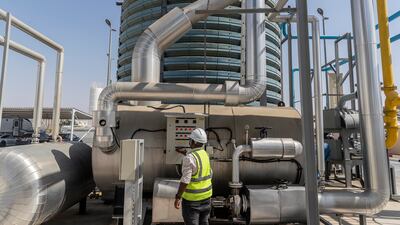
The company produces an average of 106,000 litres of biofuel a month at DIC factory -

It takes one day to complete a production cycle that converts waste cooking oil into biofuel -

About 920ml of biofuel are produced from a litre of used cooking oil -

Lootah Biofuels plans to open another factory in Abu Dhabi in April -

Mr Lootah hopes the UAE will soon introduce mandatory biofuel blends at fuel stations -
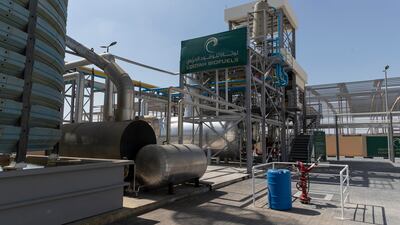
The company estimates it offset about 700 tonnes of carbon dioxide last year -

Along with biodiesel, the company also produces bio-racing fuel for 'supercars' -

The company currently has more than 100 active customers -

Lootah Biofuels has also diversified into other products such as soaps and sanitisers using glycerine, a by-product


Producing biofuels can be water-intensive and the production of biofuels from food crops can potentially lead to food shortages and higher food prices, says Mr Rao.
However, India's status as an agrarian economy “uniquely positions it as a prime candidate” for the development of biofuels, according to Mr Patil.
“The abundant and diverse agricultural production across the country provides a ready-to-process feedstock in large quantities, including sugar cane, corn, and various oilseeds, fostering a sustainable biofuel industry.”
Biofuels have the advantage of being “locally produced, providing price stability and shielding India from commodity price volatility”, he says.
To address some of the challenges arising from some biofuels, such as food security, India should increase its focus on “second-generation” biofuels, experts say.
These are made from the non-edible parts of crops, such as the stalks of wheat and corn.
“The focus should also be on using second-generation biofuels that do not rely on agricultural crops and use agricultural residue and municipal solid waste,” says Hemant Mallya, a fellow at India's Council on Energy, Environment and Water.
“The current challenge is that second-generation biofuel technologies, which are less water intensive, are either not fully mature or not cost-competitive. Biofuels also require extensive supply chains to collect biomass that does not currently exist.”
With the new global alliance, India has an opportunity “to develop and refine technologies for second-generation biofuels along with the alliance partners”, says Mr Mallya.
“The objective should be to reduce the production costs such that parity is achieved with fossil fuels.”
According to Mr Dabkara, “advanced biofuels, like cellulosic ethanol or algae-based fuels, often require cutting-edge and capital-intensive processes, rendering them less competitive with fossil fuels in the current market”.
“Achieving cost parity with conventional fuels necessitates continuing innovation, research and economies of scale,” he says.
Despite their advantages, biofuels alone would not be sufficient to meet all of India's growing energy needs.
“They are more likely to complement other renewable energy sources such as solar and wind power, along with hydroelectricity, which can provide a broader range of energy solutions,” says Mr Dabkara.

