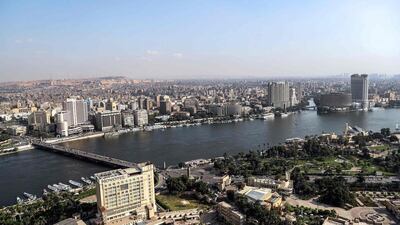
A view of Cairo in Egypt. IMF said the pandemic-related risks still exist in Egypt in light of the second global wave of Covid-19 cases. AFP

IMF reaches agreement with Egypt after first review of $5.2bn financing


Alkesh Sharma
  • English
  • Arabic

The International Monetary Fund said it has reached a staff-level agreement with Egypt after the first review of the $5.2 billion financing that was approved in June.

However, the agreement is subject to approval by the IMF’s executive board that will take its decision in the coming weeks. Upon the board’s approval, an additional $1.6bn tranche will be made available to Egypt, IMF said in a statement on late Thursday.

“The Egyptian economy has performed better than expected despite the pandemic … containment measures, supported by effective crisis management and strong implementation of policy programme helped mitigate the effects of the crisis,” Uma Ramakrishnan, IMF’s mission chief for Egypt, said.

“After recording a growth rate of 3.6 per cent in the financial year 2019-20, growth is projected to reach 2.8 per cent in the financial year 2020-21 … with a modest recovery in all sectors except tourism, as the pandemic continues to disrupt international travel,” she added.

IMF said the pandemic-related risks still exist in light of the second global wave of Covid-19 cases.

While domestic activity shows early signs of recovery and financial market conditions improve in Egypt, key sectors like tourism “remain at an almost standstill” and risks linger, it added.

The fund approved a 12-month $5.2bn loan in June to help Egypt deal with pandemic-related challenges and finance its budget deficit and balance of payments shortfalls.

In May, it approved a request from Egypt for emergency financial assistance to help cope with the economic fallout from the Covid-19 pandemic. The $2.77bn borrowed through a Rapid Financing Instrument was intended to address pressing financial needs in the most affected sectors.

Earlier this month, S&P Global Ratings affirmed a 'B' rating on Egypt's short and long-term sovereign debt and maintained a stable outlook, despite elevated external risks to the economy due to the coronavirus pandemic.

Egypt’s economy, like other countries in the world, has suffered due to the coronavirus pandemic. However, the impact has been “less severe” than that faced by many emerging market sovereigns due to the limited lockdown measures taken and a ramping up of healthcare capacity, the ratings agency said in an update.

The Central Bank of Egypt’s monetary policy remains appropriately accommodative, said IMF, adding that the Egypt's banking system remains “liquid, profitable and well capitalised”.

“We welcome the CBE’s recent interest rate cuts to further support economic recovery amid muted inflation,” said Ms Ramakrishnan.

“The exchange rate has modestly appreciated in the wake of an increase in capital inflows. Continued exchange rate flexibility will help absorb external shocks,” she said.

Egypt’s fiscal policy in the financial year 2020-21 remains focused on supporting the immediate priorities in health, protecting the most vulnerable and supporting sectors affected by the pandemic, said the fund.

“The government’s commitment to returning to a primary surplus of 2 per cent of [the] GDP as the economic recovery becomes entrenched will be essential to reduce public debt and support fiscal sustainability,” said Ms Ramakrishnan, adding that the recent publication of contracts awarded for Covid-19-related spending is a welcome step towards increasing transparency.


ELIO

Starring: Yonas Kibreab, Zoe Saldana, Brad Garrett

Directors: Madeline Sharafian, Domee Shi, Adrian Molina

Rating: 4/5

Three ways to limit your social media use

Clinical psychologist, Dr Saliha Afridi at The Lighthouse Arabia suggests three easy things you can do every day to cut back on the time you spend online.

1. Put the social media app in a folder on the second or third screen of your phone so it has to remain a conscious decision to open, rather than something your fingers gravitate towards without consideration.

2. Schedule a time to use social media instead of consistently throughout the day. I recommend setting aside certain times of the day or week when you upload pictures or share information. 

3. Take a mental snapshot rather than a photo on your phone. Instead of sharing it with your social world, try to absorb the moment, connect with your feeling, experience the moment with all five of your senses. You will have a memory of that moment more vividly and for far longer than if you take a picture of it.

How to keep control of your emotions

If your investment decisions are being dictated by emotions such as fear, greed, hope, frustration and boredom, it is time for a rethink, Chris Beauchamp, chief market analyst at online trading platform IG, says.

Greed

Greedy investors trade beyond their means, open more positions than usual or hold on to positions too long to chase an even greater gain. “All too often, they incur a heavy loss and may even wipe out the profit already made.

Tip: Ignore the short-term hype, noise and froth and invest for the long-term plan, based on sound fundamentals.

Fear

The risk of making a loss can cloud decision-making. “This can cause you to close out a position too early, or miss out on a profit by being too afraid to open a trade,” he says.

Tip: Start with a plan, and stick to it. For added security, consider placing stops to reduce any losses and limits to lock in profits.

Hope

While all traders need hope to start trading, excessive optimism can backfire. Too many traders hold on to a losing trade because they believe that it will reverse its trend and become profitable.

Tip: Set realistic goals. Be happy with what you have earned, rather than frustrated by what you could have earned.

Frustration

Traders can get annoyed when the markets have behaved in unexpected ways and generates losses or fails to deliver anticipated gains.

Tip: Accept in advance that asset price movements are completely unpredictable and you will suffer losses at some point. These can be managed, say, by attaching stops and limits to your trades.

Boredom

Too many investors buy and sell because they want something to do. They are trading as entertainment, rather than in the hope of making money. As well as making bad decisions, the extra dealing charges eat into returns.

Tip: Open an online demo account and get your thrills without risking real money.

Essentials

The flights
Etihad and Emirates fly direct from the UAE to Delhi from about Dh950 return including taxes.
The hotels
Double rooms at Tijara Fort-Palace cost from 6,670 rupees (Dh377), including breakfast.
Doubles at Fort Bishangarh cost from 29,030 rupees (Dh1,641), including breakfast. Doubles at Narendra Bhawan cost from 15,360 rupees (Dh869). Doubles at Chanoud Garh cost from 19,840 rupees (Dh1,122), full board. Doubles at Fort Begu cost from 10,000 rupees (Dh565), including breakfast.
The tours 
Amar Grover travelled with Wild Frontiers. A tailor-made, nine-day itinerary via New Delhi, with one night in Tijara and two nights in each of the remaining properties, including car/driver, costs from £1,445 (Dh6,968) per person.

The five pillars of Islam

1. Fasting

2. Prayer

3. Hajj

4. Shahada

5. Zakat 

THE BIO

Favourite book: ‘Purpose Driven Life’ by Rick Warren

Favourite travel destination: Switzerland

Hobbies: Travelling and following motivational speeches and speakers

Favourite place in UAE: Dubai Museum

COMPANY%20PROFILE%20
%3Cp%3E%3Cstrong%3ECompany%3A%20%3C%2Fstrong%3EOlive%20Gaea%3Cbr%3E%3Cstrong%3EStarted%3A%3C%2Fstrong%3E%202021%3Cbr%3E%3Cstrong%3ECo-founders%3A%3C%2Fstrong%3E%20Vivek%20Tripathi%2C%20Jessica%20Scopacasa%3Cbr%3E%3Cstrong%3EBased%3A%3C%2Fstrong%3E%20Dubai%3Cbr%3E%3Cstrong%3ELicensed%20by%3A%20%3C%2Fstrong%3EDubai%20World%20Trade%20Centre%3Cbr%3E%3Cstrong%3EIndustry%3A%3C%2Fstrong%3E%20Climate-Tech%2C%20Sustainability%3Cbr%3E%3Cstrong%3EFunding%3A%20%3C%2Fstrong%3E%241.1%20million%3Cbr%3E%3Cstrong%3EInvestors%3A%20%3C%2Fstrong%3ECornerstone%20Venture%20Partners%20and%20angel%20investors%3Cbr%3E%3Cstrong%3ENumber%20of%20employees%3A%3C%2Fstrong%3E%208%3Cbr%3E%3C%2Fp%3E%0A
Who's who in Yemen conflict

Houthis: Iran-backed rebels who occupy Sanaa and run unrecognised government

Yemeni government: Exiled government in Aden led by eight-member Presidential Leadership Council

Southern Transitional Council: Faction in Yemeni government that seeks autonomy for the south

Habrish 'rebels': Tribal-backed forces feuding with STC over control of oil in government territory